Skip to main content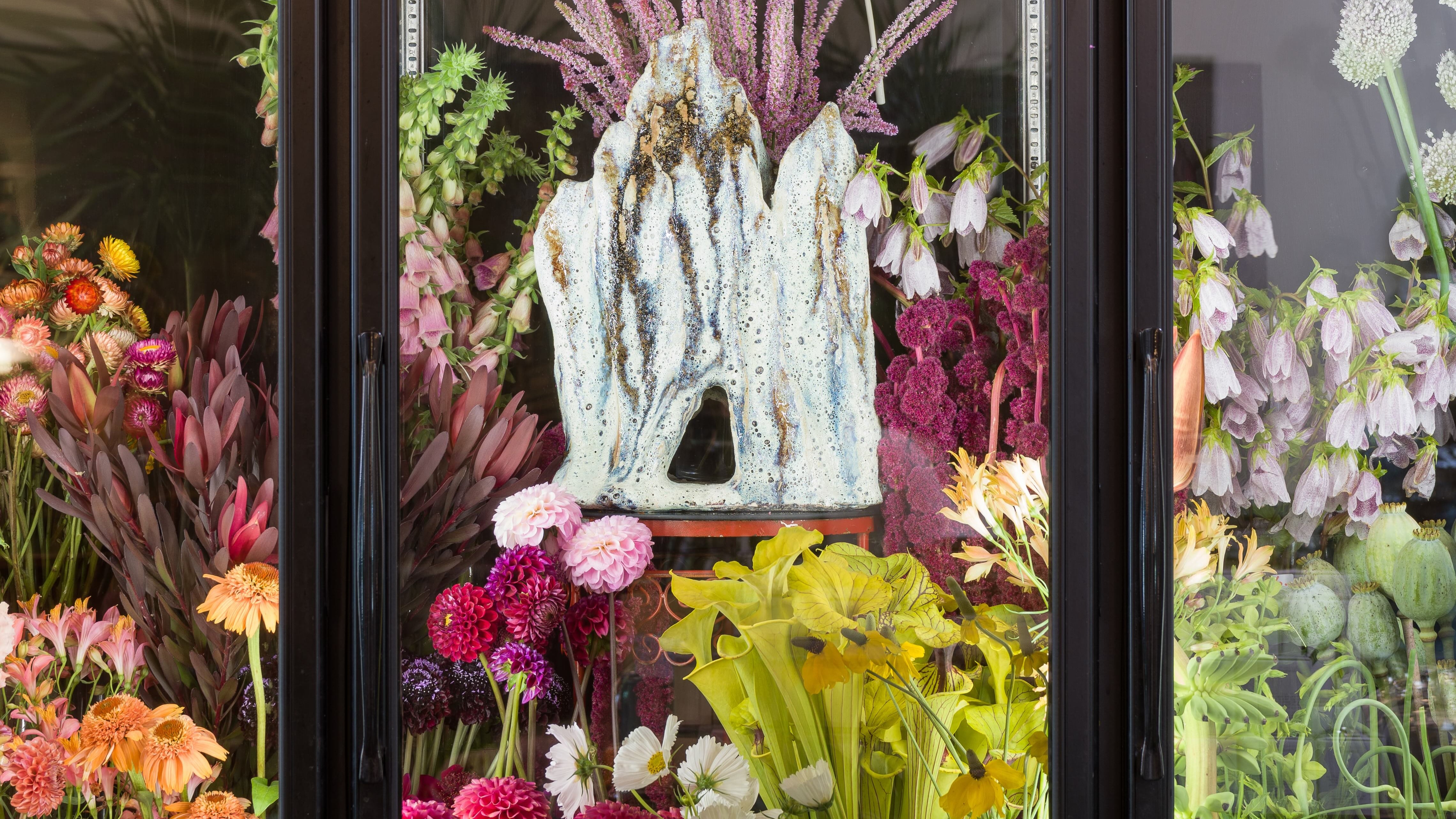
Most of Brad Mildrexler’s sculptures look like rocks. His large-scale ceramics mimic the nasty and sublime textures of cut banks, escarpments and palisades. Some resemble boulders that have sat for eons collecting wisdom in unkempt woods and muddy riverbeds. They’re mottled, craggy, even gnarly. They are an awesome and arresting kind of ugly.
Beautiful is how Bianca Sparta describes them. She’s hosting Mildrexler’s latest show, In the Garden, at her flower shop, Colibri, which recently moved to a new space on Northwest Kearney Street and 19th Avenue. Though they’re not exactly vases, the sometimes oozing, sometimes jagged sculptures fit well among Sparta’s mix of plants, flowers and household charms, such as linens, planters, boutique chocolates and greeting cards. Assembling “a collection of beautiful things” is her credo.
“Incorporating flowers and plants into this work is easy,” Sparta says. “It almost did it itself.”
One sculpture is displayed in a refrigerator of cut flowers. All works in the show are untitled, though this one looks like a fairy tale piece of aquarium furniture—an organic, magisterial archway of rocks lacquered with a frothy and iridescent glaze that breaks to lavender and opal tones on the edges. It’s a subaquatic castle for your goldfish to swim beneath. Maybe it’s Atlantis.
Amy Adams, whose gallery Adams and Ollman has shown Mildrexler’s work in the past, is collaborating to present this show in the flower shop. “Beauty is probably not the right word” for these artworks, Adams says; instead she finds “beauty in their discordance,” pointing out their sometimes precarious stacks and jagged edges.
They are, however, “very seductive,” Adams adds. “There’s a lot of pleasure in them, but that pleasure is not exactly pleasurable.”
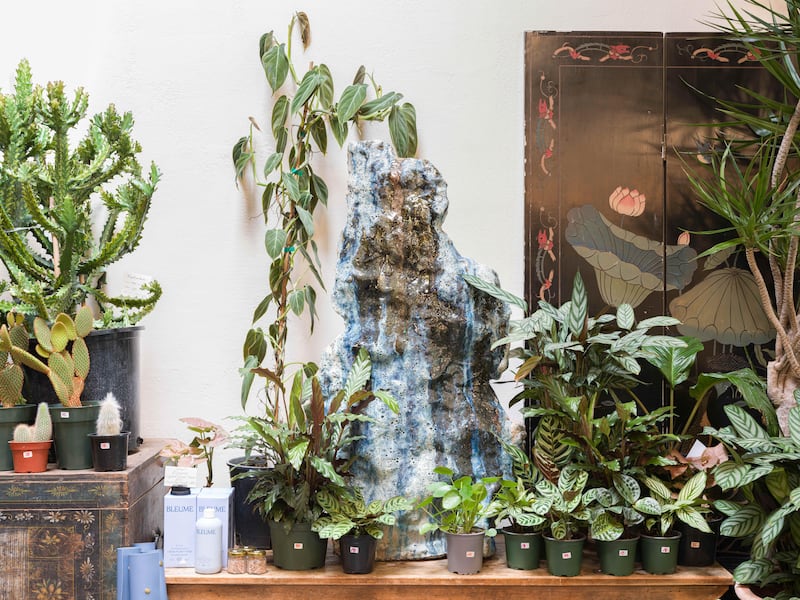
The biggest of the dozen or so sculptures is an impossibly vertical mountain standing about 3 feet high. One face is crusted in a glassy blue, as if battered by frozen wind, and its peak is draped with an obsidian slab—a kind of wispy toupee the color of shoe polish. It’s easy to imagine Mildrexler sculpting it after a winter hike around Newberry Volcano, when so-called Glass Mountain gets frozen over.
Making a sculpture of a rock—a snapshot of primordial ooze—is a surprisingly profound gesture. As Adams points out, his sculptures more readily offer the think-y pleasures of an artwork than the easy pleasures of beautiful décor.
But Mildrexler, who started working with clay as a Portland State University student over 40 years ago, and began this body of work re-creating his lifelong natural environment in 2000, is not content to have these snapshots stay frozen in galleries and private collections. He wants them out of doors, where the world can keep working on them.
“I like seeing them out there with snow on them,” he says. Regardless of how think-y and pleasurably difficult his sculptures are, Mildrexler’s ultimate intention is to make garden sculptures. And though he has shown them in several white cubes before, a sophisticated flower shop is a wonderful place to present such a thing in its intended environment.
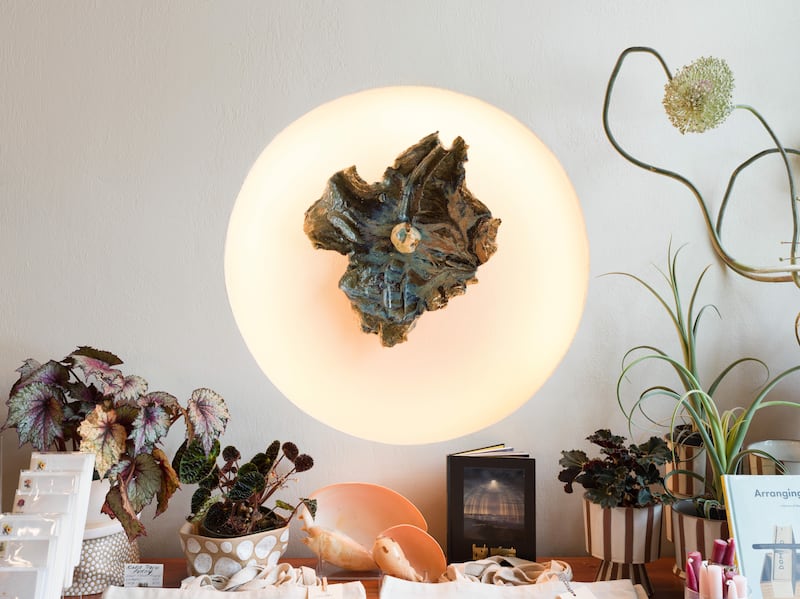
Mildrexler has cited Chinese “scholar’s rocks” as an inspiration, a practice dating to the Song dynasty (960–1279) of collecting and displaying stones shaped by nature. Similar to Mildrexler’s work, authenticity is not a huge priority in the world of scholar’s rocks. Altering the stones to replicate and enhance nature’s work is part of the practice. And the overt signs of human intervention in Mildrexler’s sculptures, a constant reminder that somebody made these rocks, are a big part of what makes them so engaging.
His pieces are often assembled from things Mildrexler picks up out in the world, like bits of glass, rocks and even scraps of metal that melt and burble in his high-temperature kiln.
“If I go somewhere, I like to get a little remnant,” he says. “I sort of remember a nice day at the beach, and I picked up this rock.” Other rocks melted into his sculptures have come from bike rides around Mount Tabor. Adding “some part of the world,” he says, helps connect his own life to the work, while making the clay feel “more real” than anything he could buy.
More than keepsakes, the artworks function as three-dimensional memories. Their references continue to morph and blur as experiences build up. For instance, a duo of small tripod-shaped pieces sitting on the shop’s floor were inspired by cedar stumps Mildrexler saw while hiking at Tryon Creek. But “then that kind of looked like a dog or a polar bear, sitting with its legs stretched out,” so he let his mind wander in that direction. They look a bit like Ryan Gosling’s friend in that new astronaut movie to me.
Mildrexler, for his part, isn’t concerned much with what you take from his ceramics. Nor does he care which words you use to describe them. It’s more that you take something.
“I like keeping it vague, and people can scratch their head,” he says, his voice big and friendly. “If you feel something for ’em, then that’s cool.”
SEE IT: In the Garden by Brad Mildrexler at Colibri, 1927 NW Kearney St., 503-288-8369, colibripdx.com. 10 am–5 pm daily, through Aug. 24. Free.