Skip to main content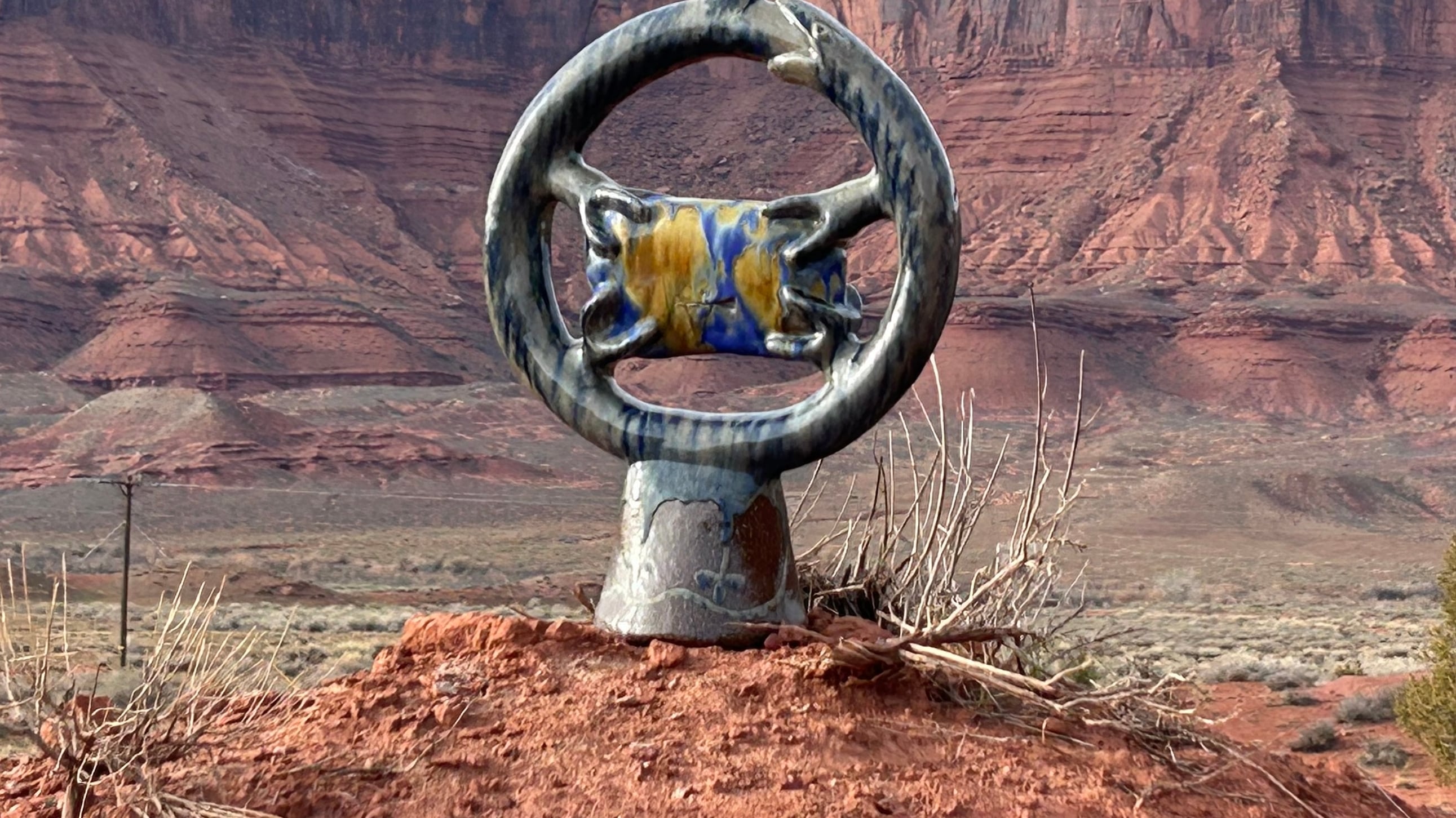
A few summers ago, a friend and I made a meme of Gollum presenting his “Precious,” but in place of the ring we sloppily copied and pasted an aquamarine trinket the size of a river stone by the artist Matilda Alair. It was an inside joke, and a light jab at the patrons of Lowell, a shop and gallery on East Burnside Street that displayed Alair’s sea-glass “talismans” among its collection of handcrafted jewelry, folk art and artfully tarnished housewares.
Of course, the meme was about us. My friend and I had summer birthdays coming up; we showed the meme to our boyfriends so they would get the hint. We were Lowell’s patrons, covetous of its highly impractical and bordering on unsightly items. But the meme was also about a certain crowd of West Coast aesthetes: artists, writers, and designers, sure, but also regular working adults who aspired to have a creative-seeming life. The meme seemed to say that our newfound eclectic tastes were really attempts to locate the glint of something unreproducible, something precious in the world and in ourselves.
In my eyes, there is one artist (also core to the Lowell mythology) whose work typifies this kind-of-young, kind-of-hip Portland consumer: Nick Norman.
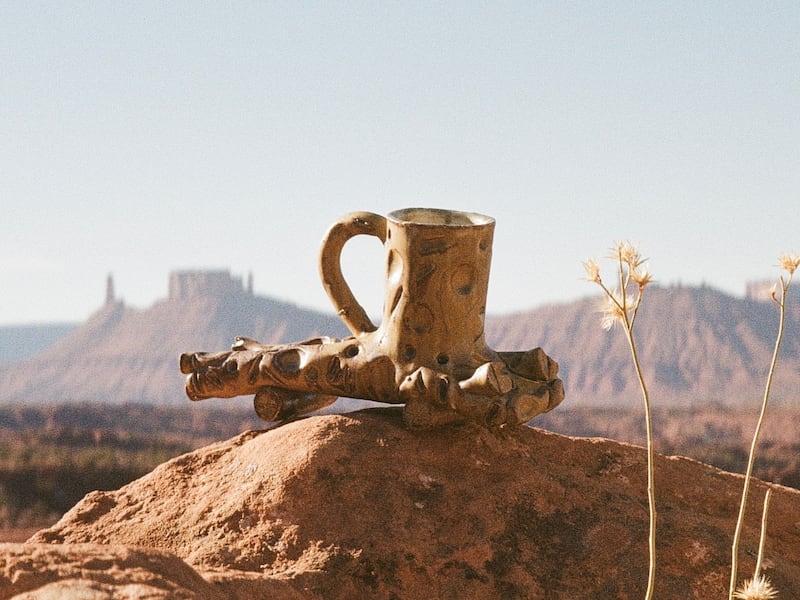
Idler, Norman’s fourth solo exhibition at Lowell, consists of a muddy range of sculptural ceramics, cartoonishly dysfunctional pottery, and hieroglyphesque monoprints. In increasingly inventive ways, all of them reference a mundane but nonetheless venerated modern amenity: the car.
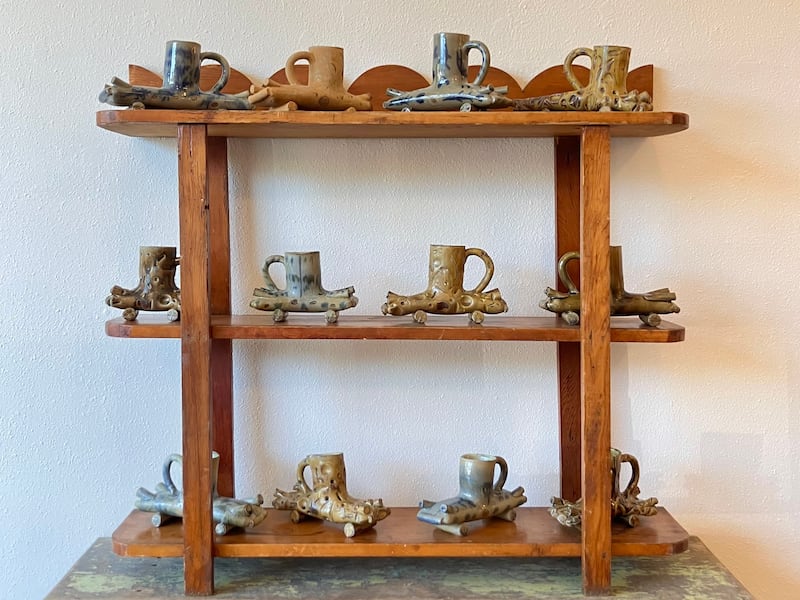
Despite being glazed in faded blues and tones of sun-scorched earth, each iteration in Norman’s Car Mug series has a distinct personality. A rather droopy bumper gives one the unmistakable impression of a catfish. Another, a stickbug. None seems even remotely functional as mugs, but that’s hardly the point.
Norman’s “mugs” are upstream of the anti-industrial American studio craft movement that emerged post-World War II. Studio craft marked a return to handmade, one-of-one objects. But instead of designing household items for practical use, artists working in this school adopted traditional craft forms to their contemporary arts practices. They made a wishful display of the desired function of everyday objects like mugs and vases and furniture and textiles. They straddled the germane routines of everyday life and the otherworldly plain of the purely aesthetic.
Norman’s fixation with cars could be read as a quaint or outdated invocation of the mode. Imminent technologies bear down with increasing intensity. So, why then, the car? Implementing ancient techniques such as salt-fired pottery and prints on hand-pulped paper, Norman figures the car and our relation to it as it is now: a revered relic. Cars today are living dinosaurs in comparison to more recent amenities rapidly becoming fixtures in our lives.
An adorable monoprint titled Car Soul addresses the concept squarely. It’s a top-down view of a figure alien in bodily proportions starred out across the four corners of a rudimentary vehicle. A yellow-blue aura forms a halo around it, stirring awe and affection, as if this car had a lifeforce of its own. There are people I suspect to be believers in “car soul,” people who regard their cars with the affection of a pet and name them things like “Puppy.”
Autouroboros, a sculpture, looks further to the past, employing a symbol revered since early human history. The title is a vehicular portmanteau of the word for a snake eating its tail. Across gnostic, medieval, ancient Egyptian and Greek mythologies, the motif represents grand ideas about the soul of the world and the cycle of life. It’s a potent icon in magical practices too. Here the ouroboros is shown in a classical fashion, with a green and blue globe in its grip. But then you catch the trumpet emblem scratched into the earth. The ouroboros, as it holds our planet in balance or terror, is a steering wheel.
Autouroboros and Car Soul, among many other of Norman’s works, are talismans. They may not have secular function, but they do have practical use for living among supernatural forces, forces that have historically persisted against human agency. They evidence a dogged persistence of wishful thinking, a will to manifest certain far-off realities, whether eradicating data centers or manifesting one’s own creative-seeming life.
SEE IT: Idler by Nick Norman at Lowell, 2136 E Burnside St., 503-753-3608, lowellshopgallery.com. Noon–6 pm Fridays and Saturdays, noon–5 pm Sundays and Mondays, through Sept. 6. Free.