Skip to main content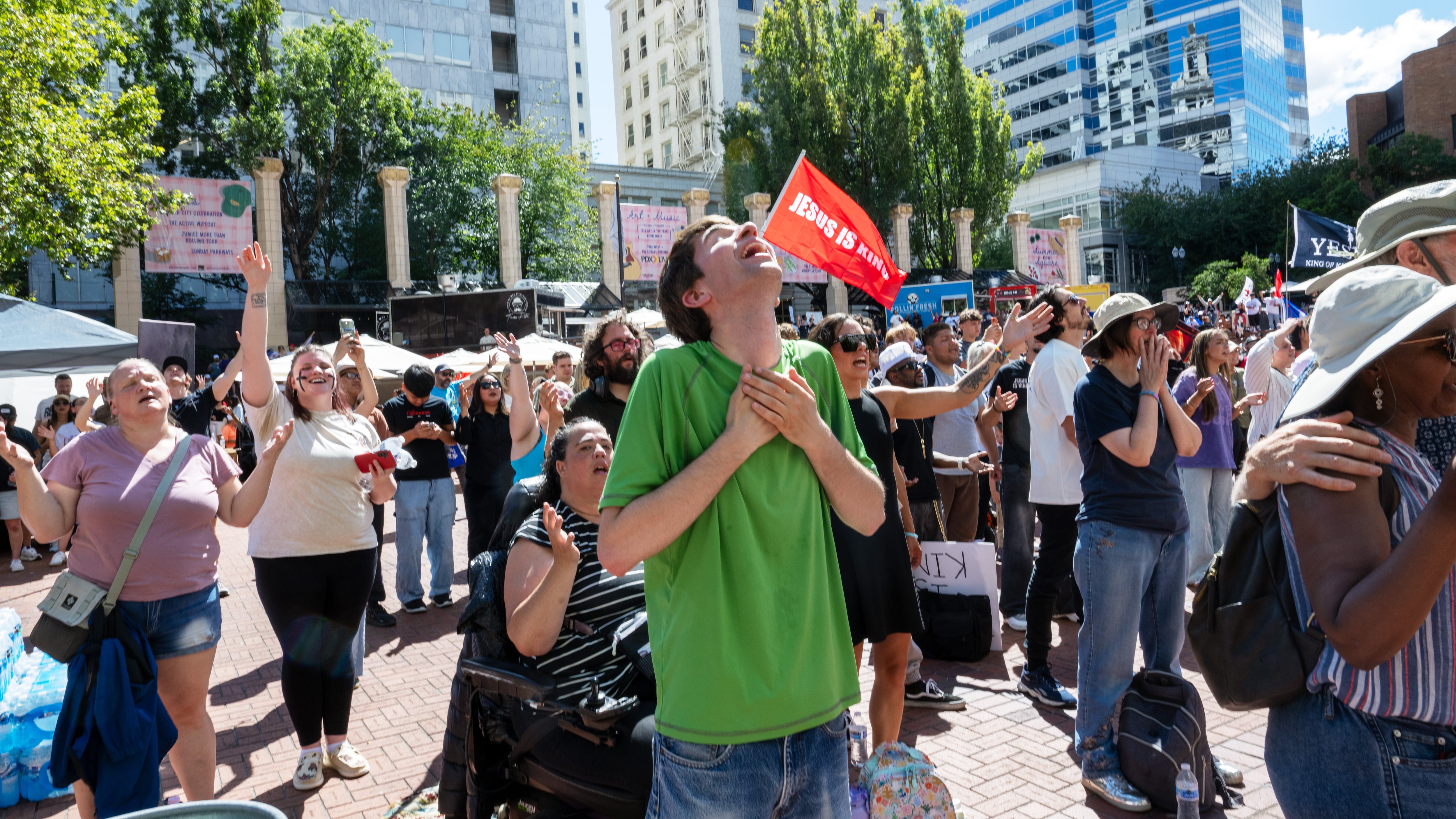
“There ain’t no party like a Holy Ghost party.” At least that’s what hundreds were told at the Portland Jesus March on July 11, as Christians from across Oregon and Washington gathered at Pioneer Courthouse Square at the call of California preachers.
Just after 2 pm, crescendoing gospel music beckoned attendees toward the stage at the square’s edge. Ivan Katrenyak, one of the event’s organizers, shouted a brief “Hallelujah!” before opening with a brazen proclamation.
“Muhammad is dead. Buddha is dead. Allah cannot hear you. Buddha cannot save you. But Jesus is alive!” his voice boomed through the PA. “We don’t have nothing to protest because Jesus already won. But this is a declaration of what Christ has done in our lives and what Christ has done in the city of Portland.”
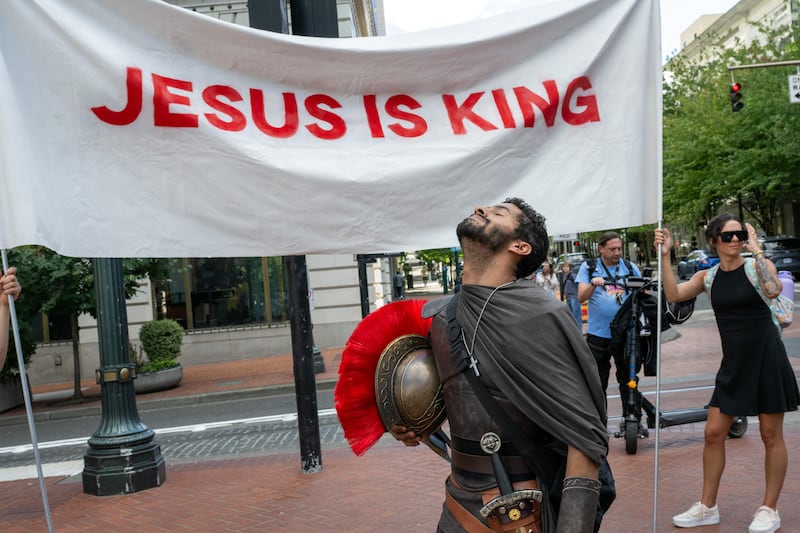
A four-person operation called United Revival was behind the event. Hailing from the United Church in Sacramento, the group started with local events in 2018. In the past few years, the millennial-aged team has undertaken a national tour, putting on what it calls Jesus Marches in cities across the country. It hosted a march in Chicago on June 20. Houston is next.
Portland’s national reputation for leftism and squalor makes it an attractive project for groups like United Revival. But the very qualities that make the city a target—progressive ideas about gender and sexuality, combined with low levels of religious affiliation—also make it rocky soil for winning converts.
But a few hours spent in the company of United Revival show that its leaders aren’t looking to have a conversation. Instead, Portland and cities like it become a foil to reaffirm the group’s message, making the roadshow more like a movie set where organizers and influencers alike can film culture war videos to post online.
Still, the event served to reaffirm the beliefs of Oregonians who share a conviction that Portland is soul-sick. Anne Townsend and her family drove in from Hillsboro. She heard about the march through Facebook, and said it renewed her faith in the Chrisitian community.
“It feels amazing to see all of these people standing up for faith in a city that is broken and, honestly, dying,” she said.
Before the Portland event began in earnest, United Revival put on an evangelism training session to teach attendees how to spread the Gospel. Attendees were asked to seek out potential converts whose hearts were open to a “relationship with God,” ideally sharing how faith had shaped their own lives along the way. “Let’s not be drive-thru evangelizers,” organizers told the small early crowd, and urged aspiring evangelists to gather contact information for future proselytizing.
Portland’s heart, however, was not entirely open to the Holy Spirit.
Forty minutes into the training, counterprotesters rolled speakers up to the revival and began playing Chappell Roan’s “Pink Pony Club.” As the lyrics recounted an epiphany during a first visit to a gay bar, the revivalists raised their hands and began to pray.
Among the counterprotesters was Pamela Hemphill, the former “MAGA granny” who famously refused a pardon for her role in the Jan. 6 Capitol insurrection. As Pioneer Courthouse Square security officers asked Hemphill’s group to move their speakers across the street, she said, “The Christians attacked me. One hit me in my back, hurt my arm, grabbed my sign, and screamed at me and gave me the finger.”
Hemphill told WW she was there to protest for a continued separation of church and state.
“In our nation, you should be free to believe in God in your own way, or not believe in God. You can be an atheist, or not an atheist,” she said. “But they want to turn this into a whole white, Christian nation believing in their Jesus—not the Jesus that most Christians follow. And it’s very controlling and it’s fascist.”
After its 2024 Portland Jesus March, United Revival wrote on Instagram that a similar scuffle had occurred with a group of antifa protesters (“our wildest March yet!”) but counted the day a success, tallying 51 baptisms.
For many Portlanders, this weekend’s large-scale religious event was a foreign sight. In the Portland-Vancouver metro area, 44% of the population identifies as religiously unaffiliated. The mainline Protestant congregations that dominate Portland’s Christian scene also tend to express their faith more subtly, and often in alliance with social justice activism.
Last fall, for example, a group of interfaith clergy offered spiritual guidance and acted as witnesses for immigrants with citizenship appointments at the U.S. Immigration and Customs Enforcement facility in South Portland.
However, in the eyes of organizations like United Revival, this approach to spirituality is just more evidence that Portland is in need of saving. That’s made it a hot spot for revivals in recent years. Athey Creek megachurch in West Linn organized the PDX Crusade at Moda Center last summer. The massive three-day revival drew Christian musicians, televangelists, faith leaders and around 35,000 devoted attendees.
Speakers at this year’s Jesus March argued that Portland’s rising rates of homelessness, drug use, mental illness and sex trafficking necessitated Jesus’ healing.
“There is no city too far gone from him. I have been to a lot of cities, but this is the one city I come into and there’s darkness and depression,” organizer Grace Katrenyak preached. “I believe, and I have big faith—that one event, one day—that Portland can be forever changed. That but today the Lord will come, speak, heal and deliver.”
While United Revival advertises itself as a nondenominational Christian organization, the Jesus Marches’ recurring motifs of healing align with evangelical Christianity’s acceptance of the miraculous and emphasis on salvation through individual faith. Whether it be healing through prayer or casting out demonic energy, evangelicalism often incorporates supernatural aspects of religion best explained by a higher power exerting its will on the world.
Revivals like Saturday’s Jesus March seek to evoke the Holy Spirit’s presence through fervent communal worship. Music brought that sense of transcendence on Saturday: Impassioned sermons were paired with building backing tracks; contemporary gospel songs were accompanied by pounding bass; and hymns were whispered to the quietly swaying crowd. The result was a concertlike atmosphere.
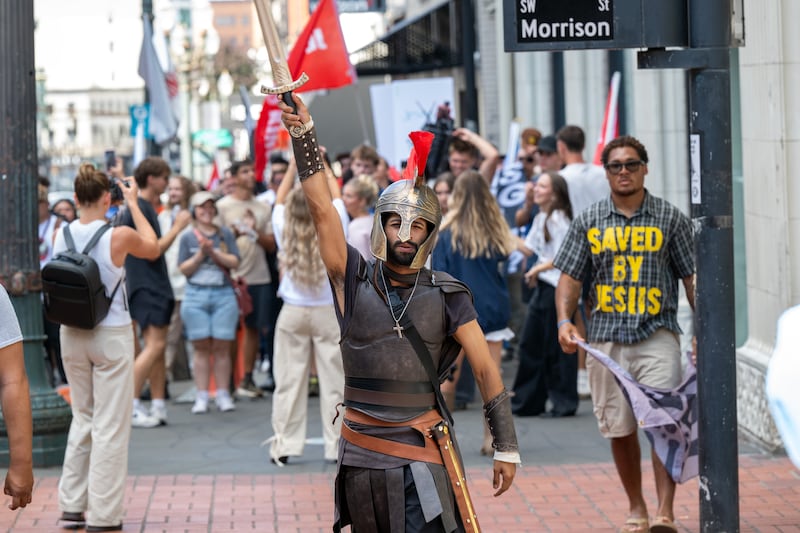
Things hit a fever pitch near 4:30 pm, as the crowd began to snake out of Pioneer Courthouse Square into the streets of downtown. Performers sang “Lace Up Your Boots,” the popular gospel song by Eniola Abioye that originated through spontaneous freestyle preaching. The song—“it’s time to ride,” goes its refrain—gave purpose to their marching.
This exhortation resonated with Mike Johnson, a downtown Portland resident. After battling addiction for nearly 20 years, he said it was his faith that finally helped him achieve sobriety. Johnson hoped the “infusion of God” into the city may help others do the same.
“To just have a shot of love and power invade this city with the Holy Spirit and the love of Jesus Christ, this is what Portland needs,” Johnson said.
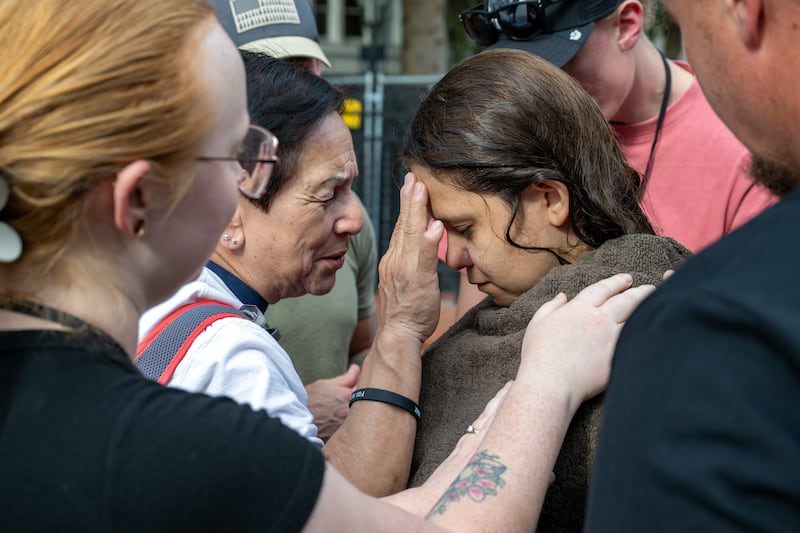
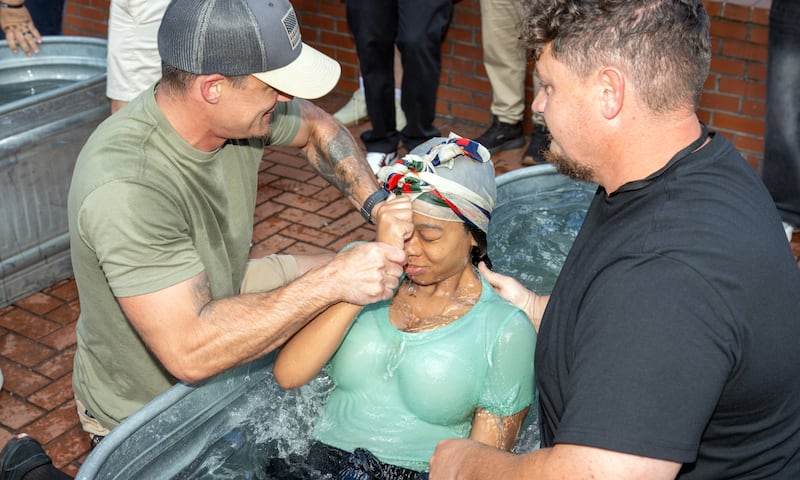
Except, however spectacular, the march never ventured all that far into the city. It made a tight, eight-block loop. At the end, back at the square, organizers had set up another fenced-off area with water troughs for impromptu baptisms. Theoretically, anyone could have converted on the spot. But by all appearances, the roughly three dozen attendees who took the plunge during the 15-minute ceremony were affirming a preexisting faith. Many wore shirts with biblical motifs and crosses.
What exactly were they committing to? A list of beliefs on the United Revival website outlines a narrow notion of who can achieve the type of spiritual connection and ascendance it champions. Most notably, the organization’s description of marriage stresses heteronormativity and strict gender roles.
These tenets surfaced vividly on Saturday during a sermon that, although clearly cribbing from Hannah Montana’s “You’ll Always Find Your Way Back Home,” delivered its anti-trans sentiments loud and clear.
“You can change your hair. You can change your clothes. You can change your name. You can change your gender. You can change your identity. You can move to a different city. But no matter what you do, you can’t change the brokenness that’s in here,” Ivan Katrenyak said, pointing to his heart.
Yet the Sacramento pastor’s message to the Rose City fell on deaf ears. And not only because it was tone deaf. A chain-link fence surrounding Pioneer Courthouse Square—a remnant of its summertime concert series—largely obscured the revival from local passersby.
The fence seemed to split opposing worlds. In one, the revivalists, cloistered in “Portland’s Living Room,” preached to themselves. In the other, the city they sought to save went about its Saturday.