Skip to main content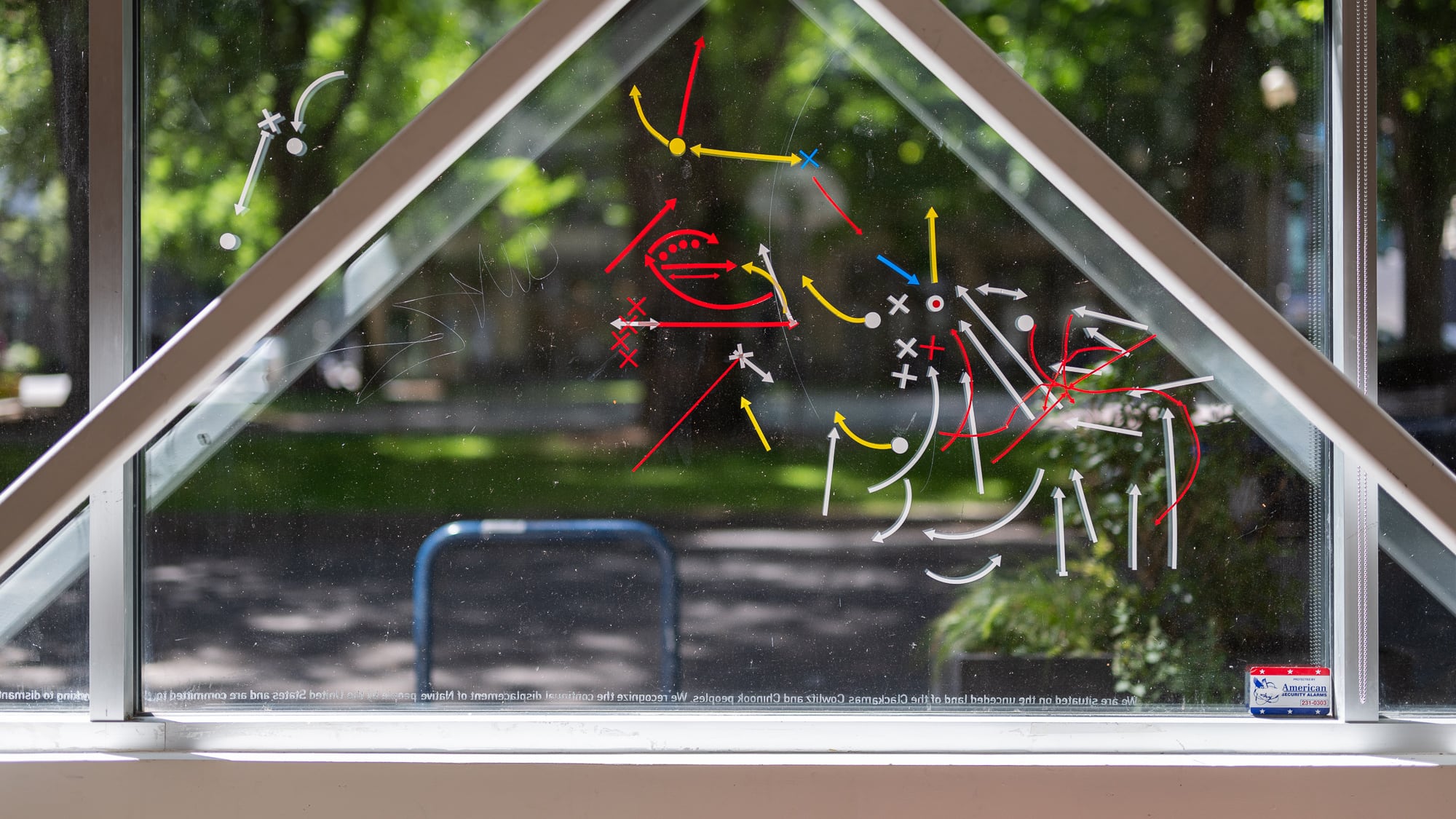
Earlier this month, the first-ever Portland Arts Week launched 16 exhibitions across town that centered, however abstractly, the theme of art and sports. Elizabeth Leach, the influential gallerist who organized the new festival, explained the inaugural theme as a way of bridging two worlds: Portland’s art gallery scene plus its sports teams and sportswear companies. It was an excuse to get different kinds of creative people talking to each other, and perhaps to show them they had more in common than they might imagine. But what of the art shows this art and sports theme brought about?
Ronny Quevedo’s scrimmage, an exhibition at Stelo Arts curated by Theo and Nancy Downes-Le Guin, offered the most sophisticated engagement with the theme. Quevedo was born in Ecuador and lives in New York. The son of a former professional soccer player, he is a kind of sports anthropologist whose art is collected in some of this country’s most prestigious institutions, including the Whitney Museum of American Art.
Quevedo’s drawings, collaged prints and installations connect human civilizations across thousands of years, placing modern games like soccer and basketball next to, for instance, Mesoamerican ballgame, a sport played with a rubber ball on a rectangular field or court that archaeologists have dated to as far back as 1400 B.C.
Instead of athletes, Quevedo repurposes game plans and rules in his work. The lines that give the universal language of sport its recognizable shape become his medium.
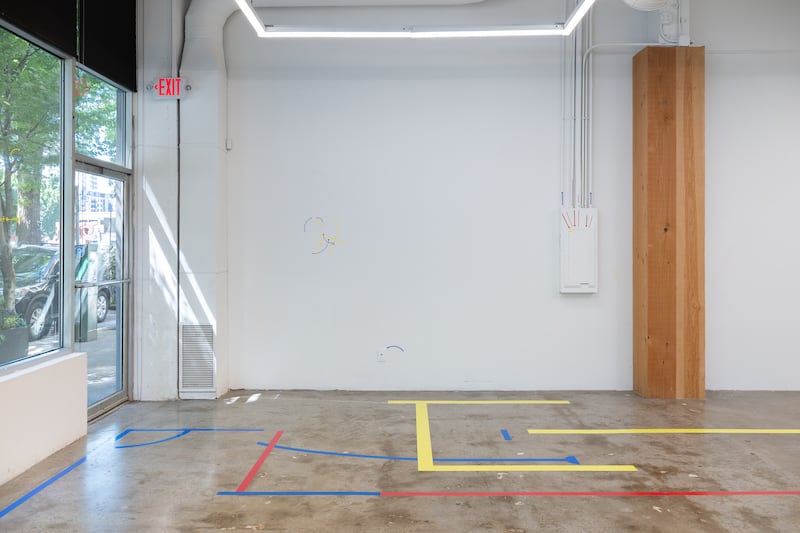
When scrimmage opened earlier this month, most of the artwork was on the floor. Quevedo had applied the hash marks and arches of a basketball court throughout the gallery’s concrete ground. They didn’t make a functional court, but the maze of clipped and overlapping lines were unmistakable to anyone who had ever seen a basketball court. The bright primary colors gave an elementary schoolyard feel. Standing in the gallery, you could almost hear the chatter of recess, laughs and cries and shoes squeaking. Knees had been scraped here, friendships begun and ended, formative joys and traumas transpired.
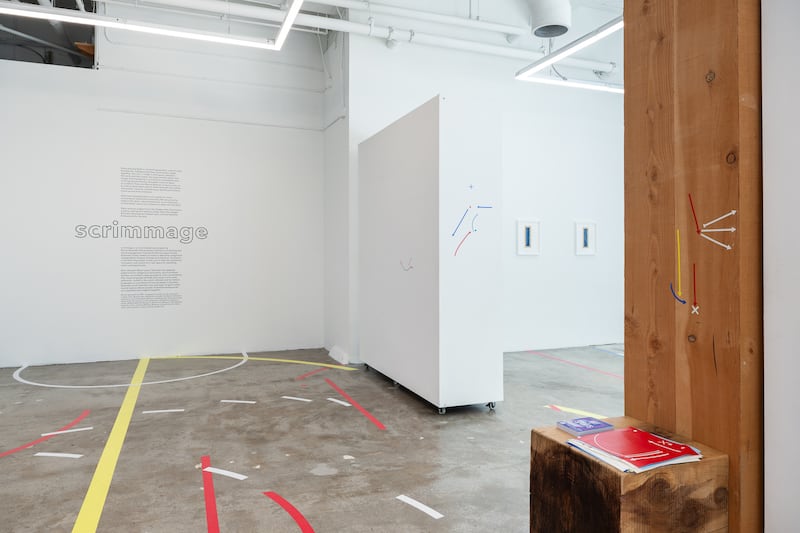
On the wall, Quevedo left a note describing how gallerygoers could produce the rest of the show. A set of “match rules” explained that a series of vinyl, removable stickers were yours to place on the windows. These resembled the lines a coach might use to diagram a play—X’s, O’s and various colors of differently curved arrows to symbolize routes. Ideally, you would find an opponent and play out a kind of match, charting your course on the glass.
The instructions are poetic and open-ended. Like the installation itself, they’re about evoking the cultural weight and social dynamics that organized sports produce rather than teaching you how to play a specific game. “Visualizing strategy and improvisation is a way to play within the abstract sense of the future,” Quevedo writes.
The plan was for guests to sketch on a select few windows. But as of a few days ago, much of the gallery was covered in intricately diagrammed plays. Windows, walls, electrical boxes—little flourishes of arrows and dots popped up all over. (This Saturday, Aug. 1, the gallery is leaning all the way in, hosting a “match” from noon to 5 pm at which the public is invited to cover every inch of the space in stickers.)
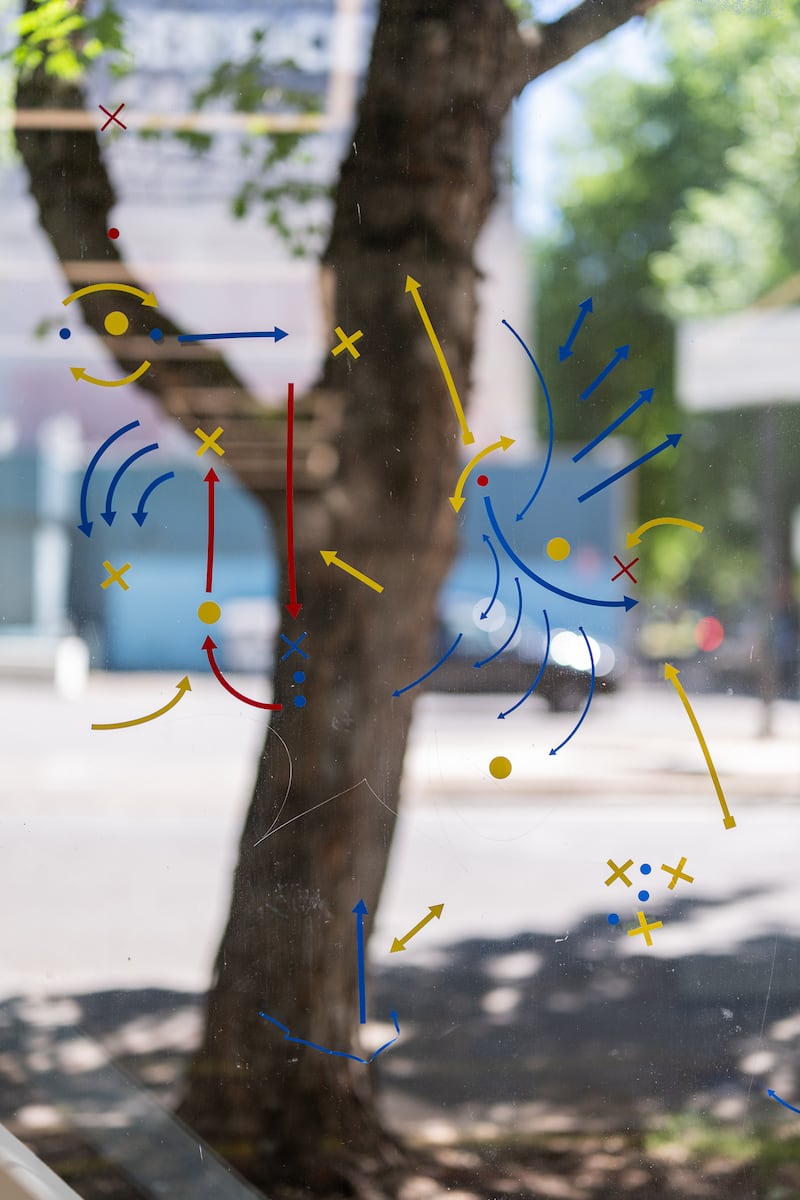
Some of the resulting sticker collages look too worried over, as if whoever made them was trying to make an artwork instead of playing a game. They were lining up their colors too carefully, or forcing the marks into a tidy pattern. But others appear to be a genuine record of actual play, which results in wonderful, abstract gestures that conjure the same organic emotions tied up in Quevedo’s own version on the floor.
As always, patterns fail, plans fail. That’s when things get interesting. All sports are animated by this threat of something going awry. And all art hinges on the idea of discovery through creation. This is, as they say, why we play the games. Leveraging the hard lines and rules of sports, Quevedo captures exactly how incapable these precise marks are of representing the real thing. In the gestures that emerge when these systems fall apart, however, he finds a record of life that hasn’t changed all that much through most of human civilization.
SEE IT: Ronny Quevedo’s scrimmage at Stelo Arts, 412 NW 8th Ave., steloarts.org. The “Match” event runs noon–5 pm Saturday, Aug. 1.Through Aug. 8. Free.