Skip to main content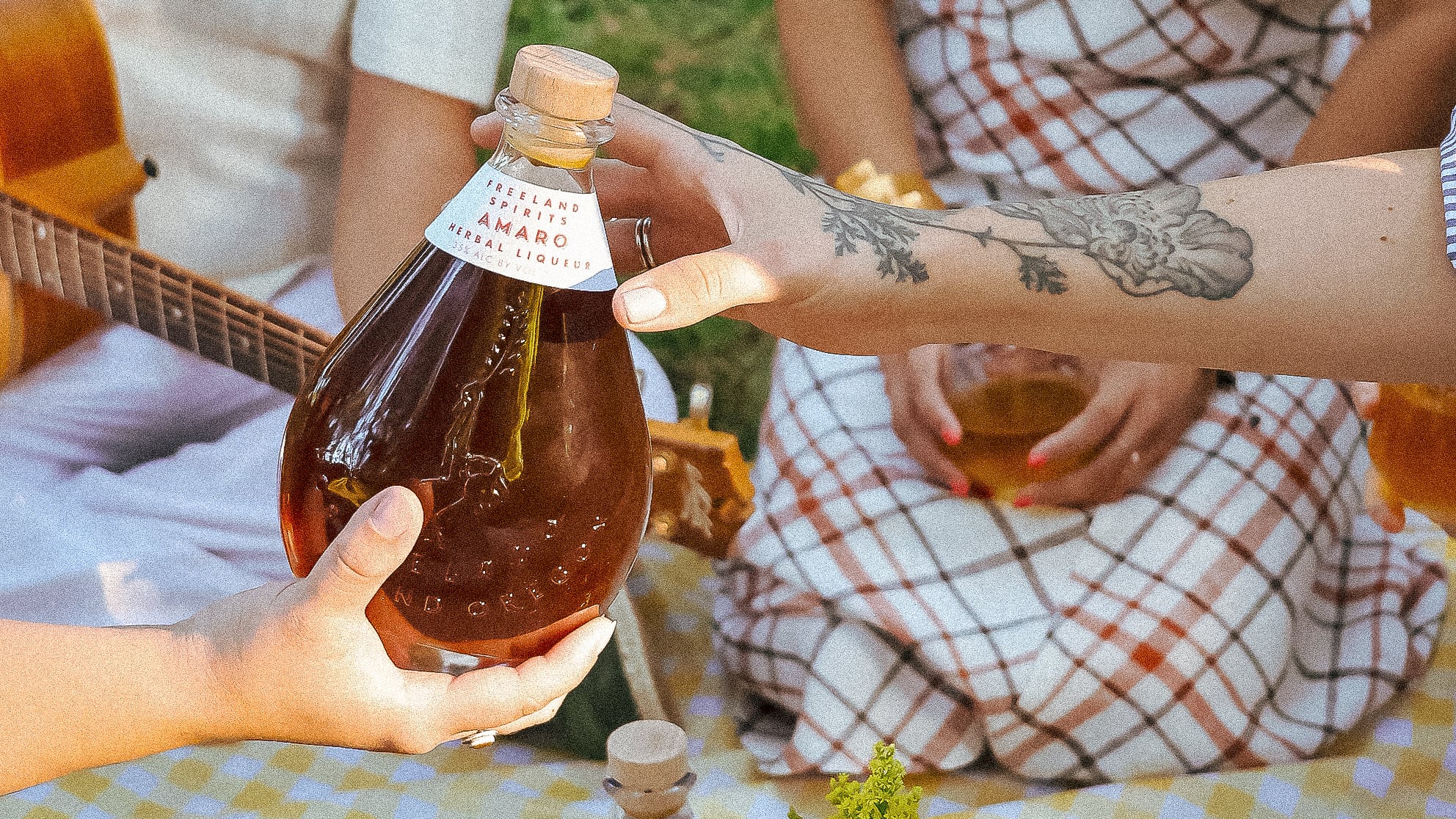
There’s a new way to enjoy Hood strawberries, and well out of season.
Around a thousand pounds of the delicate red jewels landed at Freeland Spirits’ Northwest Vaughn Street distillery this summer. To preserve the berries’ blink-and-you’ll-miss-it flavor, the lot was immediately steeped in high-proof alcohol, forming the distinctly Oregon base of Freeland’s amaro.
Strawberries are one of more than 40 different herbs, roots, spices, fruits and other flavors in the mix—topping even the 27 used in Fernet-Branca, the best known of the typically bitter, and typically Italian, herbal liqueur.
Freeland initially made the amaro as part of the Portland Art Museum’s “Everybody Is an Art Person” campaign last year, which also featured collabs with such food and drink makers as Roseline Coffee, Cloud Forest Chocolate and Son of Man cider.
What was then called “Amaro for Art” (with a portion of the proceeds benefiting PAM) came out of a series of brainstorming sessions between star bartender and co-owner of Pacific Standard Jeffrey Morgenthaler and Freeland owner Jill Kuehler and head distiller Raymond Muehlman. They tinkered over a table full of Mason jars, eyedropper bottles, spice containers, carafes and tasting glasses. The goal was “an Amaro made for Portland…something layered, generous, familiar, but still a little surprising,” Morgenthaler wrote on his website last year.
This year, Freeland added the amaro to its lineup of spirits, upping that first limited production run of just 170 six-bottle cases to 700, while keeping the hilariously complex recipe the same.
It began, Muehlman and Kuehler say, with both Fernet and Amaro Nonino as the broadest inspirations, but quickly became its own thing, with a fruitier and flowery direction, and none of the medicinal bite that some amaros have. In addition to the strawberries, there’s a “tremendous” amount of grapefruit (“not local, unfortunately,” Muehlman says) as well as rose petals (very local!), fresh turmeric, burdock, chamomile and coffee. And also: beetroot, elderflower and wormwood, all of which were local. Some of those things go into Freeland’s traditional copper still, and others into a rotary evaporator, which preserves the character of fresh ingredients without heat.
Also local was the other most important element: chocolate mint. That came right from Muehlman’s garden, though he’d sourced the first year’s batch via his mother, who got it in rural Washington via a Facebook gardening group.
“Then I realized,” Muehlman says, “to scale it up—I was in trouble.”
“Yeah, I was pretty mad,” Kuehler half-jokes. “I was like, ‘Come on! Surely there’s another mint we can use!’”
“It makes a difference,” Muehlman says. “It really ties in with the carob in the distillate, and the strawberries and citrus.”
As it turns out, there are several additional varieties of mint in the amaro. One came from the garden of a bartender at Freeland’s tasting room, and another from Sun Feast Farms on Sauvie Island. Kuehler is already lining up larger supplies of everything for 2027.
During the original development process in 2025, Muehlman brought two works in progress to the tasting table. “I was like, here’s my two works in progress,” he says. “These are the things that I’m most proud of.”
But as they kicked around whether one or the other could use a little more or less of certain flavorings, a crazy final notion emerged:
“What if we put them together?’” Muehlman says. “And that’s how we ended up with so many botanicals. It’s complicated, but it’s a complicated genre of beverage.”
Among Muehlman’s other tasting notes: citrus peel, strawberry chocolate cheesecake, and root beer. “There’s a subtle sweetness to balance the sort of herbal edge,” he says. “It’s not cloying. It hangs out in the mouth after you sip it. [And] it’s bitter enough to match the fruit.”
As far as amari go, Muehlman says this one’s designed to be more cocktail-friendly. Freeland recently began serving it in a “Summer Sparkler” with gin, simple syrup, lemon juice and sparkling wine. Muehlman’s personal fave is what he calls a “Snazzerac”—half rye, half amaro, with the same bitters and absinthe rinse as the traditional cocktail, but no sugar cube or simple syrup. (And yes, he recommends you make this with Freeland Rye, not just as a sales pitch, but because the flavor profiles match.) It can also work for a Negroni variation: Morgenthaler suggests swapping the Campari for less-bitter Aperol, and then using the amaro in place of sweet vermouth (with a bold, high-proof gin). It can also sub for vermouth in a boulevardier.
Call it an amaro for people who don’t think they like amaro. “I think that was intentional from the beginning,” Kuehler says. “We all wanted something that was great sipping on its own, and could work well in cocktails. Some of us know and love [amari], and others don’t. So we wanted it to also be a bit of a gateway. A welcome to amaro.”
DRINK: Freeland Spirits Portland Distillery and Tasting Room, 2671 NW Vaughn St., 971-279-5692, freelandspirits.com. 2–8 pm Wednesday and Thursday, 2–9 pm Friday, noon–9 pm Saturday, noon–8 pm Sunday. Bottles of Freeland Amaro are $44.99; also available at local liquor stores.