Skip to main content
On the heels of a year that saw at least 29 Oregon breweries and taprooms close coupled with a steady stream of restaurant closures, stability has grown scarce in the Rose City’s hospitality sector.
Given this, Machetes’ move from pop-ups and short-term stints into a yearlong takeover of the Hey Love kitchen looks like growth: a buzzy pop-up settling into a high-profile hotel bar. It could also function as a strategic handoff, with the Jupiter NEXT property tapping a loyal, ready-made audience to see it through the slowest stretch of the dining calendar. Likely, it is a partnership shaped by the realities of a contracting market.
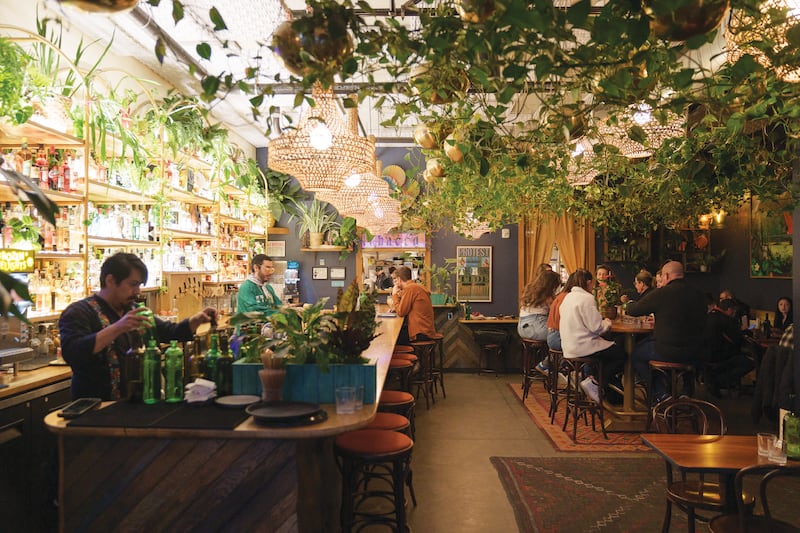
Now open in Hey Love—the softly lit, foliage-rich bar inside the Jupiter NEXT hotel on East Burnside—Machetes has settled into a yearlong residency that could extend indefinitely if the arrangement proves strong. The Mexico City-inspired pop-up, known for its oversized machete quesadillas and rotating guisados, arrives after a brief stint at Gigantic Brewing’s Hawthorne taproom. Both parties knew that residency would be short-lived, as the brewpub would soon close. Hey Love, named America’s Best Hotel Bar at the Tales of the Cocktail Spirited Awards in 2023, hands its kitchen to the pop-up in what both sides hope will be a long-term move.
For Hey Love, the transition is a welcome recalibration.
“It is very expensive and hard to run a small business, run a kitchen, run a restaurant in Portland in 2026,” says Sophie Thomson, one of the bar’s owners. Rising labor costs, climbing rent and utilities, and a pullback in customer spending made the previous brunch program increasingly untenable.
“People were either more interested in making it home or going to the big boys,” Thomson says, referring to established brunch destinations like Jam on Hawthorne and Screen Door. “It just wasn’t sustainable anymore.”
Thomson says the team wanted to get out in front of Portland’s post-COVID barpocalypse. Instead of waiting for declining brunch sales to force Hey Love into a financial corner, she says the goal was to stay fresh and relevant. The Machetes residency certainly qualifies.
Machetes handles food sales while Hey Love retains beverage revenue, with both parties splitting broader operational costs. Thomson explains the goal was to create a structure that “felt fair for everybody” without placing an “undue burden” on an early-stage business taking over the kitchen.
“We wanted them to be set up for success,” she says, noting that the shift also lifted the financial weight of running a full kitchen off Hey Love’s books.
On Machetes’ end, the move demands a dramatic change in scale. Palacios says Hey Love’s volume quadruples what his team was accustomed to at smaller pop-ups. The hotel setting brings a steady influx of guests, particularly on weekends, forcing the kitchen to move faster without sacrificing presentation, maintaining quality while adjusting to the demands of late-night crowds and destination drinkers.
But a yearlong stay affords more creative bandwidth. Diego Palacios, chef and co-founder of Machetes, says stability allows Machetes’ team to think more expansively about menu development, with plans to gradually introduce other seafood dishes, desserts and, eventually, brunch and grab-and-go offerings for hotel guests. The menu nearly mirrors Gigantic’s, for now, with room to evolve as the team finds its footing.
One example of that evolution is the beet salad ($16), which begins with a process more often associated with masa than seasonal produce. The beets are nixtamalized (treated with calcium hydroxide in a vinegar-water solution) before being grilled until deeply charred, a technique known as tatemar. The controlled burn intensifies sweetness while adding bitterness and smoke, forming the base for a salsa macha drawn from Palacios’ grandmother’s recipe. It’s a dish that signals where Machetes is headed: less novelty, more technique.
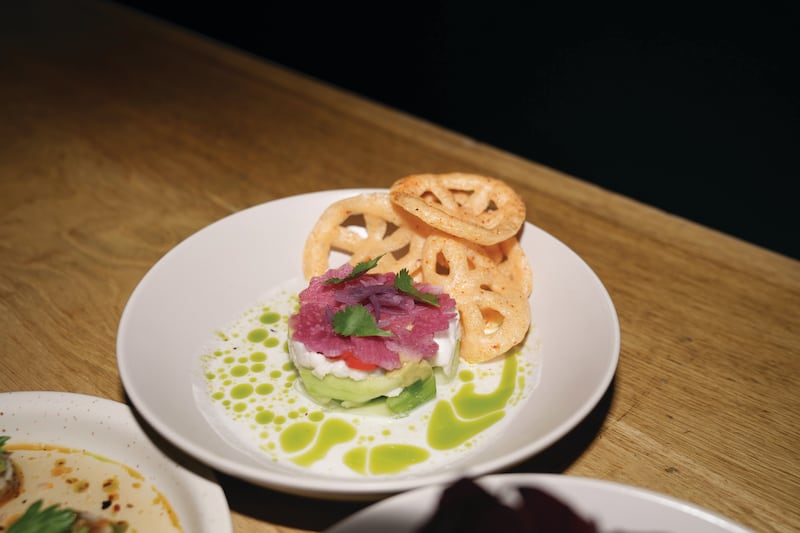
The machetes themselves ($16, $3 per add-on) remain the draw—long, folded quesadillas built for spectacle and sharing—and the format is undeniably fun. Diners have the option to divide fillings across a single machete, stacking up to four guisados in one pass. The namesake machetes introduce the kitchen; they don’t contain it. Over the past year, Palacios has pushed increasingly toward more contemporary and composed dishes—ceviches ($17) built on layered acidity offset by creamy coconut, vegetable-forward plates like the cauliflower tostada ($16), and salsas that are both punchy and structured. The machetes may be the gateway, but the range is the rub, a quiet show of gustatory gumption. Less spectacle, more sophistication.
That trajectory has already surfaced beyond the lengthy line-inducing pop-ups. In recent months, Machetes has staged collaborative dinners at Cafe Rowan and a kitchen takeover at Multnomah Whiskey Library, formats that demand tighter plating and more deliberate pacing than a sidewalk trompo. The cooking spans sidewalk theatrics and plated precision.
The setting also affords a bevy of beverage pairings for Machetes. Previous residencies placed Machetes inside decidedly more single-focus programs—a brewery taproom at Gigantic, a wine-driven dining room at OK Omens. At Hey Love, the range is wider. A high-acid white like muscadet from the Loire sharpens the char and bitterness in the beet salad, while the bar’s mezcal-forward cocktails echo the smokier edges of the proteins without overwhelming them. And for folks chasing a more authentic Mexican street food pairing, a cold lager still does exactly what it should alongside a machete stacked with multiple guisados. The shift deepens the versatility without sacrificing the street food core.
Palacios is already thinking beyond the dining room. A charcoal-fired trompo serving late-night al pastor on the sidewalk—part of a separate concept dubbed El Trompo del Diablo—is expected soon. The vertical spit is designed to draw a crowd in the way street food should: visible, aromatic, a little theatrical.
“It’s very eye-catching,” Palacios says. “Everybody’s like, what the hell?” Brunch and additional concepts remain in development.
TRY IT: Machetes at Hey Love, 920 E Burnside St., 503-206-6223, heylove.com/machetes. 3 pm–midnight Sunday–Thursday, 3 pm–1 am Saturday and Sunday.