Skip to main content
“Art is the ultimate expression and path to freedom. There’s nothing as empowering as art. It’s liberation, it’s empowerment, it’s the cape of the superhero,” gushes Brian Parham, co-founder of Rock Dojo, an award-winning music education, after-school, and live library program now touring through Multnomah County’s library system. “You pick up that guitar and all the doors are there for you to open.”
For the uninitiated, Rock Dojo is the meticulously developed after-school arts program that speaks directly to Portland Public Schools’ lack of access to arts education. Parham and his partner and co-founder, Sophie Parham, both music educators, developed Rock Dojo as a curriculum that merges guitar instruction with a martial arts belt system. Their program, a subversion of the prototypical orchestra, martial arts course, or erstwhile public school music class, is now impacting thousands of students across the Portland metro area.
Parham’s enthusiasm is as unique as it is authentic. Raised in a multiracial household with white siblings, Parham was the sole Black kid in his bubble, which had an indelible effect on not only how he created and consumed art, but also how he was perceived for doing so.
“I learned my first song, Pink Floyd’s ‘I Wish You Were Here,’ and I played it for my friends,” explains Parham of his childhood musician origins. “I practiced, practiced, practiced. I was all nervous, my fingers were shaking, my voice was trembling, and my friends were like, ‘Dude, that’s white people’s music.’”
“‘Black people don’t play the guitar, dude. They’re, like, Black people. This is our music, basically. And you don’t belong playing it.’ That’s why I’m so inspired to work with kids. So that they never have that sort of experience,” he says.
Heartbreaking as it is, it’s an experience Parham’s seeking to rectify through his work with Rock Dojo, and if the metric is lives affected through art, and music understood as a means of pure expression, they’ve had objectively, overwhelmingly successful results.
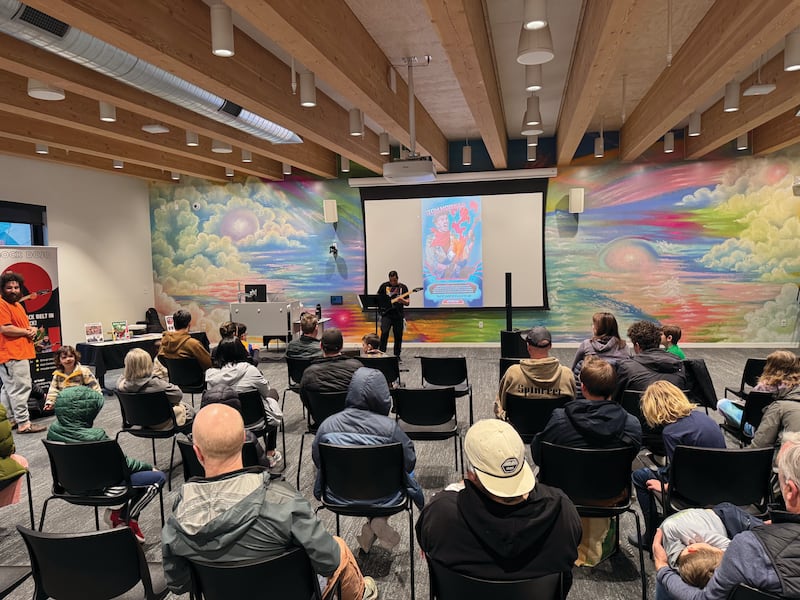
“It’s storytelling and music,” explains Parham of the curriculum he and partner Sophie created. “When I say storytelling, everything is framed through the idea that in life, we get to make a choice. We choose to be empowered or not.” And in Parham’s purview, empowerment can begin by picking up the right instrument.
Rock Dojo’s performances and workshops marry guitar-hero antics with history lessons to make them tangible, even achievable. In fact, heroism is the umbrella Parham uses to invite students into the stories created by Rock Dojo, evidenced by the structure of Rock Dojo’s shows.
For example, RISE! The Legacy of Black Guitar Heroes in Rock & Roll is a program created by Rock Dojo, and instigated by Multnomah County Library, paying honor to five legendary Black rock and metal guitar players. “It’s really fun way to take something that’s so critically important to me because of my personal story,” Parham explains.
“In RISE!, I start by playing one of my original songs,” Parham continues. “Then we actually talk about the different hero traits embodied by artists like Sister Rosetta Tharpe, Eddie Hazel, Vernon Reid, Tom Morello, and even Slash.” The program even features trading cards emblazoned with one of each of the trailblazing guitar heroes, stats and all.
Parham’s guitar is where he finds his power as well. He’s a big believer, he says, in the power of the guitar and what it can do for people without other opportunities: “It teaches focus, discipline and creative expression.”
“It’s all about stories. The stories within stories, using the melodies, using the solos, using vocals and lyrics,” Parham says. “You give me a guitar at the age, you know, at 20-something, and it feels like I could do anything with it. It opened every opportunity. And it’s been amazing.”
He refers to the expanse of creative expression the guitar afforded him once he shed the shame of his childhood debut performance, but there is also a complex suggestion that the instrument also represents dreams fulfilled floating between the lines of Parham’s glowing explanations.
“Since I picked up the guitar again, I graduated from college four times, wrote all this music, wrote all these books wrote award-winning musicals and all this stuff.” Parham also authors a comic titled The NullSong Chronicles, which also relies on hero tropes to teach music, and wrote a heavy metal musical, Elijah & the Sacred Song, as well as a prequel called Six-String Showdown.
“And all of it is just because of the power of the guitar.”
CHECK IT OUT: To learn more, check out rockdojo.org/.