Skip to main content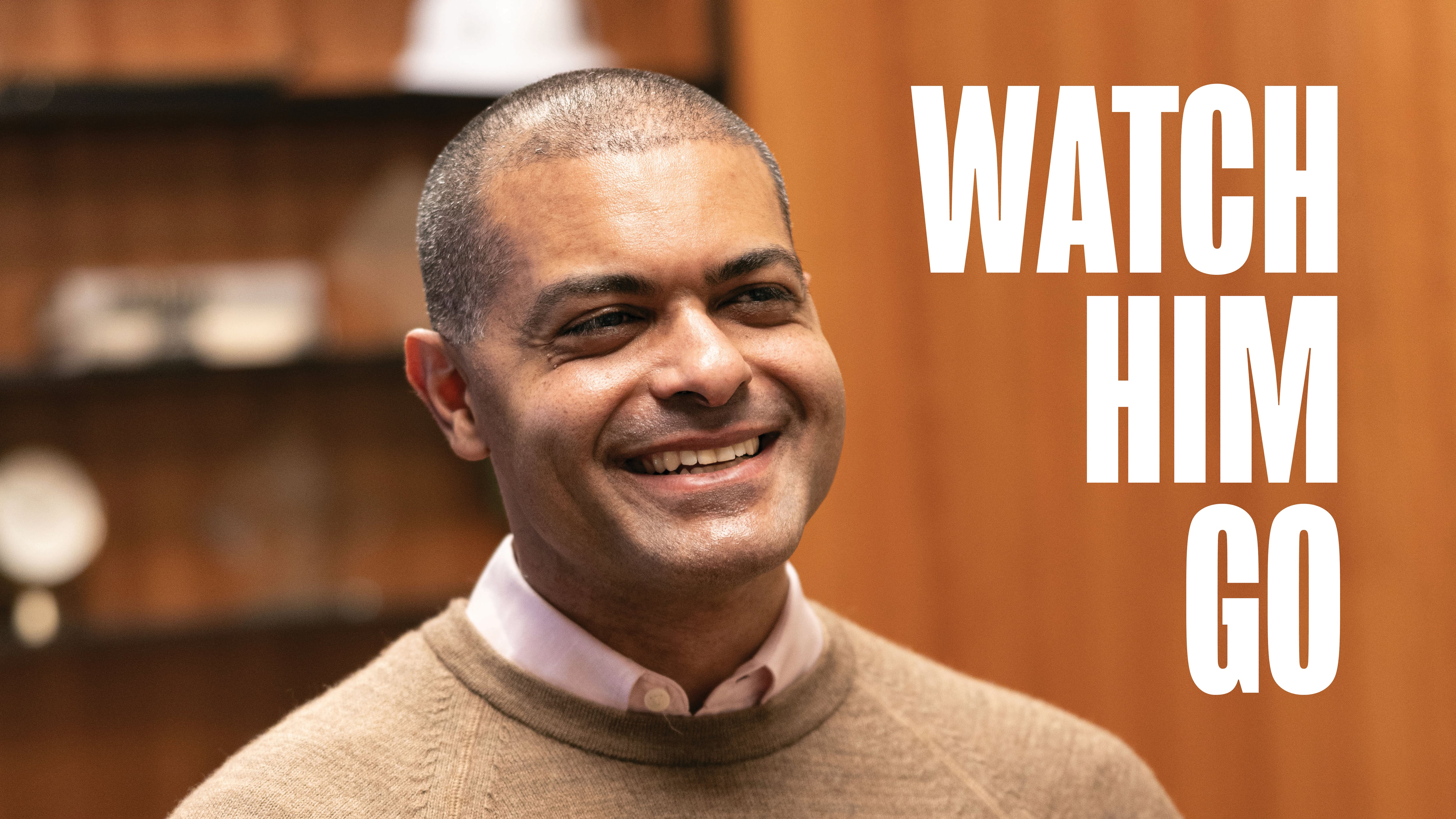
Here is Dr. Shereef Elnahal, slipping disposable blue booties over his shoes to enter a suburban laboratory. There he is dining with Dr. Brian Druker, the famous leukemia scientist. Here goes Elnahal roaming the halls of Salem. (“Smart,” says state Rep. Ed Diehl, R-Scio, recounting a first impression.) Now he’s got some words for the Metro Council. He keeps the speech brief; mainly, it seems as if he’s just come to say hello.
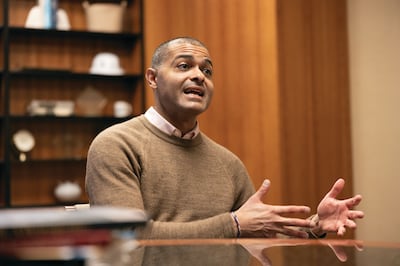
Elnahal, 40, the new president of Oregon Health & Science University, began his work in August, and since then he has proven charming, clever and, above all, omnipresent.
“You see him everywhere,” says Dr. Maria Rodriguez, the faculty representative on the OHSU board. “I see him walking down the hall. I see him on the tram. I see him in the cafeteria. Other people do, too.”
To be clear, Elnahal’s frequent staff forums and peppy weekly recap messages from Marquam Hill have not stopped some fraction of OHSU’s 22,000 employees from seeing him as a distant and overpaid suit.
But even skeptics grant he’s an open and gifted communicator, and he’s widely seen as a politics and health policy ace. More importantly, to many at OHSU, it seems he’s listening, like he cares, like he wants to be their champion.
“He gave me hope,” Rodriguez says of meeting with him. “And I was like, ‘I haven’t felt optimistic or hopeful in a really long time!’”
Elnahal will need every bit of that goodwill. He must increasingly make hard, messy decisions—they are financial, political, administrative, existential—that will test and ultimately eclipse any early impressions.
Whether he succeeds matters far beyond the contours of Pill Hill. OHSU is Portland’s largest employer and the state’s sole academic medical center. It trains many of the health care professionals who will go on to serve in Oregon, draws billions in federal funds, and offers complex care unavailable anywhere else in the state.
What’s more, Elnahal arrives at a moment of considerable uncertainty for OHSU.
Indeed, if it is the state’s health care flagship, a hearty storm is at hand, and the task before Elnahal is to rally morale, set a course, and deliver on a vision to pass beyond the gale-force headwinds of President Donald Trump—and Oregon’s own economic doldrums.
WW interviewed Elnahal on various occasions in recent months, including throughout a crisp October day that began in a nondescript Beaverton office park, a factory for very expensive drugs.
He’s got those blue booties on. So does everyone else. Yen Pham, OHSU’s chief pharmacy officer, is telling her new boss about the virtues of something called home infusion: administering these drugs in a nontraditional setting. “The patients love it,” she says, touting the convenience, how it saves hospital bed space and money too. Elnahal repeats this back, perhaps imagining conveying the message to a congressman. (The feds, Pham notes, have been slow to embrace the practice.)
Now doors open to a brightly lit room, releasing an antiseptic rubbing alcohol scent. Machines quietly hum. The techs wear white lab coats. Elnahal offers an elbow bump and introduces himself: Shereef.
Then, onward to a carpeted lobby, where Elnahal asks the receptionist if she has any advice. “Not anything I can think of,” she says. “You’re kind of doing it already—getting out and meeting people. It was weird that nobody ever really talked to or saw the guy before you.”
In the next room, a cubicle to the right is decked out in AFSCME green. Elnahal approaches warmly. The fellow, not so warm, informs Elnahal that he’s on the union bargaining team and that “I’d love a contract.”
To which Elnahal responds, “Hey, great! Me too.”
OHSU is perhaps not one ship but a fleet of dozens.
Presiding at the Department of Molecular and Medical Genetics is Dr. Susan Hayflick, who has spent much of the past three decades investigating and treating a set of rare children’s neurodegenerative disorders. “We are the go-to site worldwide,” she says.
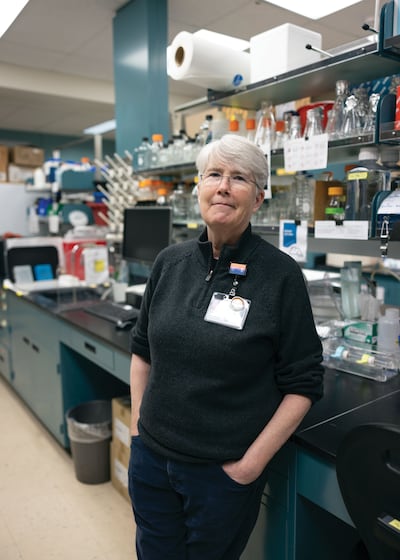
As for many Oregonians, this kind of fact makes Hayflick proud. It’s a pride money can’t buy, the kind that makes people want to show up for work. Hayflick thinks OHSU is a remarkable place. She’s gotten offers to go elsewhere, she says, and time and again she’s chosen to stay.
Yet certain developments in recent years have “made me not proud of the institution.” She’s referring here specifically to the case of a doctor who was found to have secretly photographed female students, and the inept blame-casting response of senior administration—a saga of fuck-ups later documented in great detail by a private OHSU-hired investigator.
“Why,” Hayflick wondered, “do we have to hide, hide, hide, hide, hide, and then hire an expert to come tell us what we should have been talking about all along?”
To what extent poor morale at OHSU can be attributed to the six-year presidency of Dr. Danny Jacobs is debatable. A world-altering pandemic did not help, nor did tanking public faith in the health care profession as a whole. But undeniably, the drip-drip of OHSU’s ugly business in the news, and the aloof distance and outright dishonesty of the Jacobs regime, sapped trust to new lows.
“Decisions were being made by a very small number of people in a room somewhere,” Hayflick says. And they were communicated quite poorly—if they were communicated at all.
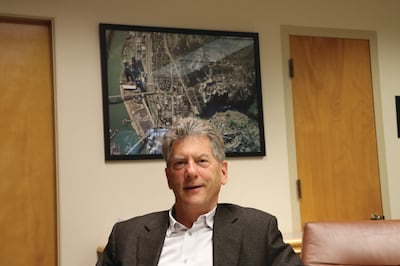
Steve Stadum got a distress call in fall 2024. Jacobs had resigned, and the board of directors needed an interim leader while it sought a permanent replacement. Stadum, whose 17-year run at OHSU had ended in 2016, had just retired from Fred Hutchinson Cancer Center in Seattle. But he felt a duty: “It didn’t feel right to say no.”
By early 2025, OHSU veteran Tim Goldfarb had also returned, to fill in as the health system’s interim CEO. “Steve called me and said, ‘Wow, this is not like when you and I worked there. People don’t trust each other,’” Goldfarb recalls. “‘They don’t trust leadership. They don’t think leadership is telling them the truth.’”
Difficulties persisted. Druker, the eminent scientist, had resigned as head of the Knight Cancer Institute in late 2024, saying OHSU had forgotten its mission and lost its research edge. Department of Government Efficiency funding cuts darkened the mood further. Meanwhile, a slow-cooking plan to merge with crosstown rival Legacy Health collapsed in May 2025—a “mutual decision,” Stadum says, that reflected the deterioration of the health care operating environment.
Still, not all developments were glum. Courts tended to block those DOGE cuts. The interim chiefs scrounged funds to expand OHSU’s overflowing emergency department. In August, Phil and Penny Knight made a mighty $2 billion gift to back cancer care, marking Druker’s return to leadership.
That momentous news became public days after Stadum’s tenure officially ended. At the announcement event on the South Waterfront, a young fellow, the new guy, was smiling, making the rounds, shaking hands.
Elnahal is a son of Egyptian immigrant doctors and the Jersey shore. Kane Kim, a college buddy from Johns Hopkins, describes him as an agile, expansive and open-minded thinker, possessed of an exploratory zeal. (“Also, he could slap the bass.”) One time, Kim recalls, the old friend group was on an adventure in Tunisia when the rental car ran aground on the side of the road, marooning them in salt flats. Some grew agitated. Elnahal laughed uproariously. Then he led the group to push the car back onto the road.
Marwa Kamel met Elnahal in 2013. After she helped her family buy a used car, the dealer got in touch to inform her that she and his nephew might get along. She’d immigrated from Egypt as a teen and was now living around D.C., having just wrapped up a master’s degree in environmental sustainability.
Elnahal, having studied medicine and business at Harvard, had returned to Johns Hopkins for his oncology residency. During their courtship, he came down from Baltimore. “We would get nerdy, use math equations to explain things in real life,” Kamel says. They got married the next year.
Kamel says her husband, who jumped early from clinical to systems-level work, is drawn to the idea of institutional turnaround. She’s wary of politics, so often a den of mischief. She believes Elnahal, in contrast, sees a “chess game.”
Following a series of Department of Veterans Affairs gigs in the Obama administration, Elnahal, at 32, became New Jersey’s youngest-ever health commissioner. Then he took the top job at the main county hospital in Newark—a surprising choice. As the state’s largest newspaper put it, Elnahal’s “meteoric rise” suggested a coming CEO job at a major hospital network. “Instead, he chose the Sisyphean assignment at University Hospital.”
The lengthy article, practically incandescent with praise, describes “a leader like Newark has never seen” who won over skeptics to turn around an institution wracked with deep-rooted challenges. Newark Mayor Ras Baraka told the paper that, where he barely ever spoke to most hospital executives, he and Elnahal talked multiple times a month.
At 37, Elnahal became President Joe Biden’s undersecretary for health at the VA, overseeing the care of 9 million people.
Running an operation at such a scale, he says he learned to lead more by influence, by setting a vision staff could believe in. He presided over a massive expansion in VA enrollment. He also hit some bumps. An audit found he’d neglected to tell his boss about millions in bonuses routed to senior executives—a VA scandal that led Republican lawmakers in 2024 to call for his resignation. (Elnahal says he took accountability for the mistake.)
In any case, Trump’s return meant that by early 2025 he was out of a job. In the wilderness for a few months, he popped in as an adviser on health care at Thrive Capital, the venture capital firm run by Joshua Kushner, the brother of Jared. Elnahal says he sought to learn about the world of private capital markets, with which he’d had little experience. Meanwhile, he was sitting for interviews with OHSU.
Members of the presidential search committee recall being struck by Elnahal’s presence. As fear and uncertainty reigned in the hard-charging early days of the Trump administration, here was a principled and perceptive-seeming consensus builder who believed in the academic medical center mission.
“There was a lot of enthusiasm,” says Lynne Swarbrick, a member of the bargaining team at a nascent AFSCME research workers union. Hayflick was on the search committee too. “It’s important not to be hoodwinked by the charisma but to actually see the substance below it,” she says. “He was charismatic and a person of substance.”
She adds, “He spoke about us like he knew us.”
It’s that same morning in October, and Elnahal’s tour continues on to the South Waterfront. The leader of a research pharmacy shows Elnahal around an upper-floor office that runs clinical trials for experimental medicines. “We do lots of first-in-humans,” she says proudly.
Now it’s lunch time. Some descend to eat, but first Elnahal must step away for a quick phone call: It concerns ongoing negotiations with an insurer that OHSU claims should be paying it more.
It can be difficult to know how seriously to take hospitals when they plead poverty, but no one thinks the Oregon health system is thriving. OHSU reported a $133 million operating loss in its 2025 fiscal year, and projected further losses in 2026.
Elnahal describes tightening up the finances as an immediate priority to secure the institution’s future. He also says he is determined to avoid mass layoffs. And that OHSU must remain a “backstop” as other local health systems cut unprofitable service lines. “We don’t have that luxury here,” he told faculty at a meeting last week, evoking a higher mission.
Elnahal prays when he can; he says his Muslim faith serves to buttress his integrity and values. He also espouses earth-bound leadership principles like diligence, jointness and transparency.
Some are probing for gaps between talk and action. In that meeting last week, faculty grilled Elnahal with questions about an abrupt recent decision by the dean of the OHSU School of Medicine. Dr. Nathan Selden, a neurosurgeon appointed by Jacobs to the job in 2024, had just removed a widely respected primary care champion from her position as department chair.
Elnahal, legs crossed in his yellow seat facing the faculty group, praised the outgoing department chair and pledged his support for family medicine, while fumbling out a neutral take on the demotion itself. (“Ultimately, that decision was made and I was informed.”)
Then there are the unions. Elnahal says a mission-driven institution like OHSU must pay a “living wage.” He also notes that OHSU wages are generally competitive. Still, stark pay disparities are bound to rankle. Elnahal’s base salary is $1.75 million a year—about 40 times more than one of OHSU’s lowest-paid workers.
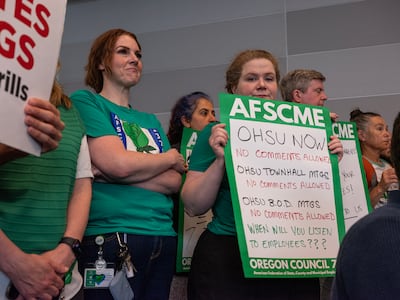
Duncan Zevetski, president of the OHSU nurses union, was put off by a comment he said Elnahal made at a town hall about needing to recruit talent at the top of the pay scale; if Zevetski had his druthers, he’d worry more about juicing pay at the bottom. “I can’t move patients into a bed unless the room’s clean,” he says.
Elnahal has thus far averted major labor trouble. OHSU secured a contract with 700 advanced practice providers in November. AFSCME 328, the massive union of some 8,000-plus eclectic staff that as of late December threatened to strike, was in recent days voting on a tentative contract. AFSCME 328 president Jennie Olson says Elnahal seems open and sincere, and that the contract was the best her union could have gotten.
Yet its passage was not assured. “Please God,” Elnahal said in that faculty meeting last week—a plea that the rank and file approve the deal. Results emerged the next evening: The contract had passed, with 84% of the vote.
If labor costs are OHSU’s primary expense, the university may face greater peril on the revenue side.
Health care and research are profoundly subsidized—and warped—by gargantuan government programs and policies, many of which the Trump administration is looking to upend. OHSU, which gets half of its revenue from the federal government, is deeply exposed. An embattled drug discount program called 340B, for example, makes up a whopping $500 million of OHSU’s $6 billion budget.
Yet Elnahal says threats to the public funding model run deeper than some might realize. “This,” he says, “is going to be an issue that lasts far beyond the Trump administration.”
He makes this point having returned from his insurer call. His fork hovers over a salad as he discusses the need to engage private industry. He’s thinking big, not just about sustaining OHSU as it is, but about a reality that is, in fact, far headier.
Casually, unself-consciously, Elnahal throws it out there: He thinks Portland could become the “Silicon Valley for health care innovation.” And OHSU the mother ship.

To some, the vision will ring almost cringingly naive. Portland is not exactly an economic dynamo these days. One close health care system observer, told of Elnahal’s comment, says he finds the idea “laughable.” Where would the money come from? Where’s the infrastructure? Why wouldn’t someone go to, say, tax-low Houston, already a health care innovation hub?
Pressed further, Elnahal insists that many of the necessary conditions are already here: In OHSU and a cluster of other universities, he sees the parallels with the North Carolina research triangle. In Intel, he sees the firepower of private industry. Yes, there are “headwinds”—Portland is not on the map for investors—but these are “addressable.” He thinks wheels can be greased considerably with better outreach and targeted policy incentives. He adds: “We’d want to get the unions behind us. We’d want to get community and civic organizations behind us. I think there’s a case to be made.”
If you remain dismissive, the founding Oregon Health Authority director says you’re being too cynical. “What is really compelling about Dr. Elnahal,” Dr. Bruce Goldberg says, “is he’s willing to come and put that audacious vision out there.”
Goldberg adds, “It’s up to the rest of us to, hopefully, help that succeed.”
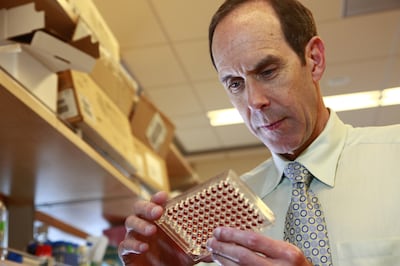
Count Druker in, too. When he stepped down a little over a year ago, he had lost faith in OHSU, he acknowledges. Times have changed. He likes that Elnahal thinks big and makes people feel heard. “Despite his age, he has an incredible level of confidence,” Druker says. “The confidence isn’t ‘I’m the smartest guy in the room.’ It’s the confidence of, ‘I’m here to listen, I’m here to learn. And I’m here to help you get more work done.’”
And yet it’s hard to ignore a CV full of two-to-three-year job stints. Elnahal previously knew little of Oregon, and for all his ubiquity in recent months, he’s often commuted back to D.C. on weekends to visit Kamel and their young kids. In December, the family moved to Portland, and Kamel says she’s trying to get her mom and friends to move here too.
Elnahal says longevity questions are fair. “The intention I have is pretty simple,” he says. “This is the last time we’re moving until my kids are graduated from high school. My marriage depends on that.” He laughs. “Feel free to print that.” (Kamel says her husband is being a bit overdramatic.)
Arriving at the Knight Cancer Institute auditorium, Elnahal delivers some opening remarks for an event with the Mexican consulate, watches for a bit, and ducks out early. Outside the theater, he adjusts his insulin pump—he has type 1 diabetes—and sets off toward the Aerial Tram, which he rides up to his next engagement, soaring above an autumn Portland below.
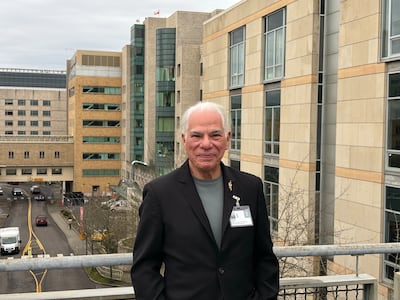
Goldfarb, preparing to step down as interim OHSU Health CEO, says he’ll hear people comment on Elnahal’s youth, wondering what he could really know. “And I’ll say, ‘This organization as you see it today was built by people his age.’”
OHSU got into a cycle of hiring older executives. But, recalling the period when the institution transformed from backwater to research hub, Goldfarb thinks of his own youth and that of longtime president Peter Kohler.
Elnahal, Goldfarb says, is a throwback to successful university leaders past: a young outsider, “somebody who doesn’t know what they can’t do.”
The sun is getting lower, and its rays catch Elnahal striding now into the main hospital building. He wears a purple bracelet fashioned by his daughter. (“If the boys give me something, I’ll wear it.”) Some leaders show him around Mission Control, a long room lined with dozens of large screens tracking the movement of patients around OHSU and hospitals across the state.
Onward to the dispatch room, where two women wear headsets and sit before array monitors. It’s quiet now, but sometimes the dispatchers see very disturbing scenes on these screens—think emergency workers coding a child. On another monitor, dogs saunter and lie at rest. “The dogs,” Elnahal says, “tell me about the dogs.” The dispatcher says the external video feed is a source of peace amid the darkness. “I glance over at the puppies,” she says, “and everything is right in the world again.”
There are more people to meet. Here in the doorway is a manager that cares for families after their loved one has perished. And there is this evening’s administrator on duty, the hospital field commander overseeing the boots on the ground.
Elnahal smiles, says he’s worked that job himself. “May you have a restful evening,” he says.
Correction: An earlier version of this article misstated Kane Kim’s name. WW regrets the error.