Skip to main content
The social atmosphere in some saunas can be austere, quiet. Sarah Mayo wanted hers to get customers talking.
Last year, disillusioned with her white-collar career, Mayo, 38, was planning an entrepreneurial turn: a small sauna business designed around conviviality.
Among many things, the vision informed her choice of heat source. “If you go with electric, then you’re not getting the crackling wood and the little bit of smoke smell and the view of the flames inside the fireplace,” Mayo says. She adds that if someone is feeling shy and doesn’t want to make eye contact with strangers, the fire provides something to look at and feel engaged.
Thus, in what would prove to be a relatively fateful decision—“fateful” in the sense that it would ignite a bitter weekslong feud in a small patch of Montavilla that would eventually grow to involve multiple bureaucracies, social media and now the press—Mayo selected the Narvi Inari wood-burning sauna stove. It’s a Finnish make, which, she says, was the most efficient available on U.S. soil.
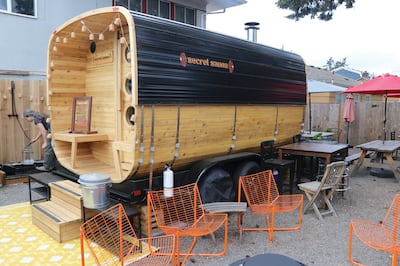
It was not, Mayo adds, the cheapest option. But she tells WW that the choice reflected a broader mindfulness she brought to bear on the enterprise. Last fall, she checked in with officials to ensure she abided by permitting and emission regulations, researched which wood burns cleanest, and forked over $24,000 to a sauna builder in British Columbia. A few weeks later her new sauna trailer rolled up outside a cafe/bar combo on Northeast Glisan Street.
Mayo had worked out an arrangement with the owner of Replicant to lease part of the bar’s patio, which abuts some neighborhood homes, in winter and spring 2026. She had already spent weeks preparing the space, erecting a shower zone, a woodshed, and a greenhouse-like structure for changing rooms and other products for purchase or rent. She named the business Secret Sauna.
The Jan. 27 launch was met with an immediate problem, one that was not a secret at all: Gray smoke was blooming from the sauna’s chimney to a degree she did not expect.
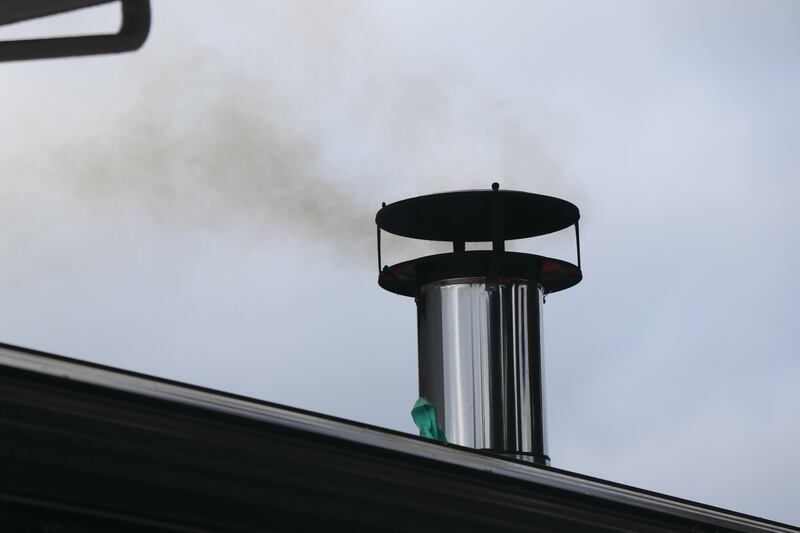
Woodsmoke is no joke. Its fine particulates can seep into the lungs and bloodstream and collect in your organs. Finding that woodsmoke accounts “for the majority of fine particulate pollution” in the area, Multnomah County commissioners in 2018 passed Ordinance 1253, restricting the burning of wood in the fall and winter during certain “red flag days” and cautioning against burns on “yellow flag days”—air quality determinations to be made by health officials. (Later, commissioners would empower the department to make such determinations throughout the year.)
The rules, intended to apply to fireplace use, old wood-burning stoves or recreational fires, did not anticipate a growing health and wellness movement tied to wood-burning devices that exist largely outside the U.S. regulatory regime—or local ones.
“Wood-burning saunas are definitely something that were not on our radar when the ordinance came to be,” says Nadège Dubuisson, the official who implemented the Multnomah County ordinance and now oversees it.
There is limited data on the proliferation of saunas, but a WW review finds of the 119 companies—active or not—listed in the Oregon Business Registry with names that contain the word “sauna,” 86 were registered from 2018 onward. A whopping 30 of them were registered in 2025. Secret Sauna was among them (though it was not among the 20-some sauna operators that converged on Milwaukie in mid-February for the first Willamette Sauna Festivaali).
Not all these saunas use woodstoves, and records obtained under public records law show that the new popularity, such as it is, has prompted only sporadic complaints to the county.
But one notable burst of activity began on Feb. 1 this year.
“Replicant, a bar abutting our backyard, installed a large wood burning sauna,” Montavilla resident and mother of two Alexandra Ornholt wrote in a complaint to the county’s Environmental Health Services division. “The smoke this weekend has been intense at times. I had to go inside.”
That same day, her next-door neighbor Kari Koch wrote that a “wood burning Sauna type structure” in Replicant’s backyard seating area had “made noxious air quality in my yard.”
Ornholt and Koch both live directly behind Replicant, with tall fences dividing their properties from the patio. In a recent interview at her dining room table, Koch, 50, tells WW she first sniffed the smoke from Secret Sauna one winter day while weeding and prepping the soil for her geraniums. “I could smell it really strongly, and then I could see it really strongly,” she recalls. “After 10 or 15 minutes, I was like, ‘God, I have to go inside. This is pretty intense.’”
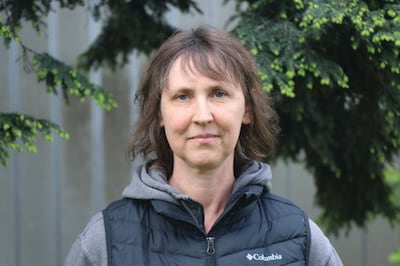
Koch is sensitive to this kind of thing. She has an adolescent child, and says her husband died of blood cancer a few years ago at the age of 43, and that he and his brother, who was also diagnosed with cancer, grew up around woodsmoke in Douglas County. (Koch, it should be noted, is not the person by the same name who leads a City of Portland workers union.)
On Feb. 18, Jon Cruz of the Multnomah County Health Department’s Wood Smoke Program responded to Koch and Ornholt’s complaints, and pledged to reach out to the business to better understand its operations and setup. “The usage of wood burning saunas is complicated based on the language in our ordinance,” Cruz cautioned in his email. Still, he encouraged Koch to let them know next time they were burning or if there was a problem in the future.
Koch let him know the next day. “It happened again,” she wrote, noting that the chimney was low, “and if it’s cloudy the smoke just fills our yards.”
By this time, Mayo, who had immediately come to suspect the original wood fuel she received was not as advertised, had replaced it with a batch from a new supplier. She says the half cord of kiln-dried oak that arrived Feb. 13 was drier and burned far cleaner, which was a great relief.
“This is so much better,” she recalls thinking, “because I’d been feeling really bad about the amount of smoke I was creating the first couple weeks. It wasn’t acceptable to me. It was a little bit bothersome to the employees in Replicant also. And then it was solved.”
But in the coming weeks, Ornholt and Koch sent more complaints to Cruz. In one, Koch wrote that she hoped there was a way the sauna could relocate to a more fully commercial area.
Cruz responded that he heard her frustrations, and that he had sent an educational mailer to the neighborhood and business in question. Later, he would write that “to my knowledge there is a policy gap when it comes to regulating wood burning saunas.” It was clear he saw his options were limited; there was nothing illegal going on and he could do little beyond encouraging the neighbors to keep documenting what they saw—a process that eventually started to feel to the neighbors like a fool’s errand.
“Have you or other neighbors talked to the bar owners or sauna business owners about their impact on the neighborhood?” Cruz asked. “I think it would be received well or even better than hearing it from us.”
In early March, Koch sent Secret Sauna a message on Instagram, saying the smoke had prevented her from gardening or sitting in her porch, and that Replicant was not the appropriate place for a sauna. “Hope that there might be a better space where people can enjoy your service,” she wrote.
The two women spoke by phone (“We were both super measured,” Mayo recalls), and while Koch was clearly not satisfied, particularly with Mayo’s assertion that the wood was clean, Mayo figured the matter would run its course.
“I’m going to do what I need to do to run my business, which I am legally entitled to do,” Mayo recalls thinking. “And then she’s going to discover through her process all the same things I have already told her, which is that I’m in a place I’m allowed to operate, and everything I’m doing is allowed. And then she’ll not like it but, like, eventually drop it.”
The neighbors did not drop it. They amassed a petition (a lawyer among them punched up the prose) and sent it via certified mail to Replicant (about 50 feet away) as well as to Secret Sauna’s registered business address, which happened to be Mayo’s home, also in Montavilla. Ornholt began contacting the press.
Mayo says she was beginning to feel harassed. One evening, she says, a drone flew overhead as her customers sat around the fire, before landing behind Ornholt’s fence. Ornholt says her spouse likes to take photos of the sun as it sets over downtown Portland. “I would never dream of spying on patrons,” she says. “That’s such an invasion of privacy.”
In any event, the feud was heating up. What Koch did, she tells WW, is not her usual style at all. But she had been particularly irritated by an earlier Instagram post from Secret Sauna, which quotes two patrons as saying they “sauna to detoxify from all the bad things that are in our air, water, and food.” She also took issue when Mayo—who asked Secret Sauna social media followers where she should go next after she leaves Replicant at the end of May—deleted a comment Koch left encouraging the sauna to choose somewhere far from nearby homes.
Feeling she had no other way to make her perspective known, Koch scribbled a notice on a plastic sign and perched it in a tree looking down on the sauna area: “Wood smoke harms health, especially for kids!” it reads in part.
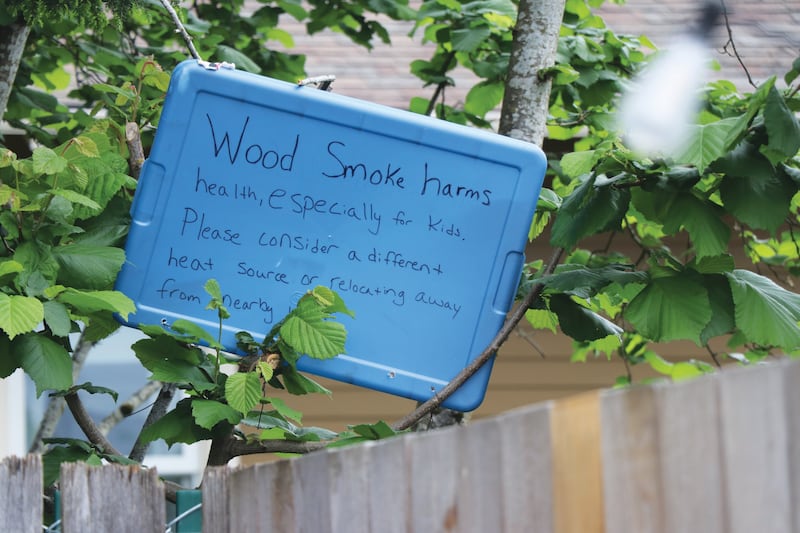
The sign loomed over the fence one recent morning while, a few feet away, Mayo went about her business prepping for the first patron in her sauna. She cleaned a liquid dispenser, vacuumed, split some wood and lit the fire.
When it lights, she acknowledges, smoke rises upward, no doubt conspicuously for those watching closely. But more heat makes the wood burn more efficiently, and eventually she says, all one can see in a hazy halo around the chimney.
Eventually, Mayo, like Ornholt contacted WW about the matter. Evidently both sides felt an objective airing in the press would vindicate their perspective.
There were other things they agreed on: Mayo and Koch both basically agreed with the county official’s characterization of the dangers of woodsmoke. Both also told WW they felt the government had failed to be an effective intermediary on this issue. Whereas Mayo was assured that what she was doing was legal, Koch felt strung along, as if she had a case to build, when actually, under existing rules, it’s unclear whether she did.
It is very much the case that certain wood can burn cleaner and certain stoves can be more efficient. But Oregon State University professor Nordica MacCarty tells WW that even relatively efficient sauna stoves are typically not designed to be as clean as woodstoves for home heating. Plus, “it doesn’t take much smoke to disturb the air quality in a neighborhood,” she says, “especially if there’s not a lot of wind or there’s an inversion or it’s in a valley.”
The day of WW’s visit was sunny with a light breeze. Koch and Ornholt have never met Mayo face-to-face, but they live so close that it’s a two-minute stroll around the block to their properties. As Mayo’s sauna came up to temperature, WW spoke with Koch in her home. The interview culminated with a visit to the backyard, where flowers bloomed all around, to observe the sauna over the fence.
Mayo could be made out through a crack in the fence, talking to someone. The sun was out and the wind was blowing. The sauna was burning-hot at this point (about 180 degrees, as confirmed shortly after). And later, when Mayo refilled the woodstove, some visible particulates briefly emerged. But at this moment, Koch acknowledged, there was not a perceptible trace of smoke in the air.
This article was updated to note that Secret Sauna’s owner plans to seek a new location when her lease ends at the end of May.