Skip to main content
As masked agents, often without badges and driving unmarked vehicles, have arrested over 2,000 immigrants across Oregon under the second Trump administration, two questions have burned across Portland like a blast of tear gas to the face.
One: Is there any way to know if these people are agents with U.S. Immigration and Customs Enforcement or its sibling agency, U.S. Customs and Border Protection? Two: Is there anything a city can do to stop them?
An ordinance passed 8–4 by the Portland City Council last week, championed by Councilor Sameer Kanal, aims to address those questions.
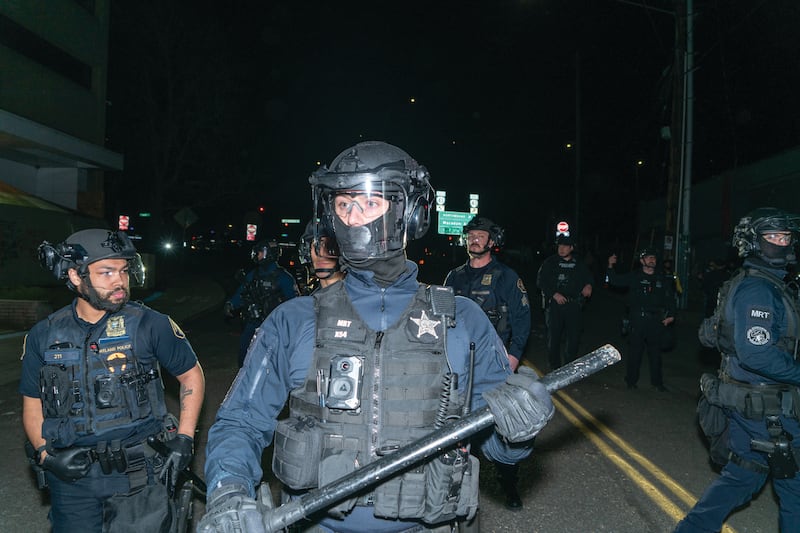
The ordinance does two main things. First, it prohibits all law enforcement officers—Portland police as well as members of federal agencies like ICE and CPB—from wearing facial coverings on the job and requires them to clearly display their badge, name and agency affiliation.
Second, it directs Portland officers to investigate and document instances of someone without proper identification trying to detain or arrest someone, and take steps to confirm the person is a legitimate law enforcement officer or apprehend them if they could be an impersonator.
“This is the least that we can do, in the sense that we are being asked by our public to determine that someone actually is the federal government before acceding to their requests,” Kanal tells WW. “And I think that if we can’t even do that much, we are failing at a really basic public safety responsibility.”
But amid council debate about its constitutionality, what the policy will look like on Portland’s streets is as clear as mud. WW tried to sift through some remaining questions.
Could the ordinance actually stop ICE agents from wearing masks in Portland?
Heck no. Kanal, his fellow councilors, the Portland Police Bureau, and the mayor all agree on at least one thing: No matter how hard it tries, the city of Portland almost certainly may not tell the federal government what to do.
“I’m really concerned that we have raised public expectations about what we can do and not do,” Council Vice President Olivia Clark said at a hearing May 27 before voting against the ordinance. “I think we may be doing a disservice to the public by creating those expectations.”
Concerns about enforceability stem from a recent case at the 9th U.S. Circuit Court of Appeals that halted a California law requiring law enforcement officers to wear the same kinds of identification Portland just required. The court said California’s law likely violates the U.S. Constitution’s supremacy clause by trying to regulate the federal government.
Robert Taylor, the city’s attorney, has said the 9th Circuit’s decision is binding on Portland, making the ordinance’s provisions related to federal law enforcement likely unconstitutional. If those portions were struck down, he said, the rest of the law would stand.
Mayor Keith Wilson asked the council to drop the ordinance for that very reason. And Councilor Steve Novick, who voted yes, did so while conceding that the 9th Circuit wasn’t likely to let Portland tell federal agents what to do. “It is barely conceivable that if the issue goes to a larger panel of the Court of Appeals, it could be reversed,” Novick said. “So we are kind of hoping for a miracle.”
Even Kanal has been up front that part of his policy will almost certainly be challenged, but has been careful not to comment on its chance of success in court.
“Let me say this clearly,” Kanal said at a recent hearing. “This ordinance cannot and will not unmask ICE agents.” He added to WW this week, “Some portion of this will likely end up in court at some point. But I’m not going to legislate out of the concern that something might get thrown out in court.”
Councilor Elana Pirtle-Guiney, who co-sponsored the policy, said it’s still important because it will create documentation of incidents of masked agents that will help in future legal challenges. “These are tools that we’re passing today,” Pirtle-Guiney said. “They don’t end the terror that the Trump administration has brought forward. But they give us tools in the fight.”
In effect, that means the council passed a policy that it expects to achieve two things: first, ban local cops from masking—which they say they already avoid—and second, compel Portland police officers to investigate incidents in which masked civilians might be pretending to be federal agents.
How often are people impersonating federal cops?
Nationally, instances of people impersonating immigration law enforcement to harass or rob immigrants have risen amid ICE and CPB’s expansion across the United States. A Noticias Telemundo investigation recently found at least 31 such instances in 2025 and six so far in 2026, up from an average of 5.3 per year across the previous decade.
In Portland, Police Chief Bob Day told the council there have been “about a dozen” possible incidents of law enforcement impostors in the past 18 months. He didn’t specify who they were impersonating, or the outcomes of any of the incidents.
In at least one recent case, someone pretended to be an ICE agent. On March 26, according to PPB spokesman Mike Benner, 19-year-old Mason Clark tried to rob a 7-Eleven on Southeast Division Street by posing as an ICE agent. He was unsuccessful, and police who arrived on the scene found he had no law enforcement ID, only a public transit card with a faded police sticker on it. “While we recognize that incidents involving impersonation of law enforcement can be alarming to the public, this type of criminal behavior is not common in our community,” Benner tells WW.
What’s the process when a Portland police officer suspects someone may be impersonating a government agent?
The first steps are clear. According to the ordinance, if a Portland police officer sees someone without clear identification doing something that would be illegal if they were a civilian—such as pushing someone into an unmarked vehicle while armed—the officer must begin a “preliminary investigation” to determine if there is reasonable suspicion that the person is not really a law enforcement officer. The officer must call their supervisor to notify them that an investigation has begun. The officer must then call the dispatch center of whichever agency the person claims to be a part of, whether local or federal.
Kanal says the Portland Police Bureau has contacts in these agencies that they can call to ask if agencies deployed an agent in the area. Whether the police officer should hold the suspected impostor while calling the dispatch center is up to individual discretion, Kanal spokeswoman Shaniqua Henry-Davis tells WW.
If after that call the PPB officer determines there’s no reasonable suspicion, such as in a case where the dispatch center confirms the presence of an officer at that location, the investigation ends there. The other officer may go on their merry way.
If the police officer determines reasonable suspicion exists, they are to treat the alleged officer as any other suspected criminal. That means they can issue commands to restrain and detain the potential impostor.
Do federal agencies like ICE really confirm their agents’ operations when a local police officer calls them?
It’s hard to say, and it’s even unknown how often PPB tries. “There’s no easy way for us to look up how often PPB calls federal law enforcement,” Benner tells WW, “but as Chief Day speaks of often, PPB is in routine contact with federal partners and would expect those partners to act in good faith and confirm an identity if we inquired.”
The situation would be made more complicated if the person in question refused to name their affiliated agency and refused to provide their own name. That would leave the Police Bureau with little clue whom to call to confirm the person’s identity.
What constitutes probable cause for a PPB officer to make an arrest in one of these situations?
Because of the range of crimes an impersonator could be committing, from kidnapping to simple impersonation, the policy’s text doesn’t tell police officers exactly what to do, Kanal says.
“Depending on the situation, we don’t prescribe in the text,” he says. “We just simply say, ‘Do the thing you would do.’...It’s up to the individual PPB officers, is the short answer.”
Under Oregon law, it’s a class C felony to pretend to be a law enforcement officer by wearing a law enforcement uniform to gain a benefit or harm someone else. More than likely, that would be the baseline charge.
What happens if the Portland officer determines there is probable cause, arrests the alleged impostor, then learns they were a legitimate agent after all? Are there legal consequences for arresting an ICE agent?
It’s unclear. The text of the ordinance says that in such a situation, “PPB officers shall promptly end any continued detention or restraint and document the circumstances of the encounter.”
WW asked Kanal what would really happen if a Portland police officer arrested a federal officer, believing them to be an impostor. “I’m not going to speculate about the singular rare hypothetical here that’s the least likely potential scenario,” Kanal responded, “because what we have is Portland police who are aware of how to conduct themselves once they’ve gotten to that point. The ordinance doesn’t really change anything there with relation to what happens after the determination of reasonable suspicion other than the documentation.”
Basically, Kanal tells WW, he doesn’t think these situations will be very common. But when they do occur, the ordinance will ensure that Portland police respond and document the incident.
What if the feds say even the early steps of this process constitute police unlawfully impeding immigration enforcement?
That’s not clear either. “I’ve made a determination that trying to predict what the federal government may or may not say or do is not an effective use of my time as a legislator,” Kanal tells WW.
But he says the city has strong legal grounds to argue that the supremacy clause—that portion of Article VI of the U.S. Constitution that gives the federal government supremacy over state and local jurisdictions— applies only to federal law enforcement officers who can prove their identities. In theory, then, asking a federal officer to identify themself doesn’t fall under the supremacy clause.
What mechanisms are in place to ensure Portland police report a suspected incident if they witness one? Couldn’t they just turn a blind eye?
In short, there is none and, yes, they could. Benner tells WW the Police Bureau hasn’t given its officers any guidance on complying with the ordinance yet, and none will be forthcoming until after contract bargaining. Benner did not specify what, exactly, will need bargaining.
Day has said clearly he doesn’t like the ordinance. In a May 26 letter to the council, he wrote: “I remain disappointed with how this legislation has been presented to the public, as well as the unfunded obligations it imposes. It represents an erasure of our efforts to set a national standard for officer identification and sanctuary protections and replaces those efforts with an added burden on both our rank-and-file sworn officers and administrative staff.” And he told the council the next day that it didn’t matter to him if the policy passed, because it wouldn’t change either PPB or federal law enforcement behavior.
Neither Benner’s nor Day’s comments mean the chief is going to direct his officers to disobey the ordinance, of course, but they don’t inspire confidence.
Neither do the early signals from the Portland Police Association, the union representing sworn PPB officers. The union demanded the clause about investigating police impersonators be bargained, and has even threatened to file an unfair labor practice complaint.
Kanal doesn’t think that will be a problem. “My assumption is that this law is going to be followed by the Portland police,” he tells WW. “A lot of the questions that I’ve been asked, the premise of the question is, what if police don’t follow the law? And I don’t think we make policy based on that assumption.”
How will we know if this policy is a success?
Again, it’s hard to say. A major provision of the ordinance is that PPB officers must write up incident reports about any anomalies, from a supervisor allowing his officers to wear scarves on duty in winter to an alleged impostor abducting someone. Such reports will go into the bureau’s annual report to the City Council. But that record being meaningful depends on PPB proactively filing such reports.
Kanal says the main kind of evidence that would show the policy is not working is if the council keeps getting reports from constituents of possible impostors not identifying themselves and the bureau not addressing the issue.
Kanal tells WW: “PPB will need to develop its standard operating procedures and all that through its directive process and train to the new responsibility, et cetera. And after some period of time, you’ll have evidence as to whether or not there is a concern like [the bureau not enforcing the ordinance], which needs to be addressed through follow-up action.”
Correction: A previous version of this article said that Councilor Kanal believed part of his ordinance to likely be unconstitutional. Kanal has said part of the policy will likely be challenged in court, but has not said how likely he thinks the city is to win such a challenge. The story also incorrectly stated that California had filed an appeal in its case at the 9th U.S. Circuit Court of Appeals. It has not. WW regrets the errors.