Skip to main content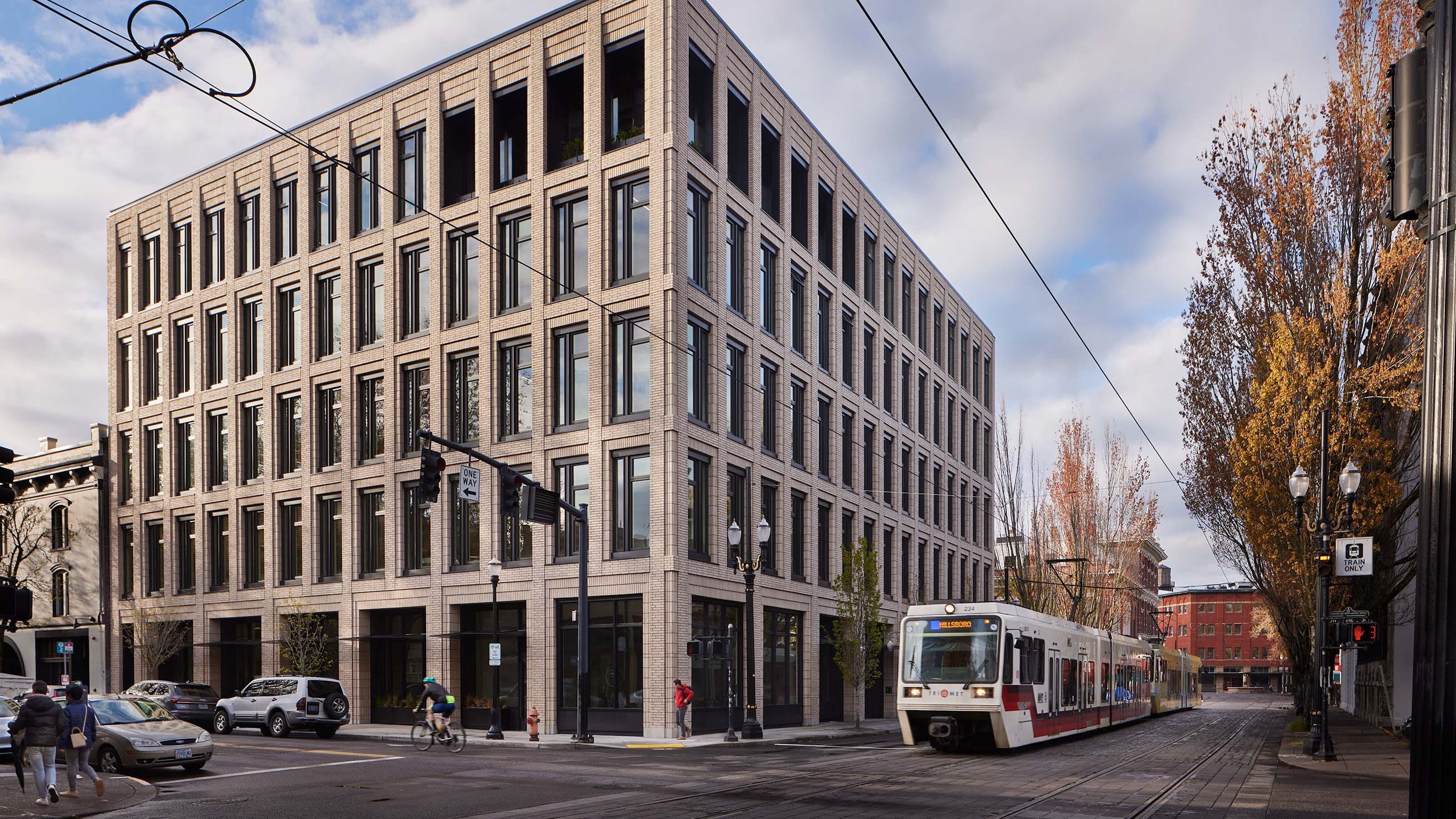
Central Portland is awash in unused office space—10 million vacant square feet of it. Vacancy rates near 40% in places. With so many options on the market, some property owners are getting more aggressive.
In the freshly built, ultra-sustainable PAE Living Building in Old Town, local brokerage Apex Real Estate Partners now offers a bonus of $15 per square foot to any broker who can land a long-term tenant. It’s a deal some in the industry call “unprecedented” and others call “insane.” (Tenant finder’s fees like this are far from standard and typically run $1 to $3 a square foot.)
And so far it hasn’t worked.
Since 2020, when construction wrapped on the PAE Living Building—which houses the corporate headquarters of its namesake engineering firm and offices for Beneficial State Bank on Southwest 1st Avenue at Pine Street—all its retail space and much of its creative office space remains unrented.
Apex CEO Nathan Sasaki, a broker in Portland since the late 1990s, hopes to draw attention to a building that was designed as one of the greenest mixed-use structures in the world.
“Unfortunately, the bonus isn’t a significant needle-mover when you consider that the property’s still vacant, and at other properties, we offer bigger bonuses than that,” Sasaki tells WW. “In Portland, we have some of the best buildings in the world, and we’re giving some very, very attractive bonuses. And our market is so anemic we can’t even lease them.”
Apex and the private partnership that owns PAE Living Building are hardly alone in their desperation. As foreclosure looms for some owners, downtown buildings offer dazzling broker bonuses to draw interest. Golf trips to Bandon Dunes. Weeklong resort stays in Hawaii. Wine tasting in Napa Valley.
Competitive and creative bonuses are nothing new in the unpredictable world of commercial real estate brokerage, where most brokers work entirely on commission. Cynical as they might seem, incentives are an effective way to get brokers to tour buildings with clients, according to Evan Bernstein, broker and partner at Pacific NW Properties.
“There are lots of options on the market right now, and a broker bonus does tend to help get a property on a tour list,” Bernstein writes to WW. “That’s what landlords want—an at-bat.”
But bonuses like the one offered by PAE Living Building, which represent a potential payout of around $40,000 for securing a single long-term tenant, are unprecedented, says Jeff Falconer, CEO of Capacity Commercial Group and a broker in Portland for more than two decades.
“It’s like five times what the high-water mark has been for a broker bonus,” Falconer says.
But some in the industry say incentivizing brokers—ostensibly there to represent tenants, not themselves—is the wrong approach.
“To lease a building because there’s a big commission for the broker—that’s probably not a good reason for the tenant,” says Jim Mark, CEO of Melvin Mark. “The building’s got to fit the tenant, not the other way around.”
Besides, Mark says, “Nothing’s going to work if there’s no demand.”
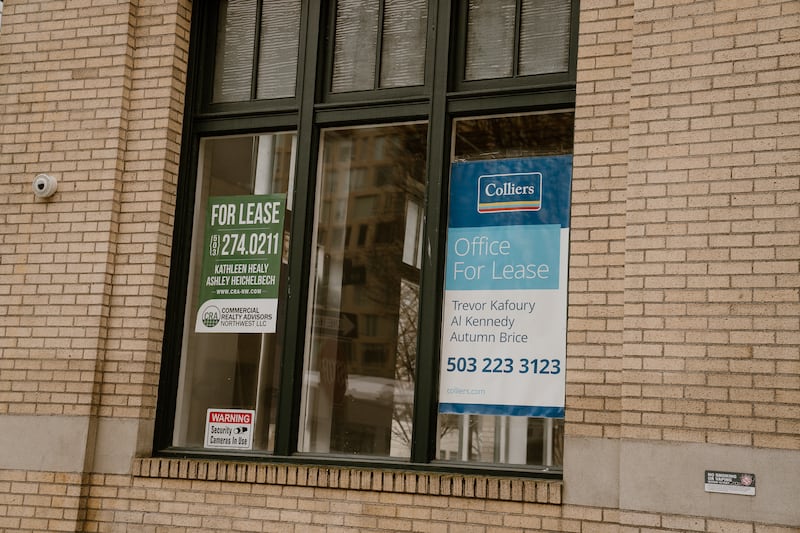
It doesn’t take an economics degree to grasp what’s happening in Portland. Compared with pre-pandemic, far fewer people go downtown—fewer office workers, fewer tourists, fewer Portlanders catching a show or dinner. Fewer dollars. Fewer eyes on the street. In fact, since the pandemic began, more than $2.2 billion in personal income has left Portland, according to Portland consultancy ECOnorthwest.
Some factors aren’t Portland-specific, like the work-from-home shift that hit nationwide. But other wounds were self-inflicted, like a civic tolerance for open-air drug markets and the politically motivated vandalism that left many executives squeamish long after the worst street conditions abated. Dozens of former Portland companies now have addresses in Lake Oswego, Beaverton or other metro-area communities unburdened by Multnomah County’s 3% universal preschool tax or Business Income Tax. (Multnomah County’s Preschool For All tax is a personal income tax that applies to employees, not their employers.) Of the top 25 employers in the tri-county metro area, Multnomah County now claims few that aren’t public agencies or nonprofits.
“If I’m a landlord at PAE, or I own that building, I’m going to do whatever the hell I can to lease it,” says Tom Brenneke, head of Guardian Real Estate Services, which owns the Ladd Tower downtown, the Crane Building in the Pearl, and others. “Would I throw in a trip to Hawaii or this or that for the guy who brings me the deal? Hell, yeah. All day long. I mean, that’s a terrible part of the world. I’m not going to mince words. I own in Old Town. I wish I didn’t own in Old Town.”
Old Town Chinatown, home of the PAE Living Building, is in many ways emblematic of Portland’s problems. A good broker might be wise to focus on the building itself—and its novel rainwater collection system and 500-year mass-timber design—rather than the underlying economic facts.
So how to draw people back downtown and spur real estate in a progressive stronghold like Portland? Ideas include rolling back recent increases to parking fines or staging scheduled “parking holidays.” Real estate professionals continue to assert the city should take the lead and require its own office workers to return to work downtown. (Mayor Keith Wilson has required it, but the largest union of city office workers has fought back.)
An idea to punish owners of vacant storefronts has yet to gain steam. The Portland City Council earlier this year studied the viability of adding a vacancy tax to combat empty storefronts downtown. That study, called for in a budget note, has been conducted, but the plan has been shelved as the council addresses the budget and other priorities.
A number of observers also say the city can do more to facilitate office-to-residential conversions, which would reduce vacant storefronts as well as introduce more people downtown, but which are difficult due to high costs and zoning laws. One buzzy approach proposed by local architect Sebastian Guivernau would employ modular prefab components to convert vacant first-floor storefronts into housing. As first reported in June by the Portland Business Journal, the idea is intended to save time and money in permitting and, with an estimated price tag of $200,000 per unit, would represent affordable workforce housing.
Portland City Councilor Mitch Green called Guivernau’s plan innovative but says it suffers from a noteworthy flaw: It doesn’t put pressure on building owners to lower their rents. And high rents plus exceedingly low demand are why Portland now finds itself with broker bonuses of $15 per square foot, Green says.
To encourage business development, Green thinks members of the council’s left wing—to which he belongs—could find agreement with business leaders and/or moderate councilors on the issue of deregulation—Mamdani-style if not Reaganite. The Democratic Socialist New York City mayor made headlines recently—and earned bipartisan praise— for his OPEN initiative to reduce permitting red tape for small businesses.
“If a small business owner who wants to engage in X, Y and Z economic activity is doing so in good faith, let’s be a good partner with them, rather than throw up roadblocks, because that’s just what our bureaucracy does,” Green says.
The drumbeat of bad news persists, and debate now centers on whether we’ve hit bottom. Last year, Hoffman Construction, Oregon’s largest construction company, with projects around the world, decamped from Fox Tower downtown to Lake Oswego. Last month saw another grim headline as Daimler announced it would close its long-standing Swan Island plant and lay off 375 workers. Now, many are considering for the first time the possibility that the Trail Blazers will leave town.
“It’s mind-numbing to think that we’re here where we are compared to where we were six, seven years ago. It just feels like a bad dream,” Falconer says. “But I guess the good news is, it does feel like a dream. So I’ve got hope that I’m going to wake up and things will be different.”