 Skip to main content
On a sunny July day, a man crouched over some bushes, clippers in hand, at the milepost 10 snow gate on Larch Mountain Road, the highest road managed by Multnomah County. He was clearing away brush from the parking area. He looked like your average Oregon hiker: outdoor clothing, a backpack, gray hair—nondescript. That was the point.
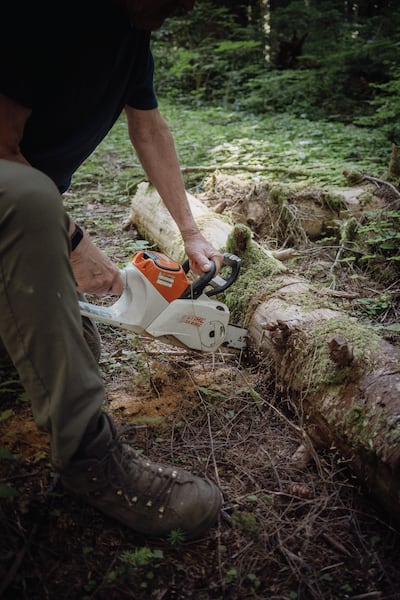
In his trunk was a chain saw.
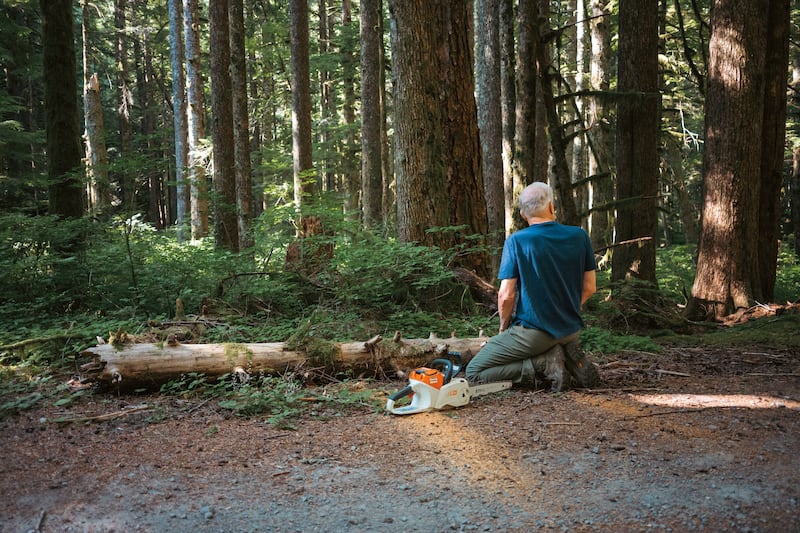
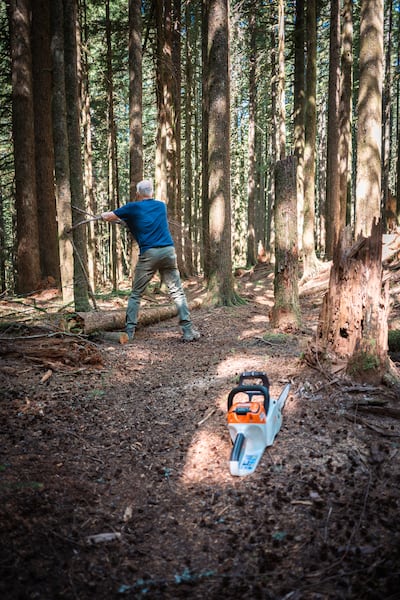
The man, who we’ll call Jed, described himself as a “guerrilla trail keeper.” He was on this mountain above the Columbia River Gorge to show off some of the trails he’d built and maintained over many decades, whether the U.S. Forest Service wanted him to or not.
Jed is 79 years old. There was a time when he could haul a gas-powered chain saw up and down some of the steepest trails in the Gorge. He gave that up years ago. Now, he can’t get far before feeling the effects of a pinched nerve in his back. “It takes away about half the strength in my right leg,” he told me. “Hurts like hell.” Still, he refuses to stop hiking. “I’ll tough it out.”

We drove down Palmer Mill Road, a Forest Service road that is closed to no more than a handful of locals with a long history in the area. Jed is one of a few with access. As we drove, he pointed to a series of nearly invisible trails and explained their history. “That one was made by some mountain bikers,” he said, pointing. None was an official Forest Service trail, yet they looked well maintained.
Jed is part of a small group of avid hikers who have dedicated much of their free time to dozens of trails that aren’t supposed to exist.
The group is small, and some of its members have never met face to face. Often, their familiarity with one another comes not from social interactions but from their trail work idiosyncrasies, like the lettering on some of the many handmade trail markers peppered throughout the forest.
He told me that the median age of his group was about 70 years old. “Some of us are going to age out,” he said. “But there are some young people coming up in this hobby too.”
Jed’s group isn’t alone. Across the U.S., small groups of avid hikers are quietly building and maintaining trails on public lands. In some forests, such as in the Columbia River Gorge, unofficial trails rival official ones in mileage.
Some of them in the past have been elevated to official status by the Forest Service. It’s an effort that requires hurdle-jumping, and in many cases, the Forest Service has relied on trail stewardship organizations to “adopt” them.
Related: Take a hike on the Columbia River Gorge’s unofficial trails.
That formal process is becoming challenging. The Forest Service has been kneecapped by President Trump’s cuts to the public service—soon, the agency won’t even have a Portland office. Wildfires have consumed official trails and restoring them has monopolized the time of volunteers.
The resource crunch is felt especially keenly in a state where some 53% of the terrain is federal land. The ease with which Oregonians can reach jaw-dropping beauty is sometimes referred to as our “second paycheck”—a reward for living here that can’t be quantified on a spreadsheet.
That’s why it matters when miles of unofficial trails, including the many that exist in and around Portland, are threatened. “The Forest Service won’t maintain them,” Jed said. “And the stewardship organizations can’t.”
So, he explained, it was up to them.
The U.S. Forest Service oversees around 160,000 miles of recreational trails nationwide, across 200 million acres. Around 15 million acres are in Oregon. The state is home to roughly 15,000 miles of trails. Managing those trails has proven difficult for the agency.
According to a 2013 U.S. Government Accountability Office report, the Forest Service faced a trail maintenance backlog by 2012 that amounted to $314 million. Only about a third of its trails got “at least some maintenance.” And in the past decade, it hasn’t gotten better.
Toward the end of Joe Biden’s presidency, the Forest Service suspended seasonal hiring for the following year, a move that resulted in the loss of 2,400 employees, many of whom were the backbone of trail maintenance.
In early 2025, the Trump administration, in coordination with the Department of Government Efficiency, fired around 3,400 Forest Service employees. While those firings were litigated in federal courts (and some reversed), the agency was pursuing voluntary workforce reductions through deferred resignations and early retirement programs. Thousands of employees ended up taking those offers.
A recreation planner who assesses trail systems around the country and who managed a large trail system in Oregon agreed to speak to WW on the condition of anonymity. He says of the voluntary reductions at the Forest Service, “Unless you really, really wanted to stick around, there were a lot of incentives to go.”
Trail maintenance, which used to be an impossible job that largely fell on seasonal workers, has only gotten worse. Now, “there are two or three people covering a million acres and 1,000-plus miles of trail. That’s the reality of the agency today.”
The Forest Service has relied on stewardship organizations to maintain trails on public lands for decades. One of them, the Washington Trails Association, initiated its trail maintenance program in the early ’90s. “It was a way to help respond to the gaps that we were seeing with federal agencies at that time,” says Jen Gradisher, WTA’s trail programs co-director. “A lot of cuts were happening around federal funding and staffing.”
When wildfires burn, such as during the Eagle Creek Fire, which scorched large parts of the Gorge in 2017, stewardship organizations are essential in their reopening.
Trailkeepers of Oregon is one of those organizations. John Sparks, editor of the online Oregon Hikers Field Guide, was an early board member of the organization. He recalls that “after the fire, TKO was the main group that came in and did a lot of the trail maintenance.”
Its can only go so far. Many trails remain closed. Sparks recently visited one of them: Munra Point, a popular yet dangerous ascent offering panoramic views of the Columbia River. What used to be a challenging yet straightforward climb became a bushwhack and a scramble through a burn scar. Sparks finished it with only a few scratches and two ticks clinging to his clothes.
Munra Point trail likely won’t get back to its formerly maintained status anytime soon. The stewardship organizations that would normally take on the rebuilding of a trail like that won’t. In fact, they can’t. In order to legally operate on Forest Service land, these organizations have agreed to follow strict protocols. One of them is that they can work only on official trails. This one, despite its former popularity, isn’t.
Trail vigilantes see themselves as the defenders of those unofficial trails. But they’re not shy about working on official trails too. One trail stewardship coordinator told WW he’s run into hundreds of hikers with clippers or saws in hand. He’s seen that trend increase, particularly with the advent of small electric landscaping tools.
Phil has been maintaining official trails in the backcountry for decades. Like Jed, Phil asked that WW not use his real name for fear of reprisal for his unsanctioned trail work.
He knows Jed well and has friends on all sides of the divide, from search and rescue crews to the Forest Service. He’s seen trail maintenance capacity shrink precipitously in the past few years. “Some of the work is really hard to do,” he says. “And it’s just not getting done.”
Phil follows a few rules when maintaining, like the Wilderness Act of 1964, which prohibits motorized equipment in official wilderness areas. Instead of a chain saw, he uses a handsaw. Other rules he flouts. “It’s just absurd,” he says, referring to Title 36 in the Code of Federal Regulations.
The rule prohibits the construction or maintenance of any kind of trail on National Forest System lands without prior authorization. The Forest Service’s own definition of “maintenance” is quite broad. It can refer to as little as “ensuring trails are passable,” meaning a hiker who kicks a branch out of the way could be in violation of the law.
There are criminal sanctions. In 2015, a man was ordered to pay $7,500 in restitution and received five years of probation for building a trail in Tahoe National Forest. But the man’s case was extreme; he caused serious disturbance to the land, including cutting down trees and splitting boulders to clear a route to his mining claim. (The forest manager who spoke to WW said he’d never heard of any ranger issuing a citation for small routine maintenance, even if it is technically against the law.)
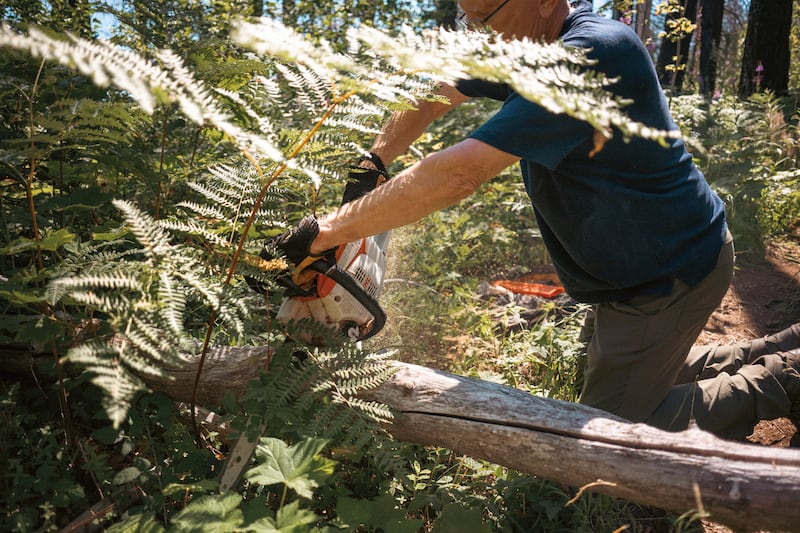
In Idaho, public radio station KUNC reported last month, the Forest Service granted recreation outfitters the right to use chain saws in the Frank Church – River of No Return Wilderness. That decision is already proving controversial.
Kevin Carr, a professor in the Portland area and an avid hiker, doesn’t consider himself a trail vigilante, but he says he tries to do his part. When he moved here several decades ago, he quickly noticed that many of his favorite trails were in desperate need of maintenance.
One day, he ran into two older men while hiking. “One of them carried a sawed-off rake, and the other guy carried a pair of clippers,” he recalls. Today, he keeps clippers and a small saw in his bag whenever he goes hiking.
“I don’t have any training,” he admitted. But, he explained, he saw little risk in doing the small stuff, like spending “10 minutes sweeping and cutting a few bushes back.” Occasionally, Carr will come across serious damage, such as a large tree across the trail. I asked him if he ever tries to “log out” a large downed tree. “No, no,” he said. “I know better than that—that’s dangerous.”
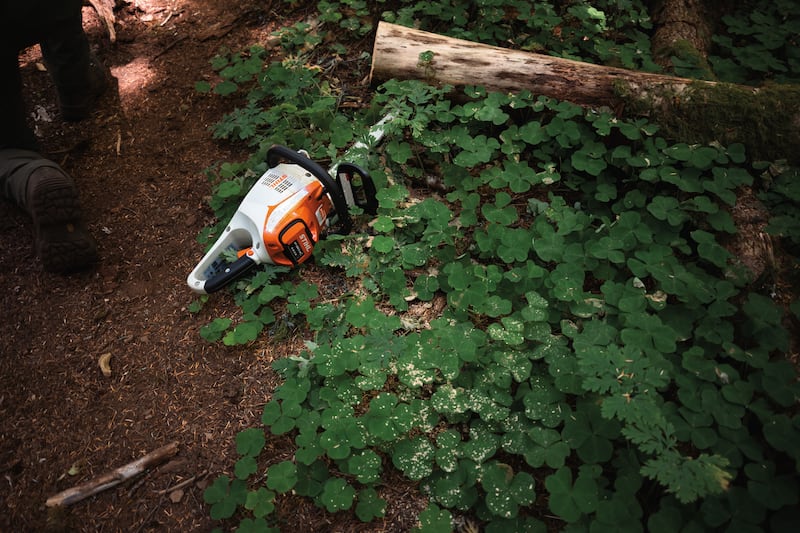
Others aren’t so careful. Some hikers try to clear out large downed trees and, failing in the endeavor, leave them half-cut. That’s a headache for stewardship organizations.
Gradisher of WTA says that “a lot of the rogue maintenance that we see out there is actually stuff we have to go back and fix.” Beyond the nuisance, rogue trail work can put hikers and volunteers in danger. “There’s a lot of liability that goes into the work happening out there,” Gradisher says. “We never encourage rogue trail maintenance. There is a lot of risk involved.”
The recreation planner who spoke anonymously has extensive experience engineering trail systems, but “in my free time I’ve been on the vigilante crews myself.”
He lauds those guerrilla efforts, but there are considerations built into the official building process that may be absent when an unofficial build takes place. “A trail can be built in the best way possible—good grades, up to our specs, better than our specs. But, who knows? It might be bisecting some elk winter range.” He says a rogue trail worker may not know about an endangered bat habitat nearby that could be impacted or a cultural site that is important to Indigenous nations.
Jed says he has no qualms about the stewardship organizations. He just won’t be joining them anytime soon. “I laud the volunteer groups. They do a lot of great work,” he says. “They’re inefficient as hell,” he adds, referring to the rules that they have to abide by. “But I respect what they’re doing. I don’t want to stop them.”
On Aug. 3 of this year, Oregon broke its all-time record for most acres burned in one wildfire season. The Big Grass Fire, which continues to burn in the state’s southeast, recently broke the record for largest single wildfire in the state’s history. The intermittent smoke that has blanketed Portland throughout the summer has largely come from the Grasshopper Fire, currently burning on the eastern slopes of Mount Hood. It’s seared large swaths of a popular recreation area, Badger Creek Wilderness. An on-the-ground assessment has yet to be made, but it is likely to have destroyed a number of popular hiking trails.
A lot of the trail maintenance backlog, Gradisher explains, “is due to the disasters that are happening out there.”
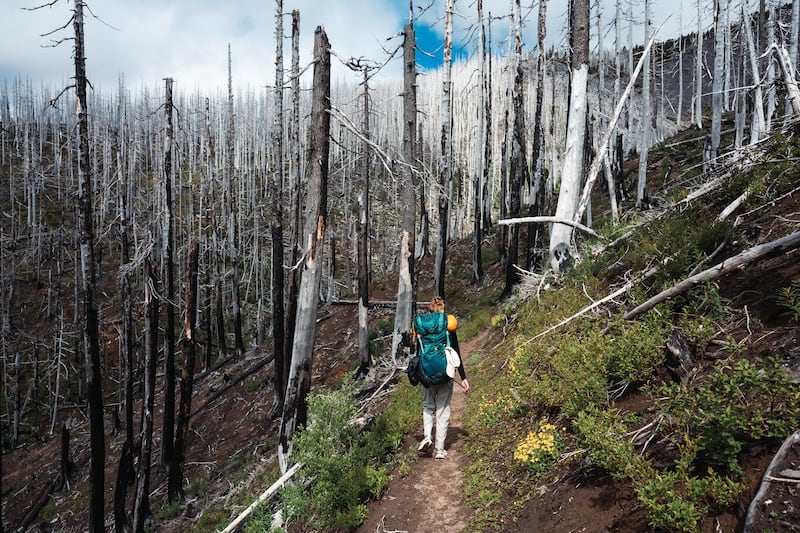
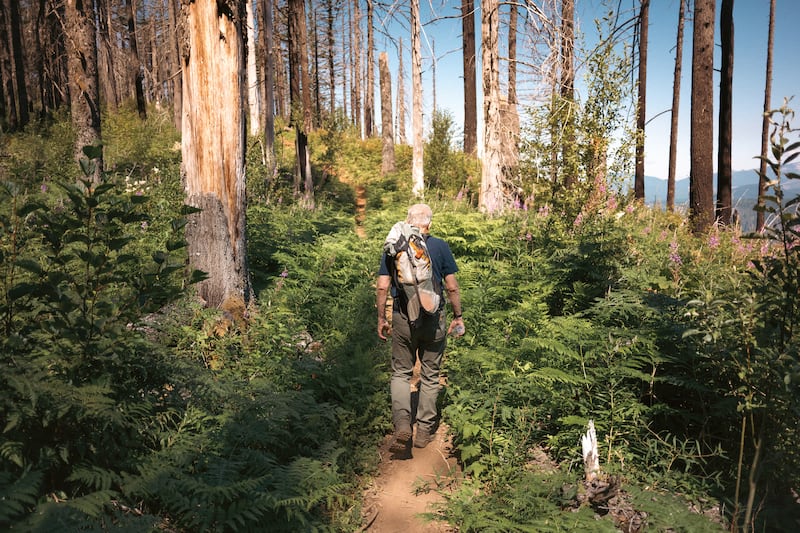
Later on that day in July, Jed and I walked through the aftermath of the Eagle Creek Fire. The canopy had opened up, flooding the understory with light. All sorts of native shrubs were bushy and overgrown. Above them were tall, singed trunks, towering precariously over the trails.
Being out on these trails in a post-burn environment is dangerous, Jed told me. He acknowledged that maintaining the trails can pose an even greater risk. “I don’t want anyone reading this story thinking they can go out and just start taking care of these trails. Don’t do this.”
He also told me he had read the entire Forest Service trail maintenance manual and knew many of the specs by heart, proving it by listing them off as we made our way to an old unofficial trail.
To get there, we weaved in and out of official trails, greeting hikers in sneakers visiting from Portland. One, seeing the chain saw, thanked Jed for the work he was doing. Jed said he gets that response a lot, though it’s not the reason he does it. “I do this to benefit mankind,” he said.
The trail we sought had been burned, and though it had been maintained over the years, it was now nearly wild. He cut back bushes as we went. Jed panted hard, and I carried his chain saw in tow. I asked him if he hid his gear when he saw people approach. “Nope,” he said. “Unless they’re wearing a badge.”
After some more bushwhacking without getting far, we were sweaty and out of breath. “Huh,” he said, looking around. The Columbia glistened 2,000 feet below us. “It may be time to retire this trail.” He paused. “Then again,” he said, smiling, “this sure is fun.”
Joe Riedl is a climate researcher in Portland. He studies the causes and impacts of extreme weather. He writes about land, the environment, and climate in the Pacific Northwest.