Skip to main content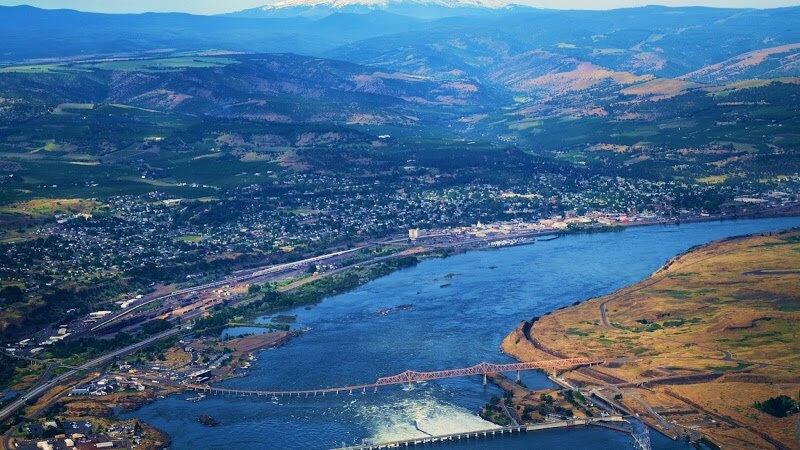
Sometimes, spotting a distinction between opposing political candidates is a challenge, especially on a hot-button issue. But not where data centers are concerned in the race for House District 52, where a longtime local official paints a vastly different picture than his young opponent.
In an WW endorsement interview earlier this week, Republican Scott Hege defended the district’s five Google data centers, the first of which he helped land in the mid-aughts as executive director of the Port of The Dalles.
“The bottom line is, from my standpoint, everything has been good,” says Hege, who’s served as a Wasco County commissioner for 16 years. “If you look, counties in Oregon are basically all struggling. There are 36 counties and I bet that there’s not six that are actually in the black. And Wasco County is one of them and by far, as good as any county in the state.”
Data centers have emerged as the issue of the 2026 election. Polling finds an increasing number of Americans feel negatively about them on multiple fronts—the environment, home energy costs, quality of life, local jobs and taxes.
Oregon has more than 120 data centers with several dozen in development—concentrated in several clusters and split by the Cascade Mountains. In total, they receive around $450 million in property tax breaks from various governments. The state has paused new data center development through next summer with lawmakers eagerly awaiting the recommendations of a governor’s advisory group, due by the end of the year.
Hege’s opponent, Hank Sanders, representing the Democratic Party and the Independent Party of Oregon, said knocking on thousands of doors in the district has clued him in to the centrality of the data center issue. Residents complain of rising water rates, an everpresent hum, a lingering “fog” and other problems, he says.
“They see that the leaders of these companies aren’t just promising, they’re bragging about how AI is going to replace all of our jobs,” he says. “And we don’t have a vision for how we protect our community from the effects of AI.”
Sanders, 25, grew up in Gaston, the son of ZoomCare co-founder Dr. Dave Reynolds and state Sen. Lisa Reynolds (D-West Portland). He spent jut a couple of years in journalism (full disclosure: he hosted WW’s podcast for a year) before pivoting to politics; he worked briefly as a campaign political director for the U.S. Rep. Maxine Dexter and then most recently worked for his mom as a legislative aide until he decided to run for office. He’s lived in District 52 for just a little over a year.
“You can’t tell our neighbors that the 550 million gallons of water going to a corporation and getting dumped back into the Columbia at different temperatures–I actually don’t know what temperatures. They won’t tell us what temperature.”
Hege cuts him off.
“You should go talk to the [Northern Wasco County Public Utilities District] director. You should talk to the Public Works director,” Hege says. “You should get the facts.”
Sanders supports a statewide moratorium on new data center construction. “For me it’s important that we pause, address all these issues, before we build another data center,” Sanders says. But he has not made clear how long he thinks that moratorium should last.
Though opposed to statewide data centers moratoriums, Hege said he supports local bans so long as they’re supported by local communities—a line favored by gubernatorial candidate state Sen. Christine Drazan (R-Canby). Hege said in The Dalles, data centers have helped fund infrastructure projects that have strengthened the water and electric grids, and rates have not increased.
“This is the thing that’s very frustrating from my standpoint,” Hege says. “If you talk to the community leaders in our community—it’s been very good. There’s been, essentially, almost no negative elements. The city has plenty of water and what’s happened is that development has put lots of money into the city and that’s allowed them to enhance the water system...And the water rates haven’t gone up—you can look.”
District 52 covers a vast area around Mt. Hood including all of downtown The Dalles. The seat is being vacated by Republican Rep. Jeff Helfrich, who’s running for Oregon Senate. The Hege-Sanders result could be close; Helfrich won by tight margins in 2022 and 2024, and nonaffiliated voters comprise 38% of the district’s electorate.