 Skip to main content
When Portlanders take to the streets today to oppose President Donald Trump’s deployment of troops to the city and support people targeted by his immigration agents, they’ll be marching in formation with the City Council.
That’s thanks to two votes councilors made, both unanimous, shortly before midnight on Wednesday, Oct. 15.
The first, the “Portland Protection Initiative,” is a resolution denouncing “any attempts to deploy the United States Armed Forces, National Guard…or militarized Federal Immigration Enforcement” in Portland.
That one has few teeth—but the second item, an ordinance, codifies Portland as a sanctuary for immigrants. Councilor Sameer Kanal’s code addition, with its five co-sponsors, “ensures that City resources are not used to enforce federal immigration law.”
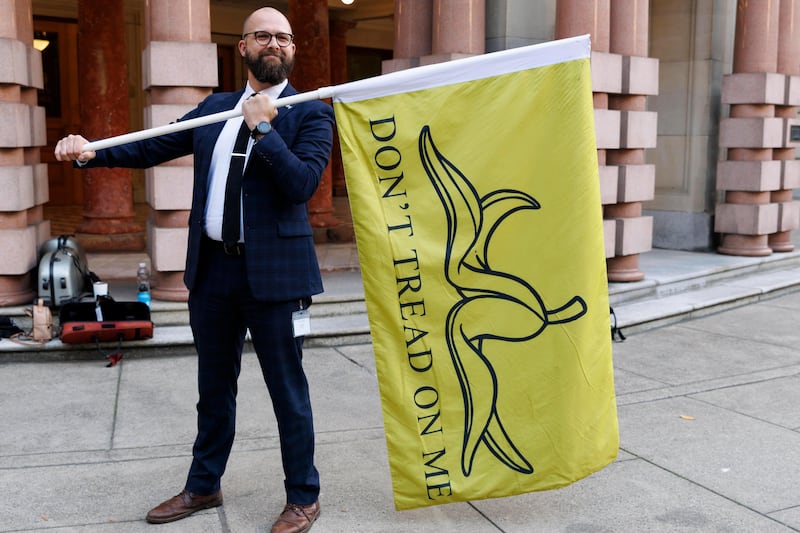
The remote and recent origins of the twin items are not hard to see. In March 2017, in the wreckage of President Trump’s chaotic travel ban, the then five-member City Council enacted Resolution 37277, which declared Portland a “welcoming, sanctuary, and inclusive City.” This included several relevant strictures, notably Police Directive 810.10, prohibiting law enforcement actions based solely on a person’s immigration status.
But since June, Portlanders outraged by federal agents detaining immigrants in courthouse hallways and on job sites have gathered nightly at the U.S. Immigration and Customs Enforcement facility on South Macadam Avenue. They’ve drawn the wrath of the White House, which has summoned the National Guard from three states to quash the resistance, which at the moment largely consists of protesters wearing inflatable animal costumes.
Wednesday night’s item 6, the “Portland Protection” resolution, remains largely a blueprint for what councilors think Mayor Keith Wilson should do in this crisis. Whether he follows the recommendations is up to him.
Modeled on a similar proclamation in Chicago, it urges Wilson to “publicly demand that the President of the United States and relevant federal agencies stand down” from the National Guard deployments threatened by Trump and now being litigated in the 9th U.S. Circuit Court of Appeals, and that it stand down from “militarized crowd-control operations in Portland.”
It also demands an array of administrative actions—which include gathering and disseminating reliable information for immigrants, “uncovering undisclosed federal enforcement and military activity in Portland,” and documenting any actions of federal authorities that may target immigrants.
If Wilson follows the council’s urging, the city, its employees and agents, and those who contract with it would be required to document any “reasonably suspected federal enforcement activity.” In theory, this creates an internal culture of self-reporting of actions directed against immigrants. Just as police are required to report excessive or inappropriate actions of their colleagues, the entire city apparatus would be on notice not to cooperate with federal immigration activities—and to report those who do.
Item 6 is the bark. Item 7, introduced with five sponsors, is the bite.
Unlike the other resolution, this ordinance is binding: “City facilities…may not be used for the purpose of investigating, detecting, or apprehending a person …[to enforce] federal immigration laws.” It responds to Trump’s “expansion of civil immigration enforcement to historical levels and detention practices that undermine community trust.” The code mentions lack of due process, masked agents, unexplained detentions, and so on—the full smorgasbord of daily and nightly life at 4310 SW Macadam Ave.
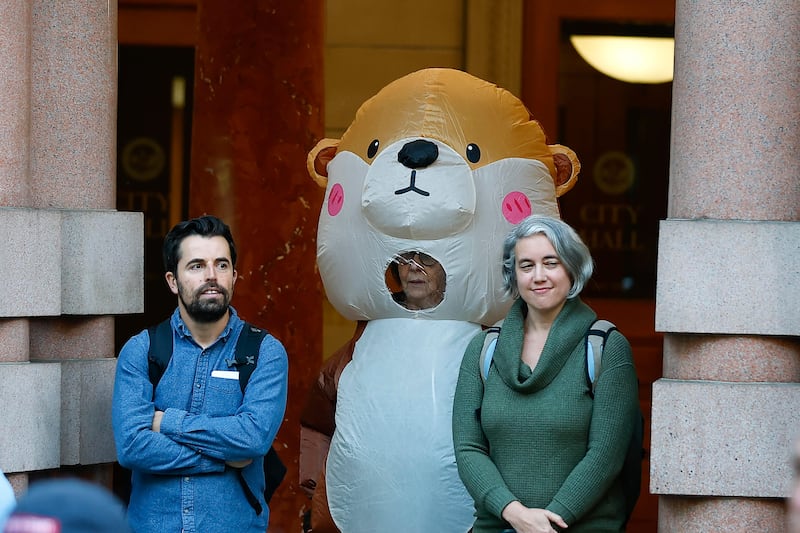
Some 70 people signed up to testify for or against enactment of the two items. All but a handful supported passage.
One woman gestured toward the beautifully appointed wooden council chamber and referred to its marble structure, and asked rhetorically whether there was a point to a fancy City Hall, if the city could not protect its own inhabitants. Another was surprised at the speed at which the current crisis (of immigration and its style of federal enforcement) had arrived.
And several ominous notes were sounded as well. A man urged the City Council to live up to the requirements of a sanctuary city because, as he put it, “the president of the United States has started a civil war.” And another man warned that if the City Council “did not take the fight to the feds,” others would: “We will do it in the streets.”
A handful of people opposed the resolution, largely echoing the rhetoric of the president. “Portland isn’t fine,” said one woman who opposed passage. She rejected “illegals” in Portland who engage in drug dealing and human trafficking, and who don’t pay taxes.
Councilors moved swiftly to approve both items, speaking only briefly—perhaps because they differed little. Councilor Angelita Morillo advocated for an emergency vote at once, saying that codification would “hit hard.” Councilor Zimmerman observed that there was “nothing honorable about what is going on in the federal government,” and that while deploying green frogs against federal overreach was no joking matter, he was nevertheless proud of how Portlanders have “shown up in the moment.”
Questions remain, however. Nothing in the resolution urging Wilson to confront the federal government is binding. And Councilor Dan Ryan raised a question about what the training required by the new code would cost. Whether this generates a new city bureaucracy remains to be seen.
But this much is clear: To the degree that it can, Portland City Council put its marker down on behalf of immigrants, and against the feds.
Clarification: This story has been updated to reflect that City Council approved a resolution and an ordinance, not two ordinances.