Skip to main content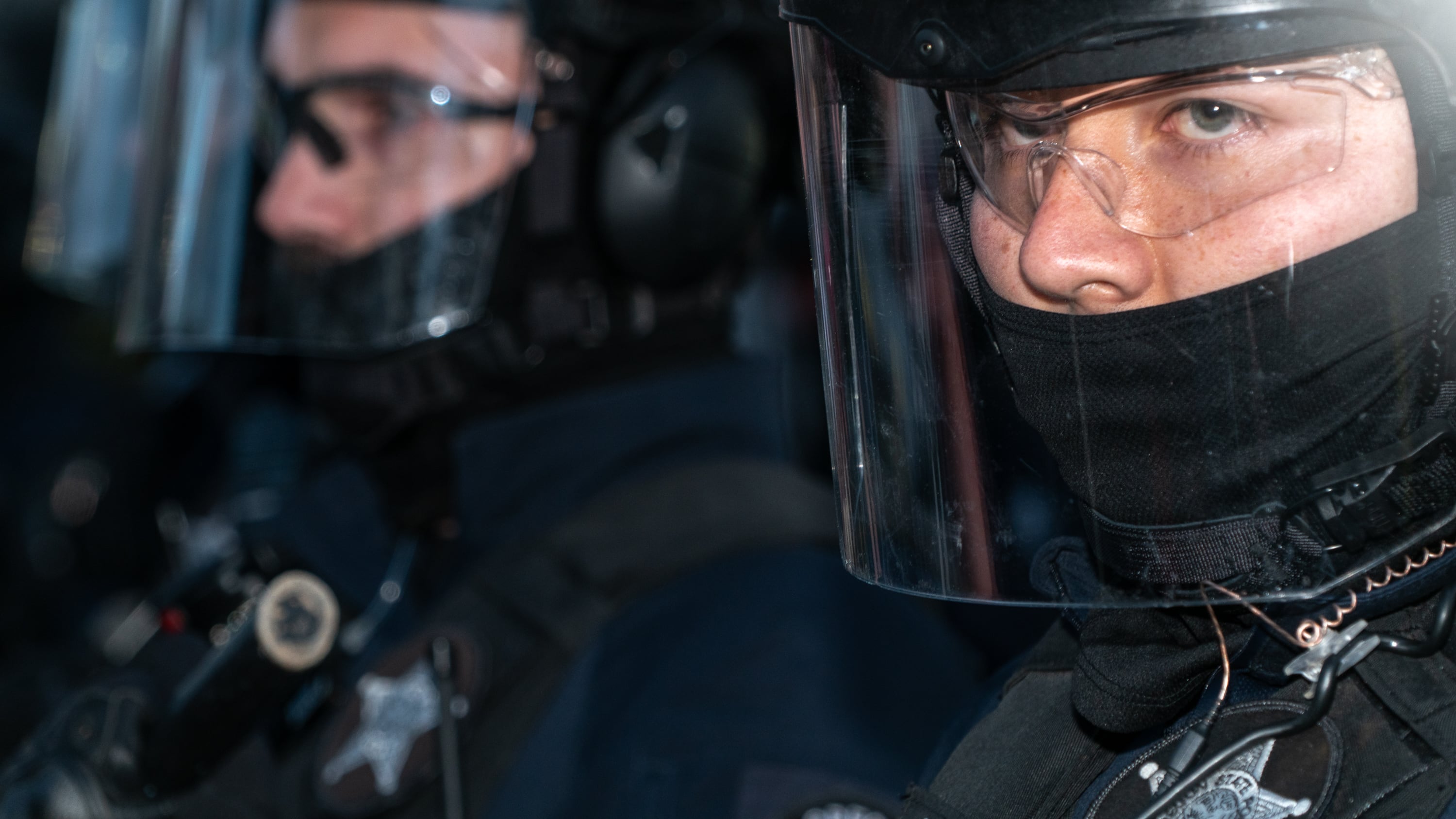
A policy that would ban law enforcement officers from wearing face coverings in Portland, and require that Portland police officers verify the identity of purported law enforcement officials who don’t display identification, has been stuck in the City Council’s policymaking process since last fall.
The policy as currently written would apply to Portland police officers, but also any other law enforcement officials present in Portland, including federal agents—though public safety leaders have said it would be unworkable for the city to enforce such rules on federal officers.
A dispute between the policy’s champion, Councilor Sameer Kanal, and the Portland Police Association, the union that represents sworn Portland police officers, lies at the center of the debate.
The union says the changes proposed in the policy—including that Portland police may request the agency, title and badge number of people who claim to be law enforcement officers—must be bargained with the union before the policy is passed. That’s according to state law, union president Aaron Schmautz says.
Kanal says that’s wrong—and that bargaining can happen after the policy is passed and need not happen before.
In recent weeks, the disagreement has taken on new life as Kanal worked to send the ordinance to the full council. He’s said the policy is an important way to ensure that Portlanders can identify law enforcement officials, especially amid increased U.S. Immigration and Customs Enforcement activity across the city.
The Portland Police Bureau declined to comment on the issue of bargaining. Spokesman Mike Benner said the bureau “does not comment on matters related to labor negotiations or bargaining.”
Schmautz, however, has been vocal about the union’s stance. As he stated to the Community and Public Safety Committee at a March 18 meeting, the union believes the passage of such a policy without first negotiating the changes sought would be illegal.
“Adding language to the ordinance saying that bargaining can occur afterwards is insufficient and is in fact unlawful,” Schmautz told the committee. “Bargaining must occur before an ordinance passes. Attempting to write city law while ignoring state law will create chaos.”
Officials with the Portland Police Bureau and the city’s deputy city administrator of public safety, Bob Cozzie, have previously said they’re concerned about portions of Kanal’s policy that go above and beyond the Law Enforcement Accountability and Visibility Act, passed by the Oregon Legislature in February 2026, which forbids all police officers from wearing face coverings, requires that police officers clearly display their name and agency on their uniform, and requires that all law enforcement agencies in the state have a “public policy regarding the use of facial coverings that generally prohibits masking.”
At particular issue for the bureau seems to be a piece of Kanal’s policy that requires Portland police officers to intervene if any other law enforcement officer fails to abide by the rules. Assistant Police Chief Brian Hughes said during the March 18 meeting that the specific provision “creates potential uncertainty when Portland officers are working with regional and local partners under a different local standard.”
Cozzie also opined during the March committee meeting that despite Kanal’s claims that the costs of enforcing such a policy would be minimal, they would in fact fall between $51,000 to $500,000. He also said the Public Safety Service Area—a portion of the city administration—hadn’t been involved enough in the policy’s creation.
In a statement, Kanal disputed Cozzie’s characterization of a lack of dialogue. “We’ve listened to and incorporated feedback from community groups, from folks inside the city—such as the Public Safety Service Area, the Portland Police Bureau, and the Bureau of Human Resources—and from Portlanders broadly," Kanal said. “We’ve also worked extensively with city attorneys to ensure that the policy we’re putting forward aligns with the new state law and labor laws and can withstand the legal challenges that are inevitable when pushing back against an authoritarian government.”
His office did not respond to a question whether the City Attorney’s Office had provided Kanal with a legal opinion on the specific bargaining question.
Schmautz repeatedly told WW that the union’s problem with the ordinance is not the substance of the ordinance itself, but the fact that Kanal is trying to pass it without the city first bargaining with the union.
“State law and our contract requires specific order of operations to bargain in good faith,” Schmautz says. “[Kanal] isn’t following it and has no authority to bargain on behalf of the city. As a result, the substance is moot.”
Since he took office in January 2025, Kanal has routinely tangled with the police union over various policing policies he either brought forth or supported, and now he says the union’s argument that the changes must be bargained before the ordinance is passed is misguided.
“The idea that the council cannot legislate unless something is bargained in advance does not logically make sense, as the council cannot direct our bargaining team on legislation that hasn’t been voted on and passed,” Kanal says. “As a result, the PPA’s position would effectively mean that no policy proposals that could impact collective bargaining units can be initiated by the City Council.”
Kanal said during an April 15 Committee of the Whole meeting that four of his colleagues had bypassed a committee vote by agreeing to send the policy to the full council on April 30. (Four councilors can send a policy to the full council even without a committee vote.)
Should the policy pass and the union take the position that it violates bargaining law, the union could file an unfair labor practice complaint under the National Labor Relations Act. When asked if the union would consider doing so, Schmautz evaded the question and instead wrote: “If the city says it is pro labor, will the city choose to knowingly violate labor law?”
Correction: A previous version of this story stated that Kanal was one of the four signatories to send the ordinance to the full council without a committee vote. That’s incorrect. The four councilors were Candace Avalos, Mitch Green, Tiffany Koyama Lane and Angelita Morillo. WW regrets the error.