Skip to main content
A new report shows police response times to high-priority calls in every part of the city are well over the Portland Police Bureau’s strategic target of responding to 75% of such calls in under 10 minutes.
Layla Decker, a physics and music student at the University of Portland, analyzed some 50,000 high-priority calls from 2025. Decker found that the average response time in every single census tract in the city (census tracts are designed by the Census Bureau to approximate neighborhoods and group residents with relatively similar characteristics) is several minutes over PPB’s goal.
According to Police Bureau data, Decker tells WW, police’s average response time across the city for high-priority calls was 21 minutes.
To be sure, it’s well known that PPB’s response times are well over what they should be. The bureau’s annual report says the average response time for a high-priority call citywide was 19.5 minutes in 2025—slightly lower than the average Decker found in her analysis. (The bureau declined to comment on Decker’s report specifically.)
But Decker’s census tract data—which doesn’t include 2026 calls—offers a detailed look at where in the city high-priority calls are responded to the fastest, and where such calls are responded to the slowest.
The bureau says it gets a high-priority call—defined as “danger to life, serious injury, or urgent incidents where immediate response is needed”—about once every nine minutes.
The shortest response times, most of which are on the eastside, are around 12 to 14 minutes. The highest times are on the extreme western and eastern edges of the city. The outer westside of the city has the greatest concentration of response times between 28 and 35 minutes, but the other highest times are sprinkled throughout the city. Tracts in the Beaumont–Wilshire, Mount Tabor, Eastmoreland, and Lents neighborhoods all have average times between 27 and 29 minutes. Such tracts are often adjacent to tracts with times as low as 14 to 18 minutes.
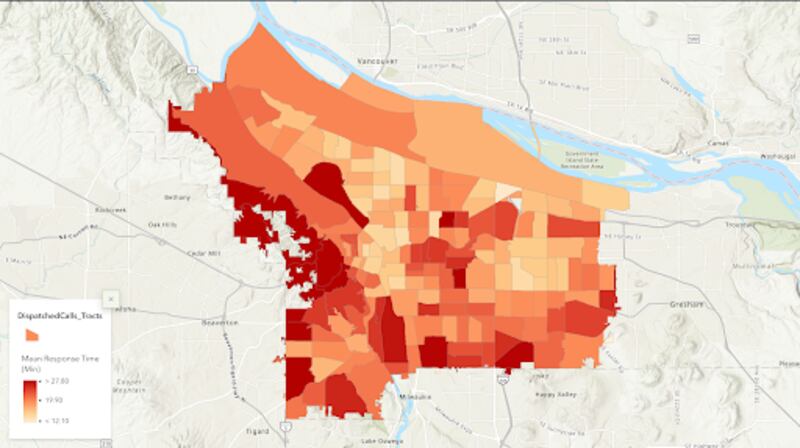
Decker doesn’t draw conclusions about what explains such great disparities among census tracts, but she says geography is a likely candidate for some areas, “with slower service concentrated in outer areas of Portland.” She specifically highlights the Portland’s West Hills as a possible reason for longer response times on the outer westside.
One tract on the eastern edge of the Centennial neighborhood has an average response time of over 40 minutes.
Police Bureau spokesman Sgt. Kevin Allen declined to comment on the report itself, but said the bureau was doing the best it could with limited resources.
“Sometimes we will make the decision to focus our resources on a particular problem, even though that may mean that call response times will be affected,” Allen said in a statement. “That’s a trade-off we are willing to make because we have to constantly distribute and redistribute our limited resources in ways that will have the biggest impact on crime and the fear of crime.”
Decker says her analysis would suggest that there’s little correlation between response times and income and race. “These findings suggest that response time variation in Portland is driven more by systemwide constraints than by localized demand, traffic, or demographic factors,” the report says. But she wrote that her findings are “limited to census tract-level analysis and may not capture more localized or intersectional forms of inequality.”
Decker says her research, which she conducted as part of a class on geographic information systems, stemmed from the current public discourse on response times and public safety in Portland.
Indeed, the Portland City Council just passed a bruising budget for fiscal year 2026–27 that makes significant cuts to the police and fire bureaus. (There were no cuts to actual armed officers, but the bureau’s unarmed response program is slated to be gutted as a result of the budget.)
Meanwhile, a ballot initiative aimed for the November ballot would require that the city hire some 400 additional police officers using 25% of the Portland Clean Energy Fund, the city’s climate tax.
The initiative is backed by the police and firefighters unions, as well as prominent business figures like auto dealer Jeff Swickard. The Community Safety Coalition, the political action committee propping up the initiative, has raised just under $1.1 million. The Portland Police Association, the union for sworn police officers, has contributed nearly $550,000 to the PAC. The union gave $300,000 alone on June 15, its biggest lump sum yet, as the race to collect 40,437 signatures by July 6 intensifies.
Decker’s full report, including more detailed findings and interactive maps, can be found here.
The Portland Police Bureau has hired 38 officers so far this year, bringing the bureau’s total sworn members to 809, 572 of whom are officers. That’s about 20 members more than this time last year, Allen tells WW.