Skip to main content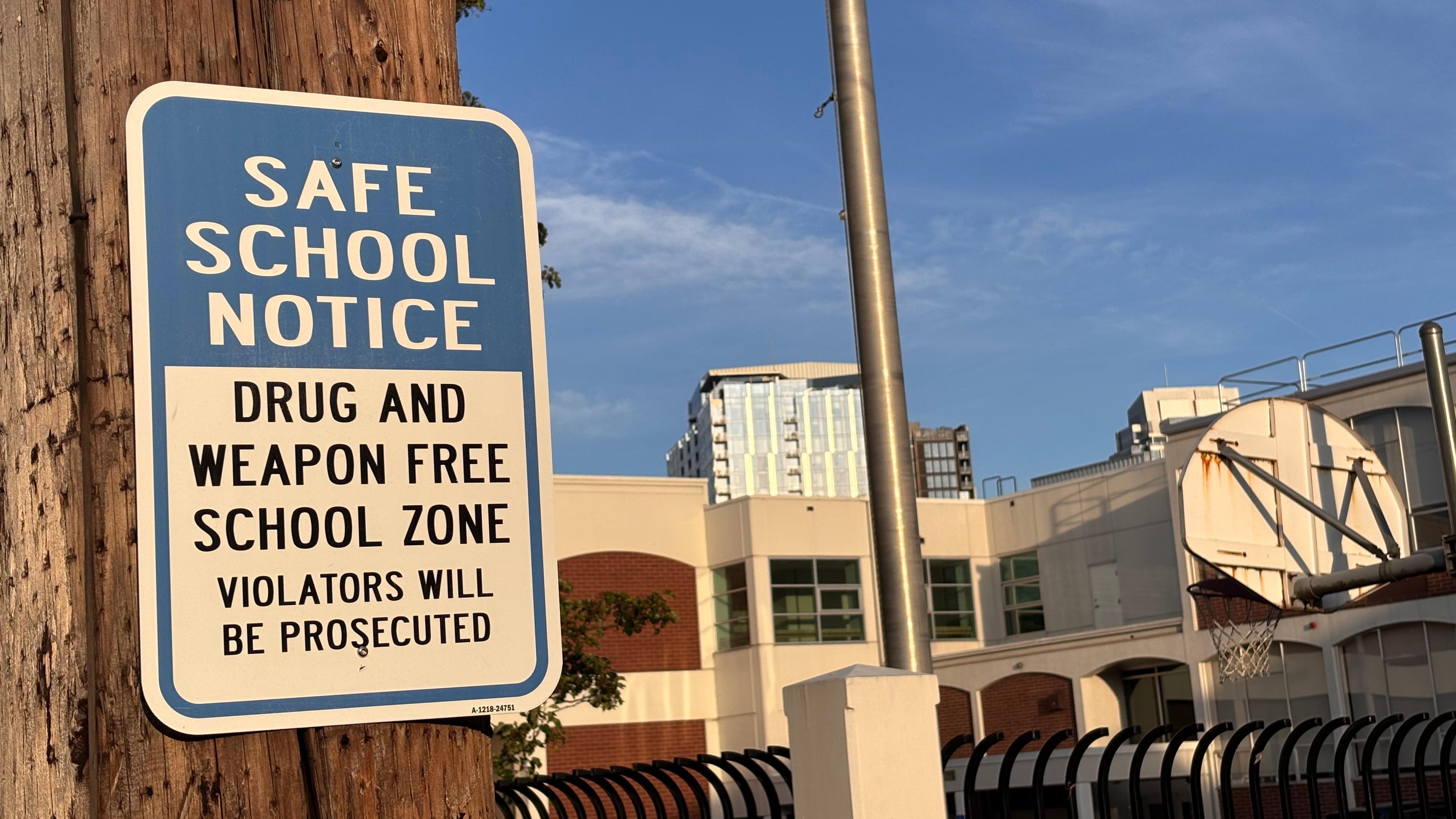
A proposed ordinance from two Multnomah County commissioners to prohibit mobile syringe service programs from operating within 1,000 feet of K–12 school buildings faced some early scrutiny from advocates and the county chair at a Thursday morning work session.
Needle and syringe distribution near schools has been a years-long issue across Multnomah County, with parents expressing frustration about the conditions children encounter on their walks to school. But it leapt into the public consciousness last year largely due to neighborhood advocates in the Northwest District whose complaints about an SSP near Cathedral School got the attention of TV stations and Republican lawmakers.
After state legislation that would have implemented an SSP-free zone around schools failed in the short session, commissioners Julia Brim-Edwards and Meghan Moyer co-sponsored the ordinance, calling it a way to provide relief to constituents as the county works to balance public health with safety. (SSPs contribute to public health by limiting disease transmission through used hypodermic devices.)
Under their ordinance, any mobile SSP in violation could receive “a letter of education to ensure compliance.” The ordinance outlines that the county would issue a notice of violation specifying details about the incident and any corrective actions, and that the county might file in circuit court for injunctive relief. (The draft also indicates a mobile SSP could operate in the boundary “when a public body has expressly approved” such an operation.)
On Thursday, many community advocates for safe routes to school thanked the county for taking up the issue. But most who spoke objected that the enforcement mechanisms, as they stood, were too weak.
Michelle Milla, co-founder of Stadiumhood, a subcommittee of the Northwest District Association, said she was concerned the county had not considered the infrastructure it would need to enforce the ordinance properly, including who would be in charge of processing complaints or what a timeline would look like. Milla also noted it was unclear what public bodies would be able to approve exceptions to the rule, and whether those exceptions would be approved through a public process.
Milla added, “A boundary is only enforceable if you know who is operating and where. Right now the ordinance does not require providers to identify themselves, register their locations, or disclose distribution volumes in any public body. Registration is what makes the buffer enforcement doable in practice.”
Brim-Edwards and Moyer both emphasized that the county has limitations on what it can do about prohibiting mobile SSPs within certain boundaries. The state is responsible for licensing and regulating healthcare practices, Moyer said, adding that the ordinance would come with a revocation clause that will ensure the county does not overlap or duplicate with eventual state policy. (Such a clause is not listed thus far in writing.)
“We have different tools than the state, and so we relied in some ways on the tools that the county attorney told us we had,” Brim-Edwards said. She added a hope that lawmakers “recognize that they actually have more tools than the county has in terms of enforcement.” (Several state legislators indicated in public comments that they saw the work at the county as a temporary measure to address immediate safety concerns while the state works toward a long-term solution.)
The issue of jurisdiction also came up, as some community members and commissioners flagged the ordinance’s exclusion of preschools or childcare facilities, asking why it would apply only to K-12 schools. (Senate Bill 1573, the unsuccessful statewide legislation, extended the 1,000-foot boundaries to childcare facilities.)
Antonia Lawler, a mom to a preschooler, said there are many preschools in the 1,000-foot boundary of a mobile SSP in the Hollywood neighborhood. One of them, Lawler said, had established a “morning syringe cleanup” before class could begin.
The answer was that the county was once again limited in what it can do. “I didn’t want preschools in there…because we don’t always know where they are. It would be incredibly difficult to actually enforce that,” Moyer said, noting the state is in charge of licensing and the county has no sense of where all preschool sites are. “When you regulate something, it has to be something that is reasonable to implement.”
Meanwhile, County Chair Jessica Vega Pederson had her own long list of questions around how the county would afford to implement a regulatory apparatus. Health department leaders estimated that enforcement would cost between $133,000 and $435,000 a year, though those were very preliminary figures that did not, for example, account for creating a registry.
Vega Pederson rattled off a number of her concerns, including what areas of the county SSPs would be able to operate in if they were restricted under the proposed boundaries, who had to witness violations for them to be considered legitimate, and how the county would fund its regulatory arm. (Brim-Edwards had previously said that she and Moyer had laid out a budget amendment that would increase the cost of tobacco retailers’ licenses and increase fines for selling tobacco to minors.)
Vega Pederson and Brim-Edwards briefly butted heads as the questions continued, disagreeing over whether commissioners’ offices had adequately responded to questions Vega Pederson had raised. Discussion will continue May 21, when the ordinance is scheduled for a first reading.
“I take very seriously what this board puts forward as a proposal,” Vega Pederson said in defense of her questions. “I want to make sure that we understand what we’re taking on in terms of what it takes to implement this and implement in the right way that it’s going to have a meaningful impact on our community. This is really what this conversation is about.”
Portland People’s Outreach Project, a major SSP in the metro that community advocates have said operates regularly within 1,000 feet of school zones, did not respond to WW’s request for comment on the draft ordinance.
Honora Englander, an addiction medicine professor at Oregon Health and Science University, shared a message with WW she’d sent to Brim-Edward’s office opposing the boundaries by schools. Englander wrote that the proposal would worsen litter near schools and that SSPs have not been shown to increase crime or disorder in surrounding neighborhoods.
Englander also wrote of her own implementation concerns with the ordinance, noting that schools are widespread and that SSPs would be forced to use their limited resources on constant remapping to avoid potential violations instead of concentrating on disease prevention.
“In some areas, limiting where [mobile SSPs] can operate functions as a de facto ban,” she wrote. “Rather than improving safety, these constraints would push people further from services, increase unsafe syringe disposal, and undermine the very public order the bill seeks to promote.”