Skip to main content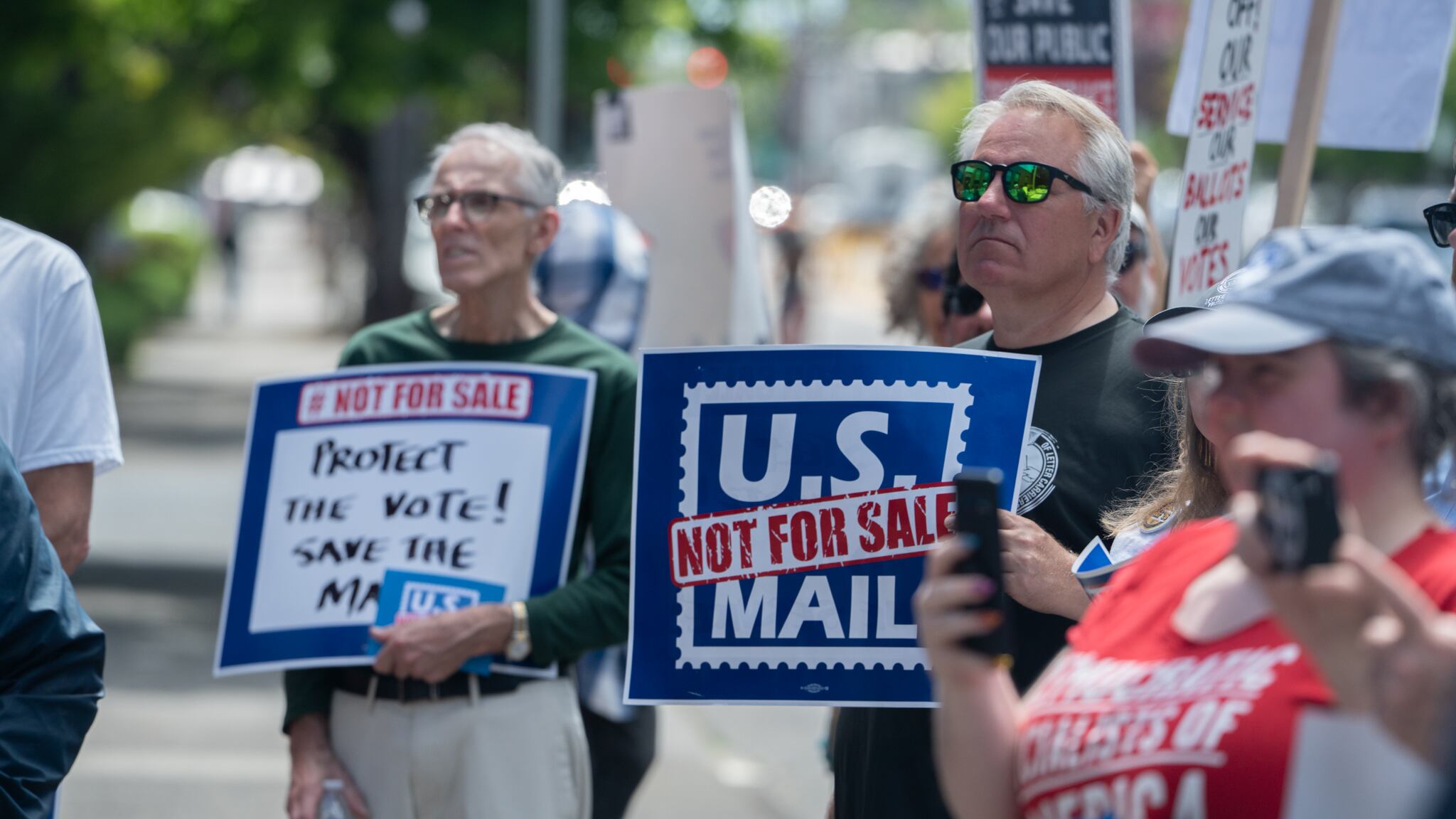
With less than 90 days until the midterm election, a federal judge this week dealt another blow to Donald Trump’s effort to undermine mail-in voting in Oregon and other states.
On Tuesday, U.S. District Judge Indira Talwani issued a preliminary injunction that upholds and expands an earlier order blocking an attempted overhaul of U.S. elections by the Trump administration. The lawsuit was filed in March by the League of Women Voters of Massachusetts and joined by a coalition of voting rights groups and Democratic policymakers, including Oregon Attorney General Dan Rayfield.
Talwani’s injunction prevents the U.S. Postal Service from implementing provisions of a 2026 executive order that restricts voting by mail. EO 14399, Ensuring Citizenship Verification and Integrity in Federal Elections, attempts to use USPS to collect lists of mail-in or absentee voters and issue ballots only to those preauthorized by the federal government.
In April, Oregon became one of 22 states to join the lawsuit.
In an interview with WW, Oregon Secretary of State Tobias Read praised the ruling, saying every eligible Oregonian should be allowed to vote in a convenient manner.
“I think this administration is pretty desperate to avoid the accountability that an election represents,” Read says. “We’ve beaten them in court repeatedly, as have many other states. We’re prepared to do that as many times as it takes because we’re defending the Constitution and the right of Oregon to determine how we run elections.”
The U.S. Constitution designates authority over the Postal Service to the federal government, and the power to conduct elections to the states, though Congress may pass laws that regulate federal elections. Since the 1980s, Congress has approved legislation intended to support voting by mail and increase citizen participation in voting.
Trump has falsely claimed widespread voter fraud cost him the 2020 election. In a post on Truth Social in August 2025, he wrote he would “lead a movement to get rid of MAIL-IN BALLOTS.”
“ELECTIONS CAN NEVER BE HONEST WITH MAIL IN BALLOTS/VOTING, and everybody, IN PARTICULAR THE DEMOCRATS, KNOWS THIS.”
This June, Judge Talwani blocked EO 14399, preventing the federal government from requiring states to turn over voter rolls. That decision was appealed to the U.S. Supreme Court, which has yet to rule on the matter.
Tuesday’s decision strikes down proposed USPS administrative rules that would have restricted mail-in voting.
“Where the EO is presently causing confusion and threatening both increasing chaos and an erosion of trust in our democracy, the court finds that enfranchisement heavily outweighs the executive’s attempt to unconstitutionally insert itself into the domain of election regulation,” Talwani wrote in Tuesday’s decision.
The lawsuit is one of 74 against the Trump administration joined or filed by Rayfield, according to his office’s federal litigation tracker. Several other pending cases would also affect Oregon’s vote-by-mail system, according to the Oregon Secretary of State’s Office.
“The U.S. Postal Service delivers the mail,” Rayfield wrote when he joined the lawsuit in April. “President Trump wants to turn letter carriers into election gatekeepers—and that’s not a role the Postal Service was built for, not a power the federal government has, and not something Oregon will accept.”
Oregon was a pioneer in voting by mail, a method meant to increase turnout, reduce staff time and—compared with voting in person at designated polling places—offer voters more time to make informed decisions.
Oregonians have voted this way since the 1980s when the practice was restricted to local then statewide elections. In 1998, a ballot measure made Oregon the first state to conduct presidential elections entirely by mail. And since 2000, all primary and general elections have been held in this format.