Skip to main content
State Sen. Janeen Sollman (D-Hillsboro) says she knocked on 2,700 doors in her district in the lead-up to last month’s primary election. Overwhelmingly, constituents wanted to talk about one thing.
It wasn’t her opposition to Senate Bill 916 (which provides unemployment checks to striking public workers), even though that vote had angered some of the state’s most powerful labor unions. No voter asked why she supported Senate Bill 1555 (a failed plan to reconfigure state education funding), which the teachers union considered a betrayal.
No, it was another issue that had left some of her longtime supporters uneasy.
“They said, ‘Why have you changed, Janeen?’” Sollman tells Willamette Week. “‘Why do you love data centers?’”
They’re the country’s hottest political flash point. Drawing fears over affordability, environmental and health impacts, and AI-fueled job loss, data centers have emerged as the newest third rail in American politics. Sollman learned this the hard way. She lost her Senate reelection bid to an upstart primary challenge by educator Myrna Muñoz, funded by progressive interest groups she’d alienated. They paid to pelt voters with ads focused on data centers in a widely watched contest—a rare instance of an Oregon incumbent facing a serious intraparty challenge.
Some in Oregon think if the data center issue can be used to take down as powerful a lawmaker as Sollman, in as tech-friendly a place as the Silicon Forest, it could shape a lot of races in November, including the race for governor.
Says Oregon political consultant Doug Moore: “Thousands of candidates are tied to this issue.”
Considered ground zero of Oregon’s data center boom, Hillsboro has cheap power, a generous incentive framework, and easy access to transpacific fiber-optic tie-ins and the nearby tech sector. The city’s 21 active data center sites also stand on some of the continent’s premier farmland, and the land use fight between tech and ag stretches back decades. But amid nationwide backlash, there’s increasing concern Oregon’s fifth-largest city isn’t getting a great return on the approximately $85 million a year in tax breaks it gives data centers.

Sollman waded into the fight by sponsoring Senate Bill 1586, aka the Oregon JOBS Act. It would have, among other things, expanded Portland’s urban growth boundary by 1,700 acres in the Hillsboro area (an amendment later whittled this down to 373 acres of industrial land) and allowed construction of some new—albeit not standalone—data centers.
Sollman ultimately withdrew SB 1586, but the damage had been done. Muñoz seized on the incumbent’s initial support for the bill and pressed hard on the data center issue.
“I have heard from other people running across the state of Oregon, and data centers is a main issue,” Muñoz tells WW. “I understand there’s even some Republicans running against data centers, so it’s a pretty important topic for all Oregonians. It goes across parties because none of us really want to be poisoned or left without electricity or with horrible water. None of us want that.”
Spurred by fed-up, online-activated citizens, local governments around the state are now exploring ways to roll back incentives. Residents of Prineville and Boardman—with long-standing relationships with data centers—have pushed back and demanded new restrictions.
Data center unrest has turned up in inner Portland, rural La Pine and—of all places—Hillsboro, birthplace of Oregon’s tech industry, where, on two occasions in the past two weeks, dozens of angry residents crowded City Hall to demand a change in Hillsboro’s relationship with data centers. The lively display of public participation suggests Muñoz’s victory might not be a fluke.
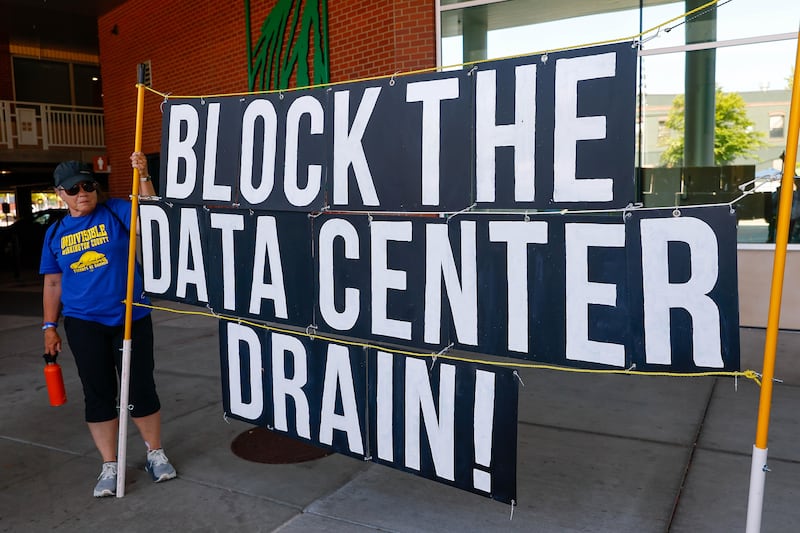
Until very recently, Sollman might have seemed an unlikely target for an environmental backlash.
Last year, she co-sponsored House Bill 3546, which would have tried to hold data centers accountable for their energy usage. Sollman also co-sponsored a producer responsibility bill to reduce plastics that was among the country’s most aggressive, and she led the way to protect and update Oregon’s first-in-the-nation Bottle Bill.
As chair of the Senate Energy and Environment Committee, Sollman earned high marks from the influential Oregon League of Conservation Voters with Conservation Scorecard ratings of 100% in 2021–22, 86% in 2023–24, and 91% in 2025. She was OLCV’s “Unsung Hero” of 2023 for her “determination” and work behind the scenes to advance the league’s legislative priorities.
Then, this year, it spent $50,000 against her.
“While Sen. Sollman did great things on reducing plastics, she was too often a roadblock on the significant climate and clean energy progress we need now,” OLCV executive director Lindsey Scholten writes to WW, citing SB 1586 as an example.
“Myrna came out in strong opposition to this bill, testifying in opposition. She really spoke for her community in pushing back against more data centers taking over critical farmland. She is the leader we can count on to prioritize Oregonians’ environmental values over corporate interests.”
Throughout the heated Senate District 15 primary, Muñoz made data centers—her opposition to them and Sollman’s alleged support (which Sollman denies)—front and center in speeches, glossy mailers, and online ads.
“Once a data center is developed, nothing else can be done on that land. It’s poisoned now,” Muñoz says in one ad shown a half-million times in the five weeks before the election. “I will help us organize against data centers here. That’s why I decided to run.”
Days before the election, the Muñoz campaign ran an ad featuring progressive icon Jane Fonda.
“Myrna’s race boils down to a high-stakes local battle over data center expansion and the environmental impacts of these water- and power-hungry complexes,” Fonda proclaimed in the ad viewed more than 50,000 times.
In the end, Muñoz won 51.7% to Sollman’s 46.1%. She faces Republican Harold Hutchison in the general election. (Given the district’s predominantly Democratic voter registration, it won’t be close.)
Last month’s primary saw the elevation of a number of candidates who’d made opposition to data centers a central issue, including House District 27 Dem Tammy Carpenter and new Metro Council President Juan Carlos González.
They ran in Washington County, where frustration was in evidence on June 2.
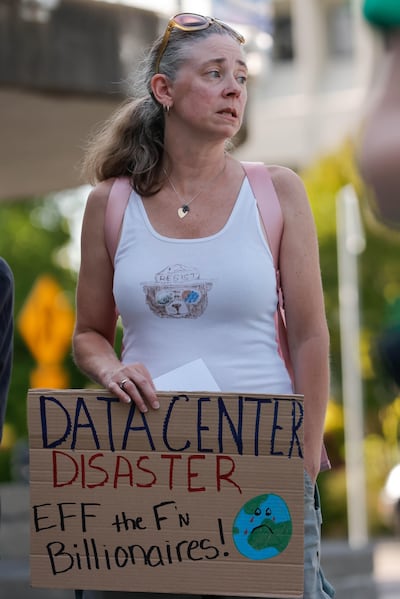
For two hours, impassioned residents testified one after another in the Hillsboro Civic Center, many outraged by recent reporting in The Oregonian that shows a slew of new data center contracts will continue to provide tax breaks for decades into the future. Many data center opponents wore green “Recall Beach Pace” shirts—a reference to Hillsboro’s moderate, pro-business mayor, whom activists have taken to calling a “data centrist.”
“They’re laughing at us,” real estate broker and independent journalist Dirk Knudsen told the council. For six years, Knudsen has kept up a steady drumbeat of informed advocacy on his Hillsboro Herald blog. “They think this is funny. They’re having fun taking our money.”
Pace, who was away on vacation, was elected last year to a four-year term. Activists say they’re “exploring” a recall—whether they move forward with a petition will depend on how Pace responds to the moment. The movement also has designs on three of six Hillsboro City Council seats in the November election. Current Hillsboro City Councilor Kipperlyn Sinclair, a friend to the movement, will run for a seat on the Washington County Board of Commissioners.
Demand for data centers is now so strong that Oregon’s availability of land and water and lack of a sales tax should be more than enough to attract them, according to Jim Scherzinger, a policy expert and former director of the state’s Legislative Revenue Office.
“Communities like Hillsboro have gotten benefits from data centers, but it’s becoming clear [local governments] may have paid more than they needed to,” Scherzinger says. “Thousands of Oregon businesses provide public benefits every day without special incentives.”
Though many activists in Hillsboro hail from the political left, data centers aren’t strictly partisan, according to state Sen. Mike McLane (R-Powell Butte), whose rural district is Oregon’s largest in geographic area.
“A lot of my constituents, and conservatives in general, want to protect farmland, and they’re concerned about energy and the grid,” McLane tells WW. “They believe data centers should have to pay for their infrastructure and that burden should not fall on other ratepayers.”
It was a bipartisan crowd in La Pine that firmly rebuked businessman Jeff Keller, who recently tried to build a 20-megawatt crypto data center in an industrial park off Highway 97. Last month, after Keller’s Boxminer project had traveled several steps through the development process, community members caught wind and crowded town hall. In the end, the city council unanimously rejected Keller’s proposal.
Keller got his start building data centers in 2017 and has built several in Ohio. He says he looks for one thing in siting a data center: cheap power, and he’s come to view tax breaks and other incentives as unnecessary: “They tend to bring up all kinds of negativity.”
To be sure, as a one-man operation, Keller is quite distinct from the multinational corporations that invest in Oregon like Google, Facebook and Amazon. He noted the irony of his project’s opponents connecting through a Facebook group.
“Who do they think ‘data centers’ are?” Keller says. “That’s the hypocrisy of this.”
With the primary over, political consultants who spoke with WW say this debate could have a big impact on general election contests in November. It’s a crosscutting issue, frustrating voters on both sides, and it’s complicated—involving land use, NIMBYism, tech-sector jobs, and rising utility rates.
Public affairs consultant Christian Gaston, who advises officials and candidates for statewide and local office, says some pols may run from their past support for data centers. That may prove difficult.
“It can depend on how an incumbent talks about their record, all the way down to how authentic they seem when they’re explaining what they’ve done in their legislative career,” Gaston says.
Affordability is now the top issue for voters who have little appetite for tax breaks for multinationals, according to political consultant Moore. But as communities push back, developers will only look elsewhere, and it could be the state’s poorest regions that bear the brunt, environmental and otherwise.
Moore expects data centers will continue to decline in popularity, but rather than run from the issue, leaders could appeal to voters by being proactive.
“These things have to go somewhere. That’s why we need an actual plan,” Moore says. “It’s the challenge of good leadership. You can’t just say no, no, no.”
In March, the Oregon Legislature approved a moratorium on new tax breaks for data centers. Around a dozen states have taken action to curb incentives; at least three governors have acted unilaterally. Gov. Tina Kotek has convened an advisory committee to make policy recommendations by October.
Jody Wiser, president of reform-minded Tax Fairness Oregon, says the governor would be wise to distance herself from data centers. Kotek’s own economic development package, HB 4084, was altered significantly last legislative session after concerns emerged that it could expand tax benefits for data centers. Wiser says Kotek’s weakness on this issue could leave her vulnerable to a Muñoz-style campaign, but from the right.
“We’re trying to get the governor to get ahead of this issue,” Wiser says.
This week, after state utility regulators paused a proposed 29% rate increase for data centers—called for by Sollman’s POWER Act—Portland City Councilor Mitch Green echoed Wiser on Bluesky.
“If I were the governor running for reelection I’d be…calling for a speedy review of the rate proposal,” Green wrote. “Ratepayers are waiting for relief from the costs that have been shifted onto them by these data centers.”
Portland is a major cord-cutting market that might exemplify the growing demand for data centers, which have quietly existed downtown since 1999, hidden in plain sight in the Pittock Block building. Now, with sky-high office vacancy in inner Portland threatening a self-reinforcing “doom loop” scenario, real estate brokers are pitching several tower properties for possible data center development. This could lead to conflict between moderates and progressives on the council.
At least one progressive councilor seems to have softened her tone. In December, Councilor Angelita Morillo wrote on social media that she’d allow data centers in Portland “over my dead body.” But in a statement this month to WW, she committed to a public process despite strong concerns.
“For any new project proposed in Portland, I want to see full transparency, clear information about public costs, and solid evidence that the project substantially advances the public interest,” Morillo writes.
For her part, Myrna Muñoz hopes the moratorium gives the governor time to hear from constituents. She’d like the state to research the public health impacts of data centers and devise plans to address the loss of water, electricity and rural way of life. And she wants Hillsboro to end all tax breaks for data centers and address land use exemptions that have allowed their proliferation.
She says she leaned into the issue after listening to voters.
“We do not need any more data centers—this is coming from the people. This is not my idea,” she says. “I plan to do whatever the people of my community wish for me to do. That’s what a senator is supposed to do.”