Skip to main content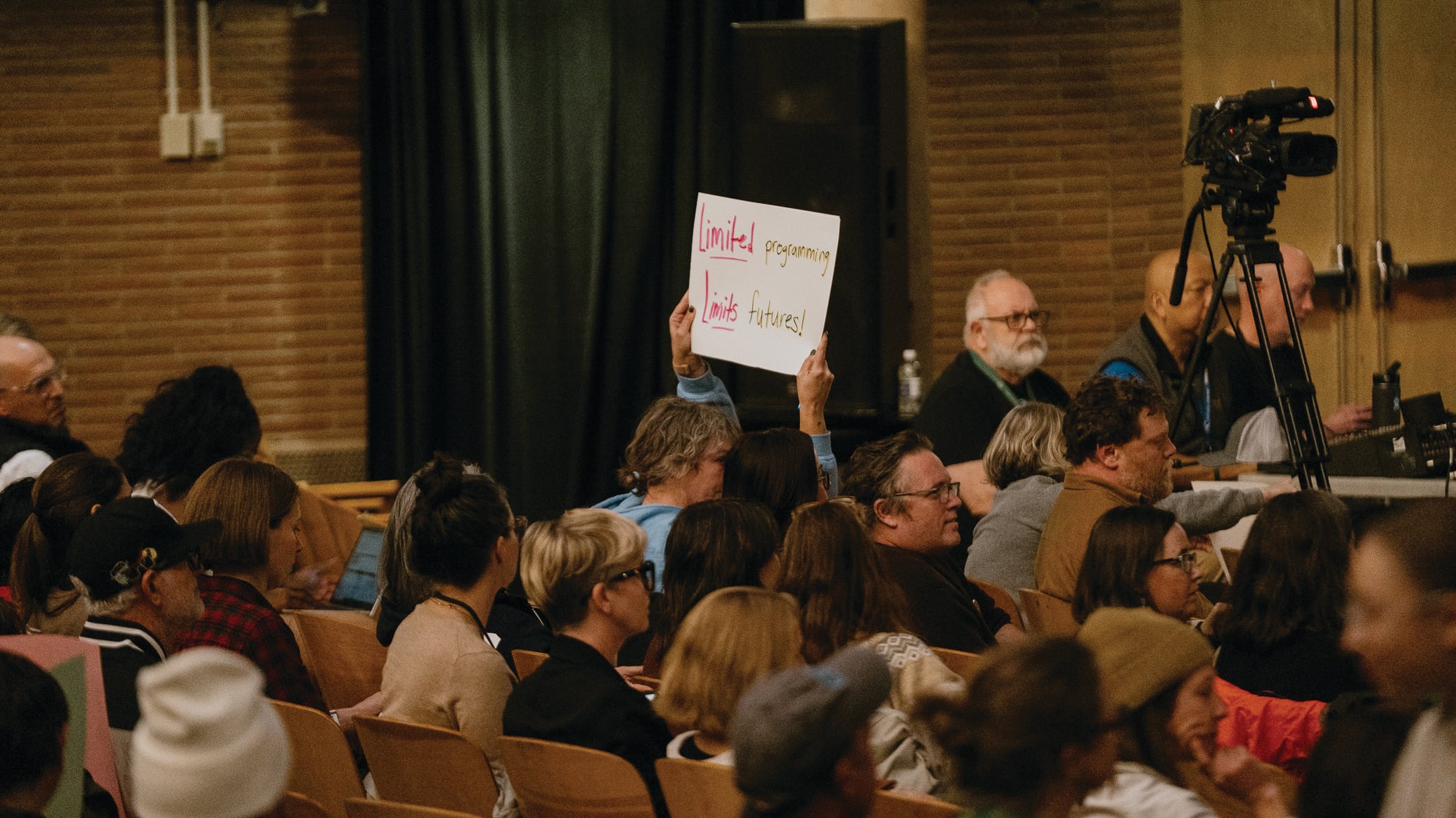
At the root of the debate over boosting Jefferson High School’s enrollment lies a math problem.
Portland Public Schools’ enrollment projections don’t justify modernizing all nine of its high schools. But the school district has now passed bonds to do just that, and plans to scale Jefferson back up to a comprehensive high school—meaning it will provide students with multiple paths to graduation, including an array of Advanced Placement courses and electives.
Doing so requires increasing the school’s student body, which this year hovered at 391. But it’s hard to do that while ensuring that the student body of each high school stays above 1,100 by 2030–31, which district officials say is necessary to justify comprehensive programming. In one of the final three enrollment scenarios PPS presented to parents, Roosevelt falls to 1,020 students.
What’s happening in North and Northeast Portland offers a window into the consequences of overbuilding high school capacity, which WW examined earlier this year (“Too Many High Schools,” March 19). Back then, Carrie Hahnel, a senior associate partner at the education consulting firm Bellwether, said new buildings do little good if the district can’t supply the resources necessary to fill them. PPS cut $40 million from its current year budget, and is projecting it will have to cut $50 million in the upcoming year.
“When districts have too many sites given the enrollment, they’re spreading their operating funds thinly across the district, and that reduces the opportunities students can have,” Hahnel said then.
It’s no surprise, then, that parents across the affected schools are recognizing that the more students in a building, the better. Parents with opposite high school allegiances are on the same mission: trying to get as many parents to join them in filling each high school. Allan Rudwick, a parent of a sixth grader at Harriet Tubman Middle School and two younger kids at Boise-Eliot/Humboldt Elementary, says he supports giving Jefferson a chance. But he thinks mass participation is key.
“If a bunch of parents, especially the wealthier ones, all bail, it will have a major impact on everyone at the school,” Rudwick says. “It’s important that we convince the majority of families that live in the Jefferson district to actually send their kids there. That will be huge for the community.”
More kids justify more teachers and more offerings, Rudwick says. “If everyone tries it out, it will be better for everyone.”
That’s the same concern that has motivated key parts of the opposition.
Laura Westwood, a mom of a fifth grader and a second grader at Irvington Elementary School, says she worries that as the district considers growing Jefferson’s enrollment, it’s not considering how it might destabilize schools like Grant, which is currently district’s largest high school, with 2,074 students. Even without boundary changes, Westwood notes that Portland State University forecasts Grant will be down more than 300 students by the 2030–31 academic year. PPS’s boundary change scenarios have the school’s enrollment falling by as much as 900 students by that year.
Westwood says the neighborhoods that feed into Grant have a population that’s aging—and will supply fewer children in the coming decades. She encourages PPS to forecast beyond the 2030–31 academic year. “I worry that by making such a drastic change and removing a large percentage of Grant’s catchment, that is going to create the opposite problem at Grant of going below that critical 1,100 threshold that is needed.”
Read our cover story: The Future of Portland’s Historically Black High School Could Hinge on White Parents.