Skip to main content
After an inconclusive series of meetings through August, it appears indexing the Preschool for All tax to inflation may be back on Multnomah County’s radar. A new analysis from top economists shows the program can comfortably weather adjusting the tax brackets to keep pace with inflation, and would remain solvent without a scheduled 0.8% rate increase.
But that analysis is based on assumptions about program costs that have come under fire in recent weeks.
County commissioners in August largely hesitated to make a decision on indexing the tax on high earners, noting they lacked information on how that would affect the program’s long-term revenue and programming. That delay largely matched the thinking of a Technical Advisory Group the county convened back in July. Known as TAG, the seven-person group of economists, a demographer and business leaders were split on indexing in summer, noting in part that modeling would strengthen their recommendation.
Since then, the modeling TAG members asked for has resulted in some major revelations, including that the county was forecasting for too many preschoolers to participate in Preschool for All. That led to an analysis ECOnorthwest in December showing that, with fewer kids enrolled, the program’s fund balance could surpass $2 billion if commissioners proceeded with a scheduled tax increase. (That modeling has changed slightly since; the forecasting now shows the program would hit about $1.99 billion.)
At a Jan. 14 meeting, ECOnorthwest explained how a number of policy proposals could affect the status quo trend, including indexing and indefinitely delaying a scheduled 0.8% tax increase. The firm also conducted analyses on whether those proposals would be sustainable under the TAG’s definition. (The group currently defines an economic scenario as sustainable if it meets two criteria: The fund balance in year 10 must be above zero, and cumulative revenues must exceed expenses between years 11 and 20.)
The first notable chart on indexing shows that the fund balance would not grow nearly as significantly if the tax were indexed, but would still sit in the tens of millions in its lowest years, before recovering starting in 2038.
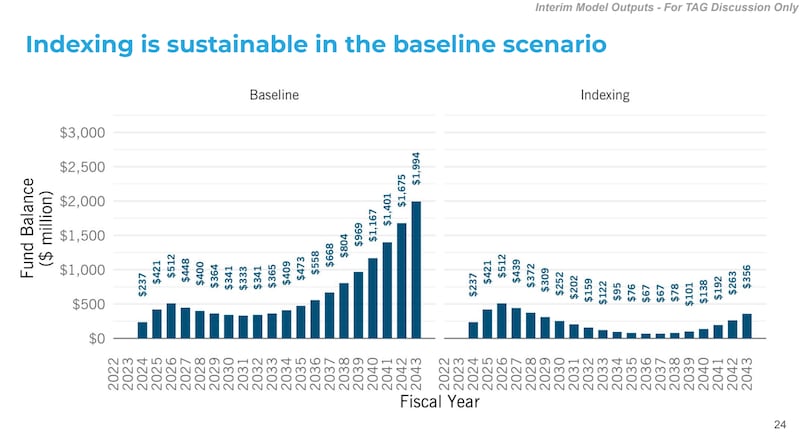
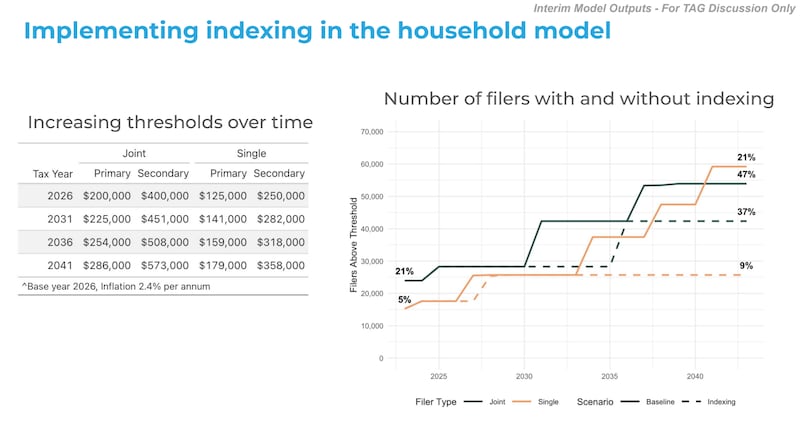
The indexing modeling is based on increasing income thresholds over time to change who qualifies for paying the tax. (The tax currently kicks in as a 1.5% tax on income over $125,000 for single filers or $200,000 for joint filers, and an additional 1.5% on income over $250,000 for single filers or $400,000 for joint filers.)
The other financial lever County Commissioners have previously pulled is around delaying a planned Preschool for All tax increase of 0.8%. ECOnorthwest’s modeling finds that, while the program’s fund balance would go into the red through much of 2033, it would show signs of recovery by 2040 and be back in the hundreds of millions shortly after.
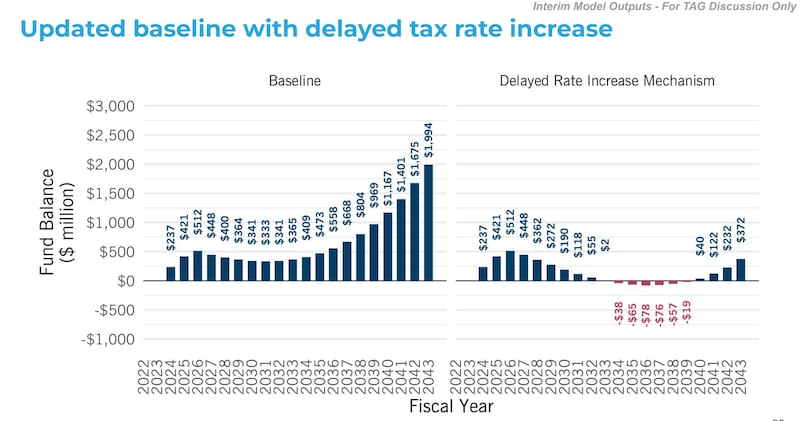
The modeling is, at first glance, optimistic for supporters of indexing—including Gov. Tina Kotek—and high earners eager for a delay in the planned increase. But they come with one big catch.
As WW reported on Monday, there’s brewing concern from members of another advisory group, the Program Advisory Group, that ECOnorthwest’s model underestimates how much seat costs and fixed costs will grow each year—currently at 4% and 3% per year, respectively. TAG members have pushed for a baseline of a 5.2% yearly increase, citing national firms, or even 6% like Portland Public Schools.
County Commissioners are largely concerned with how revenue will affect preschool programs. And under a baseline scenario that assumes 5% growth in both seat and fixed costs, both indexing and an indefinite tax increase delay would fail the TAG’s sustainability test.
At this point, county officials are asking TAG members to use this modeling to combine multiple factors to present their recommendations. (For example, they want modeling what would happen if the board implemented both indexing and an indefinite delay on the tax increase.)
Commissioners also want TAG members to fiddle with the assumptions about revenue growth for the program (the ECOnorthwest assumption of 8% is smaller than historical data from the program), the number of 6 and 10 hour days, and seat costs. They’re also working under a crunch: The commission will be weighing changes in mid-April.