Skip to main content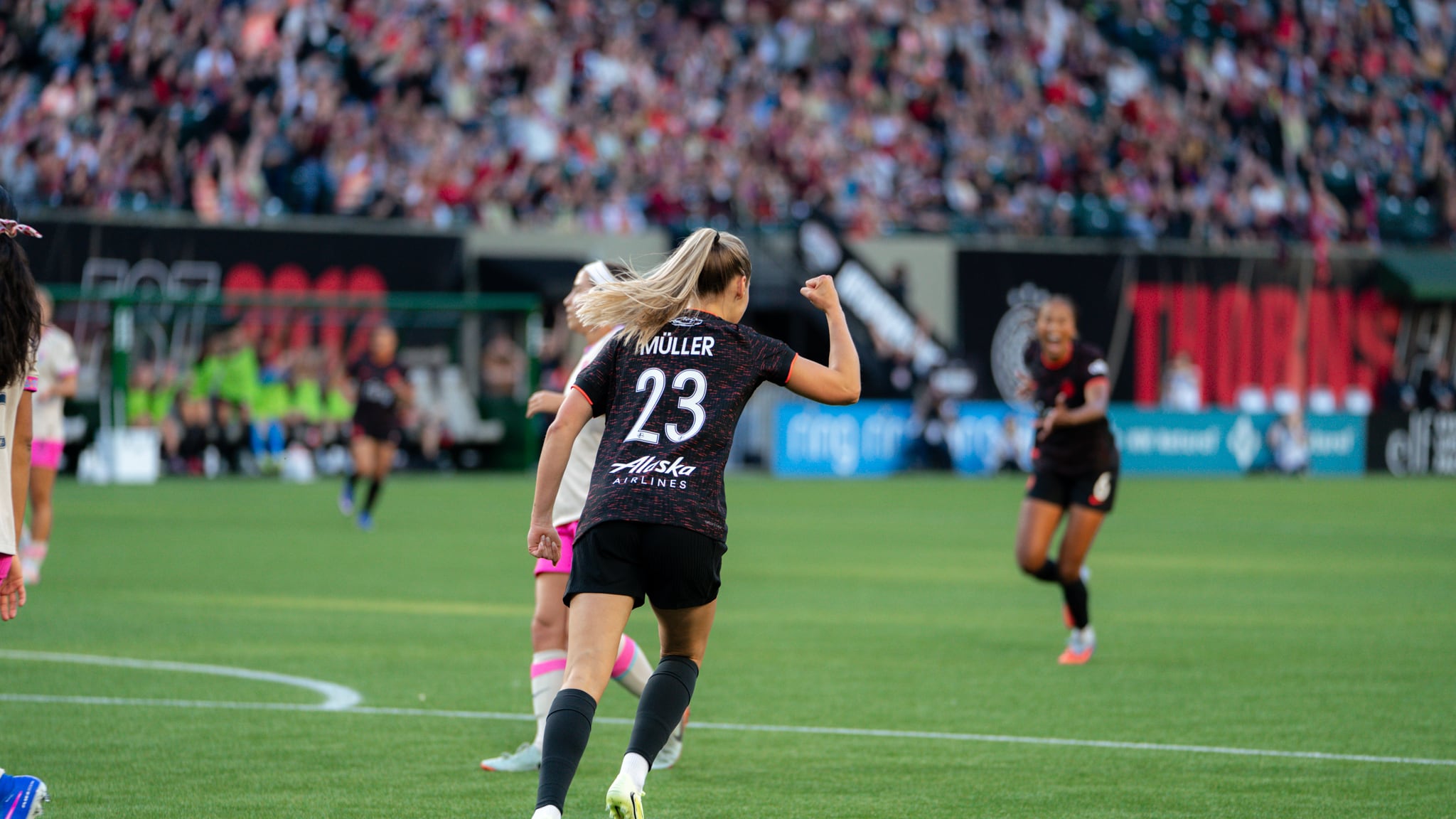
As the final whistle sounded, Portland Thorns goalkeeper Mackenzie Arnold was exuberant. She pumped both her fists, unable to contain her huge smile as she jogged across the pitch to embrace defender Mallie McKenzie and pat defender M.A. Vignola on the back.
The Thorns had just shut out Bay FC 2–0 on May 20. The whistle marked 594 minutes since the last time Portland allowed a goal on its home pitch, a league record. What’s more, Thorns defenders scored both the goals.
So, you could say Portland’s defense is pretty decent this year—and they’re really good at home.
It’s not just the shutout record or that defenders are scoring—though McKenzie, Vignola and Marie Müller as three of the team’s seven goalscorers this year doesn’t hurt—but the way that the whole team stays organized out of possession and denies their opponents from receiving the ball in dangerous areas.
Portland has conceded 12 goals in their first 12 games of the season and shut out their opponents in seven of those matches. That’s as many shutouts as the team recorded in all 26 games last year.
To be sure, the team is only on pace to allow three fewer goals than last season, because when the Thorns’ opponents score, they do so in bunches. Losses to the San Diego Wave, Racing Louisville and, most recently, the Kansas City Current each came by a 3–1 score But the shift in Portland’s defense from last year to this is evident.
“I think we are extremely good at defending,” Thorns head coach Robert Vilahamn said after his team beat the Seattle Reign 2–0 in their home opener in March. “We spoke about keeping them [Seattle] away from our penalty box, make sure they don’t create so many shots at goal. Because I think last year they [the Thorns] had some problem with that.”
It’s a fair assessment. Last year’s Portland squad showed flashes, but they couldn’t stop conceding early goals if their lives depended on it. (In fact, their playoff hopes quite literally did: The Thorns bowed out of the 2025 postseason in a semifinal loss to the Washington Spirit in a match where the Spirit scored their game-winning goal in the 27th minute.)
This year, it’s a different story. “We’re going to be a very good and compact team,” Vilahamn said early this year, after the Seattle win. And the Thorns are working toward being just that.
“I really do think the successes that we’ve had defensively is a reflection of our team as a whole,” team captain and defender Sam Hiatt said after the Thorns’ Sunday match in Kansas City. It hasn’t been perfect, and both Hiatt and Vilahamn are quick to admit as much. The Current match was far from Portland’s best game.
But it’s clear they’ve made strides since the early game concessions of 2026, that even when they don’t always get it right, the cohesive idea is there. And also, that sometimes when you’re already down a goal and committing more players to push for an equalizer, you leave yourself vulnerable to a counterattack. Vilahamn acknowledged as much after the Kansas City loss, but he said he’d rather take the gamble if his team’s already in a losing position. That’s part of why those games in which the Thorns have conceded this year have turned into goal fests for their opponents.
“The way that we are defending as a unit right now is really admirable,” defender Mallie McKenzie said after Portland’s 2–0 victory over the Bay last week. “You have forwards dropping back into the 18[-yard box] to help defend with their outside back.
“It’s a team effort,” she added, “and it’s showing.”
That effort is partially a result of coaching. As mentioned above, Vilahamn’s style emphasizes compact play—to limit the space where other teams can find openings against the Thorns—and keeping opponents out of the 18-yard box, which limits the threatening places where opponents can take aim at the net. He’s also credited first assistant coach Sarah Lowdon for the work she did with the team during the offseason.
But it’s also a testament to the players themselves: The Thorns have shown they can succeed when they commit to support each other, their buy-in to Vilahamn’s tactical vision, their trust in one another on the pitch.
“A big thing of being a Thorn is cheering each other on,” defender Vignola told WW last month. “We all really are rooting and cheering for each other, and I think that’s something that makes us, as a back line, who we are.”
Being on the same page becomes especially important in building cohesion when a team rotates as much as Portland’s defense has in this first half of the season. The Thorns have started seven different defenders and two goalkeepers across their first 12 games.
They’ve used six different center back pairings—a position that traditionally doesn’t rotate often to allow the duo to build chemistry and an awareness of one another’s typical positions in last-ditch defensive efforts. But Vilahamn trusts the four players he’s used there and knows he can count on them to step in and out of lineups as he best matches his defenders’ strengths to counteract that of a given opponent’s attack.
“I think Robert has done a good job of being clear about the organizational structure that we want and what it should look like,” Hiatt said. But the team effort is also important: “The games where we have a shutout or don’t concede very many goals, it really is a testament to the work that our front line and midfielders are putting in.”
That work shows when someone like Reilyn Turner or Olivia Moultrie drops back to cover in Portland’s goal box, in Jessie Fleming’s relentless pressure, in Arnold’s confidence protecting her net. It feels like when one defender gets beat, two other players step up to take her place.
“It’s a very fun group to be a part of,” McKenzie said after the Bay FC win. “The energy makes you want to work for one another.”