Skip to main content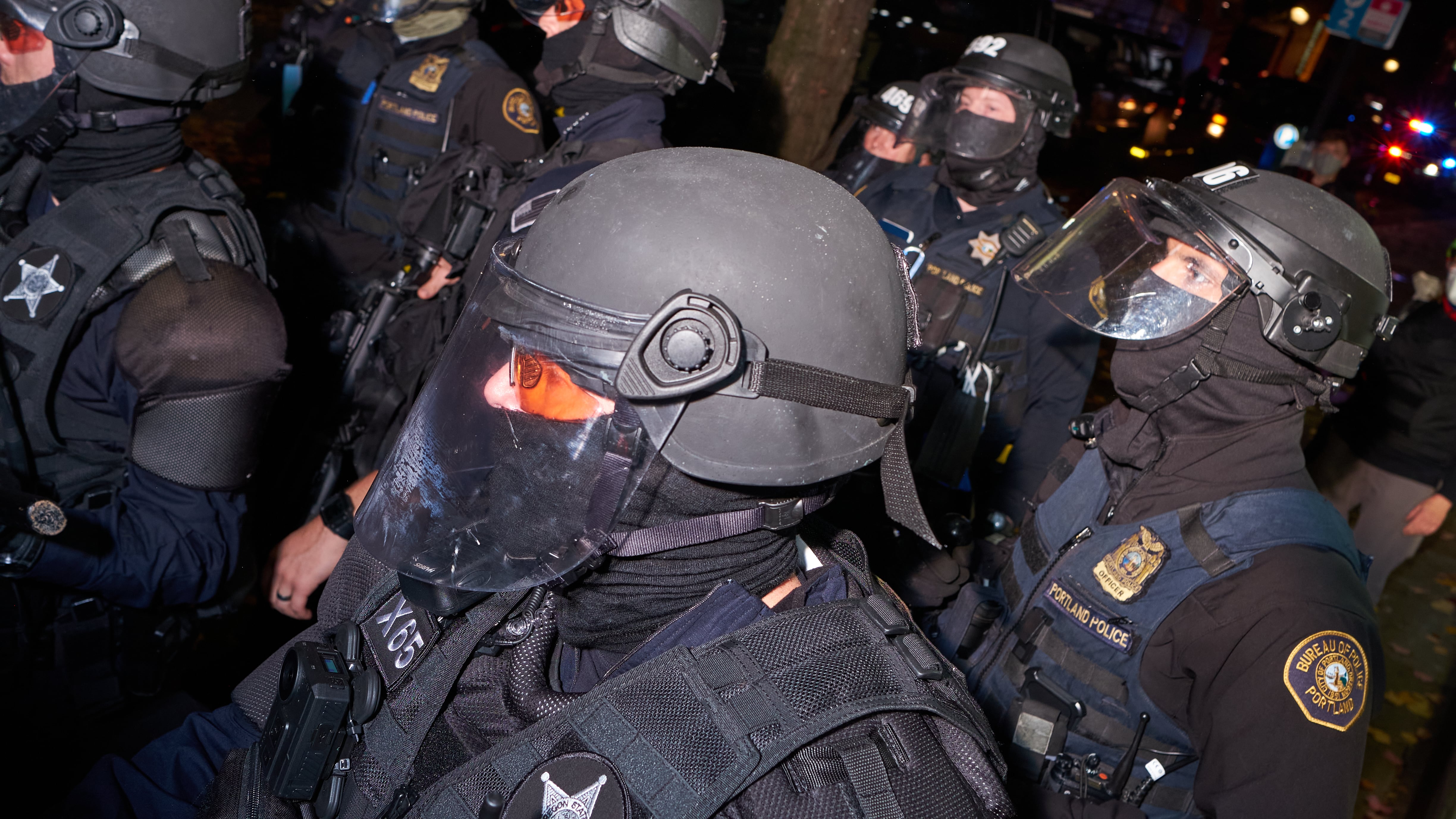
The Portland City Council passed an ordinance Wednesday prohibiting law enforcement from wearing facial coverings and requiring them to clearly display their badge, name and agency affiliation. Passed by an 8–4 vote, the ordinance also requires that Portland police officers document any instances of someone trying to detain or arrest another person without proper identification.
The ordinance applies to all law enforcement officers, including Portland police and federal officers from agencies like U.S. Immigration and Customs Enforcement and U.S. Customs and Border Protection. Still, councilors conceded that the city does not have the legal authority to enforce the mask ban against federal agents.
“Let me say this clearly,” said Councilor Sameer Kanal, the ordinance’s primary sponsor. “This ordinance cannot and will not unmask ICE agents.”
The ordinance states that immigration enforcement under the second Trump administration has created an “environment of profound fear.” Detaining people with unmarked vehicles and removing them without explanation are “tactics historically associated with secret police units in authoritarian regimes,” the ordinance reads, and leave communities unsure of whether the officers are actually employed by the federal government or are vigilante impostors.
Kanal highlighted a recent investigation by Noticias Telemundo that found at least 31 instances of people posing as masked immigration agents across the country to rob or harass immigrants in 2025, and another six so far in 2026. His ordinance would make it easier to identify and prosecute such impostors, Kanal said.
The ordinance comes in response to a requirement by Oregon House Bill 4138 that all law enforcement agencies adopt policies prohibiting officers from wearing facial coverings during official duties except for clearly defined, narrow exceptions. Gov. Tina Kotek signed that bill March 31. Jurisdictions have 180 days from the signing to adopt the policy or make their own.
But the city ordinance goes further than the state’s policy. Councilor Steve Novick noted at Wednesday’s meeting that the state law only applies to officers doing criminal law enforcement. ICE does civil law enforcement, meaning the Senate bill “effectively exempted ICE from the identification requirement,” Novick said.
But even though the ordinance applies to immigration officers, councilors agreed a city resolution would not have an impact on federal law enforcement’s conduct. In April, the 9th U.S. Circuit Court of Appeals halted California’s requirement that law enforcement officers wear visible identification like their badge, name and agency affiliation. The court said that the law likely violates the U.S. Constitution’s supremacy clause by trying to regulate the federal government.
Robert Taylor, the city’s attorney, said that the 9th Circuit decision is binding on Portland, meaning the ordinance’s provisions related to federal law enforcement are likely unconstitutional. If those portions of the legislation are struck down, he said, the rest will stay in effect.
Multiple councilors said that in light of the 9th Circuit’s decision, they were concerned the bill set unrealistic expectations for Portlanders that the city could change how the federal government conducts its immigration operations.
“I’m really concerned that we have raised public expectations about what we can do and not do. I think we may be doing a disservice to the public by creating those expectations,” said Council Vice President Olivia Clark, who voted against the resolution.
Councilors Elana Pirtle-Guiney and Steve Novick, who voted for the ordinance, both said it would be a “miracle” if the court’s decision was overturned on appeal. But the ordinance’s requirement that the Portland police document possible violations would help in any future legal challenges, Pirtle-Guiney said.
“These are tools that we’re passing today,” Pirtle-Guiney said. “They don’t end the terror that the Trump administration has brought forward. But they give us tools in the fight.”
The Portland Police Association, the union that represents sworn Portland police officers, has raised issues with the policy in the past. The union has contended that changes in the policy—including that Portland police intervene if other law enforcement officers break the rules—must be bargained with the union before the policy is passed. (Kanal has argued otherwise.) The PPA’s resistance is part of why it took Kanal nine months to pass the ordinance.
Police Chief Bob Day said the ordinance would not significantly change Portland police officers’ conduct and that he did not care whether it was passed or not. He added in a statement to WW, “What the ordinance does is create additional administrative and compliance responsibilities for the bureau, and those requirements will require time and resources to implement and manage.”
The PPA is currently in contract negotiations, Day said, and multiple components of the policy will need to be bargained on. “I would just ask that we initiate the bargaining process as soon as possible,” Day told the council.
Multiple councilors who voted against the policy, as well as Day, asked instead that the city simply enact the state law as is.
“[The state law] was designed to be a good step forward, a good promise to Oregonians,” said Councilor Eric Zimmerman before voting against the policy, “and Portland could have been a teammate in all of that.”
A previous version of this article incorrectly stated that California had filed an appeal in its case at the 9th U.S. Circuit Court of Appeals. It has not. WW regrets the error.