Skip to main content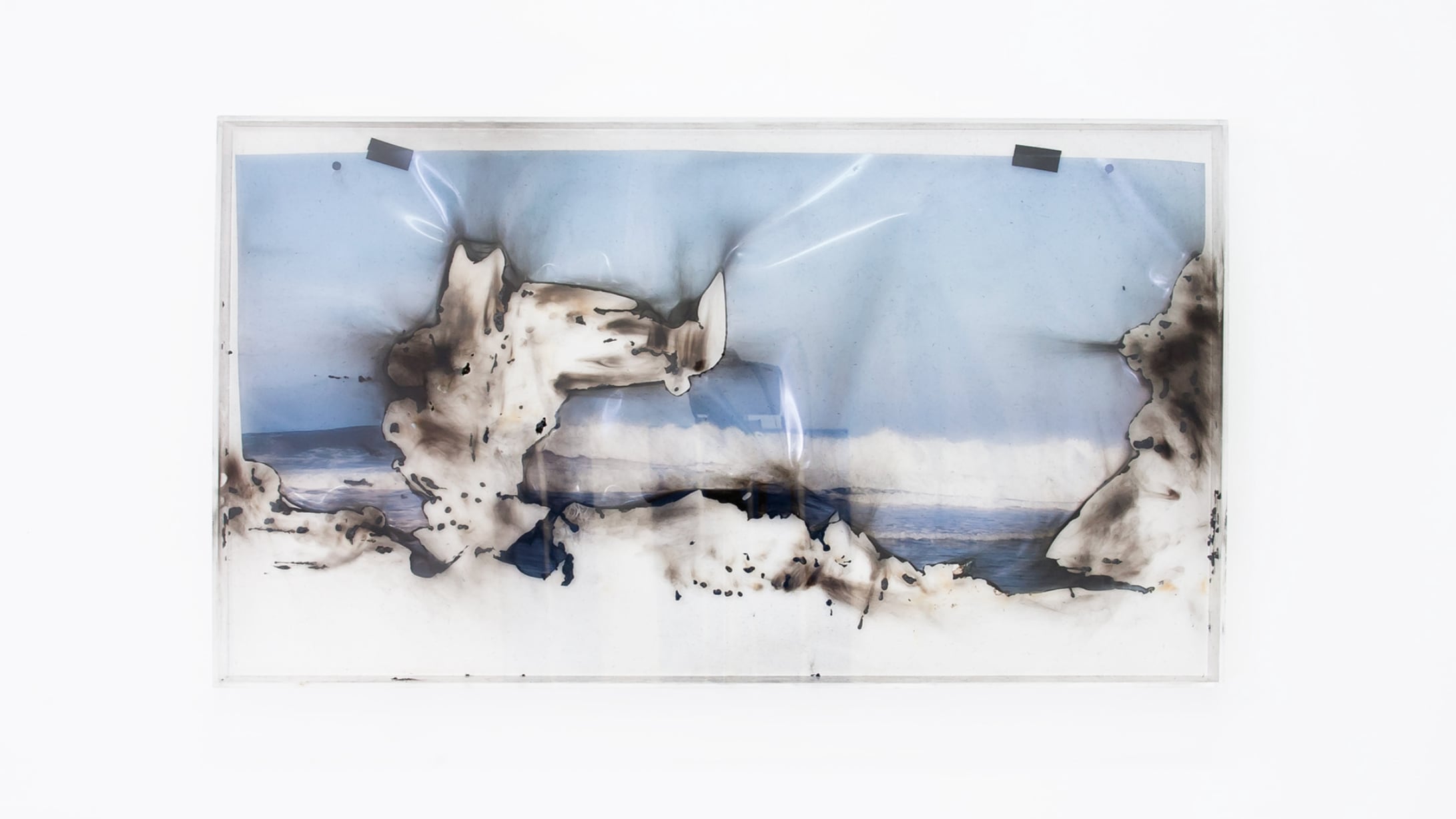
I’ve been part of a few groups: a reading group, a recovery group and, twice in college, group art shows. All have been subjected to a common organizing principle, a theme. Themes are good for drawing an unlikely crowd into shared space and conversation, but they’re just as likely to mislead, over- or underselling what’s actually on offer. Rarely do they have any bearing on how the individual parts of a given group will cohere, or what their presence together might ultimately mean.
SOCIETY’s summer group show anticipates no such unity. The title, Mike Jodie Derek Sidony Stephanie Taryn, is simply the first name of each participating artist: Mike Bray, Jodie Cavalier, Derek Franklin, Sidony O’Neal, Stephanie Simek and Taryn Tomasello. It’s an art show displaying work by these artists, all of whom coincidentally live in the Pacific Northwest. Otherwise, no pretensions and no promises. Significance, rather than prescribed, has a chance to be found.
Some might be surprised to find the gallery in a compact room at the top of a janky stairwell beside Mother Foucault’s Bookshop, a place with a social function that’s difficult to describe even after 15 years of operation. But it’s in this unconventional office of sorts where Ido Radon, curator and director of SOCIETY, organizes exhibitions that transport viewers away from Southeast Grand Avenue. Under Radon’s purview, this unprescribed grouping feels far from incidental.
It was Sidony that initially commanded my attention. O’Neal’s work spans performance, writing, drawing, sculpture, and other mediums I wouldn’t try to classify. Often, these categorically challenging forms employ mathematics to create “provisional structures.” Basically, a kind of scaffolding—conceptual and material—that works for the time being, impermanent, holding things in place for a little while.
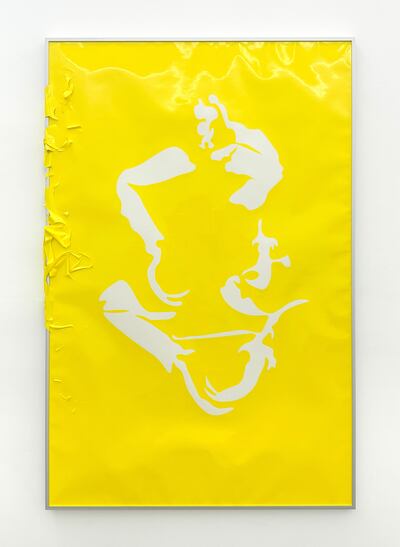
In this show, the aluminum frame of O’Neal’s two-dimensional sculpture fig for leg lock is a provisional boundary for a yellow vinyl cut-out that’s not quite bound by its frame. The left corner drips pollen yellow. Centered in the frame are complex white forms, oblong protrusions that recall the inky heptapod language from the movie Arrival. These shapes recur throughout O’Neal’s work as either a reference to or product of abstract mathematics: a field that, in my rudimentary understanding, embraces a kind of imperfect fidelity to the physical world.
On the wall adjacent to fig for leg lock is another contested frame. Mike Bray’s No beginning…no end is technically a photo of a beach, a photo of a wave midbreak. But this tranquil scene has undergone a process of active decomposition—notably, it was set on fire. A plexiglass box, its own provisional structure, preserves the evidence. Soot, melted plastic turned black, and a handler’s fingerprints cling to its surface, further obscuring the familiar coastal tableau taped to the white gallery wall.
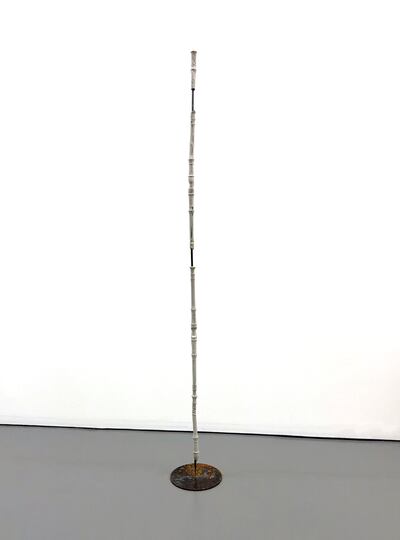
Elsewhere, familiar forms from childhood are eerily repurposed. Derek Franklin’s sculpture The Deal is Done stacks cement-casted recorders (the wind instrument) vertically, end to end, mouthpiece to mouthpiece. The effect is a foreboding, enlarged spine, a spindly structure on a slight tilt. Up close the pale recorders are veined, cracked and crumbling away to expose a steel armature. One thinks of late-stage urban decay and also osteoporosis, infrastructures in the middle of giving out.
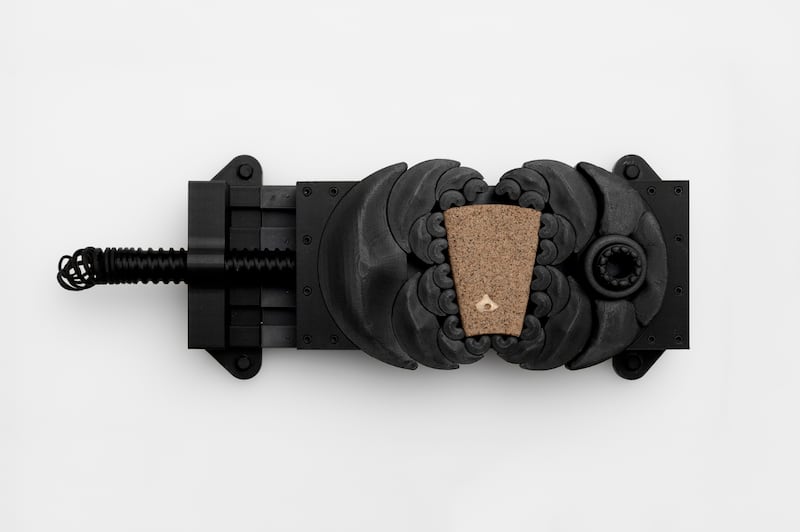
Stephanie Simek, however, fends off deterioration. Equally applied pressure in Fractal Vise with Keystone holds a block of sand together with a matte-black, 3D-printed device that looks like an alien maw. Set in the sand is an inconspicuous gem.
A “fractal vise” is a woodworking tool that helps keep particularly tricky objects in place. I can’t look at the elegant apparatus without thinking about how much tension must be required to keep every grain of silica exactly where it is. It’s an impossible job, but one many of us demand of ourselves all the time.
A few parables readily come to mind, like motherhood, recovery and more generally the will to exert agency over life’s innumerable parts. The displacement of these parts—life’s objects, all seemingly in our control—would precipitate not just a loss of self but the world as we’ve known it thus far. I imagine what order the sandy keystone’s hard edges would cascade in if the grip were to loosen. An apocalypse of sorts, if you want to see it that way, but a provisional structure, to be sure.
SEE IT: Mike Jodie Derek Sidony Stephanie Taryn at SOCIETY, 711 SE Grand Ave., 2nd floor, psocietysocietysociety.com. Noon–5 pm Saturdays, through Aug. 1. Free.