Skip to main content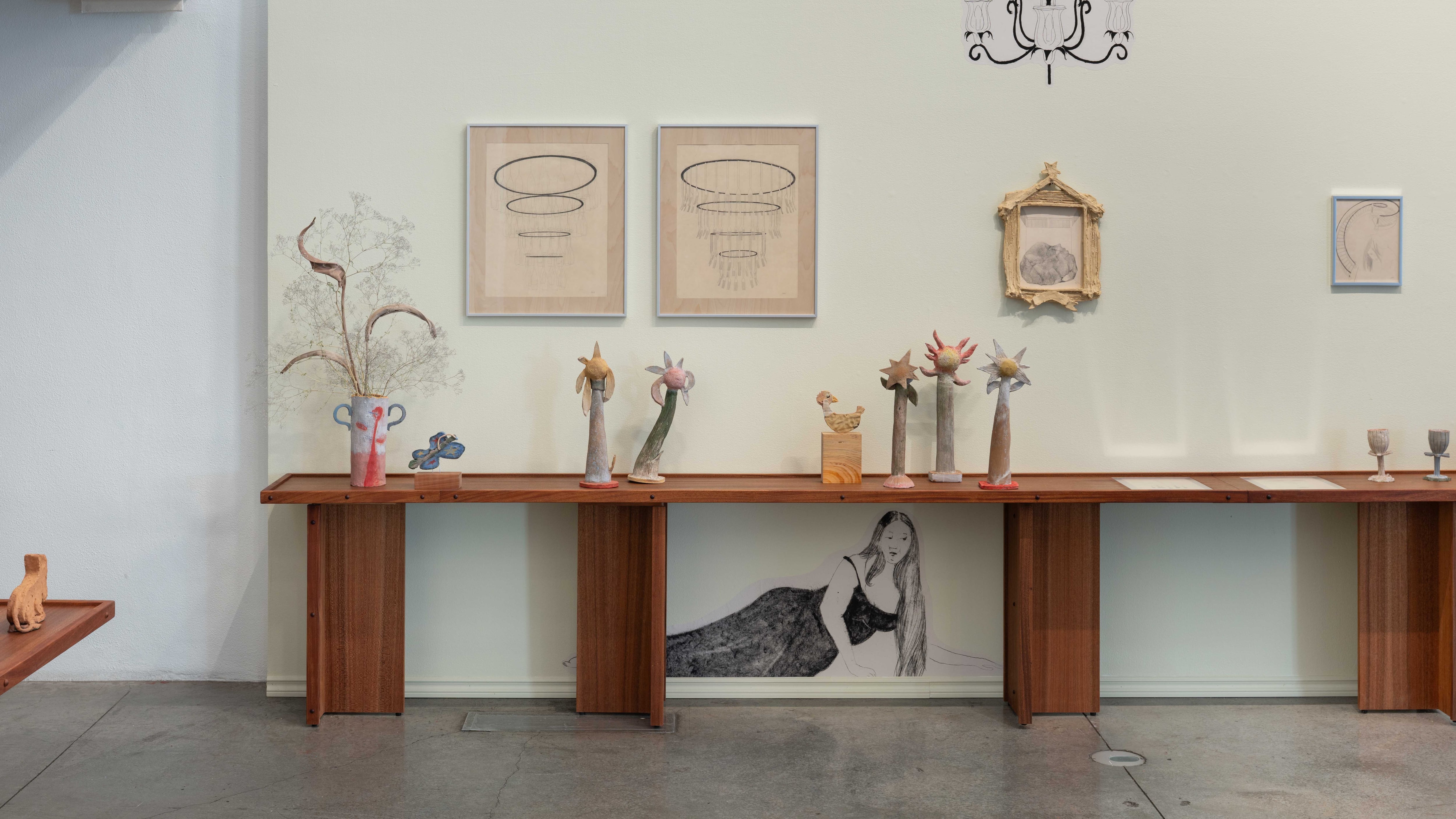
It’s not a comfortable time to make art. It hasn’t been.
The Trump administration threatened to decimate the National Endowment of the Arts, the whole thing, in May 2025. But slashing arts funding is not new or specific to any political party. Following Bill Clinton’s reelection in 1996, federal arts funding dropped by $62.8 million, which remains the biggest year-over-year dip on record.
It is, however, a better time for advertising. Though every industry has its pecking order, according to a 2025 study by S&P Global Market Intelligence, people who work in advertising earn about 26% more than the national average.
Advertising is big in Portland, and for an artist, it’s not a bad gig. Walk into any gallery and odds are good that an artist with work on its walls has a day job at one of the many ad agencies in town. While the artists’ profession may not always be listed in the exhibition text, gone are the days of the ’90s and early 2000s when such an admission would condemn you for life as a sellout. Today, “selling out” is what you do to pay the bills, and it may even be something you can take pride in.
At least it is here, in the gallery in the lobby of ad agency Wieden+Kennedy’s Portland HQ, where curator Bijan Berahimi makes a point of giving commercial artists (those who make a living working for clients) an opportunity to generate art works without the constraints of a brief.
Wieden+Kennedy is of course the Portland-founded global advertising firm one could easily credit for establishing Nike’s cultural dominance in the late ’80s. Though far from a global empire, Berahimi’s own agency, FISK, has over the past decade asserted a style of graphic design that seemingly everybody wants, influencing the look of countless businesses, public institutions and, most notably, album covers for Clairo, Tinashe and Aminé, to name a few.
FISK’s offices have taken form in many configurations, but always they have included a gallery project. About a year ago, Berahimi took over W+K’s cathedral-like lower-level, turning the expansive space into the latest version of FISK Gallery.
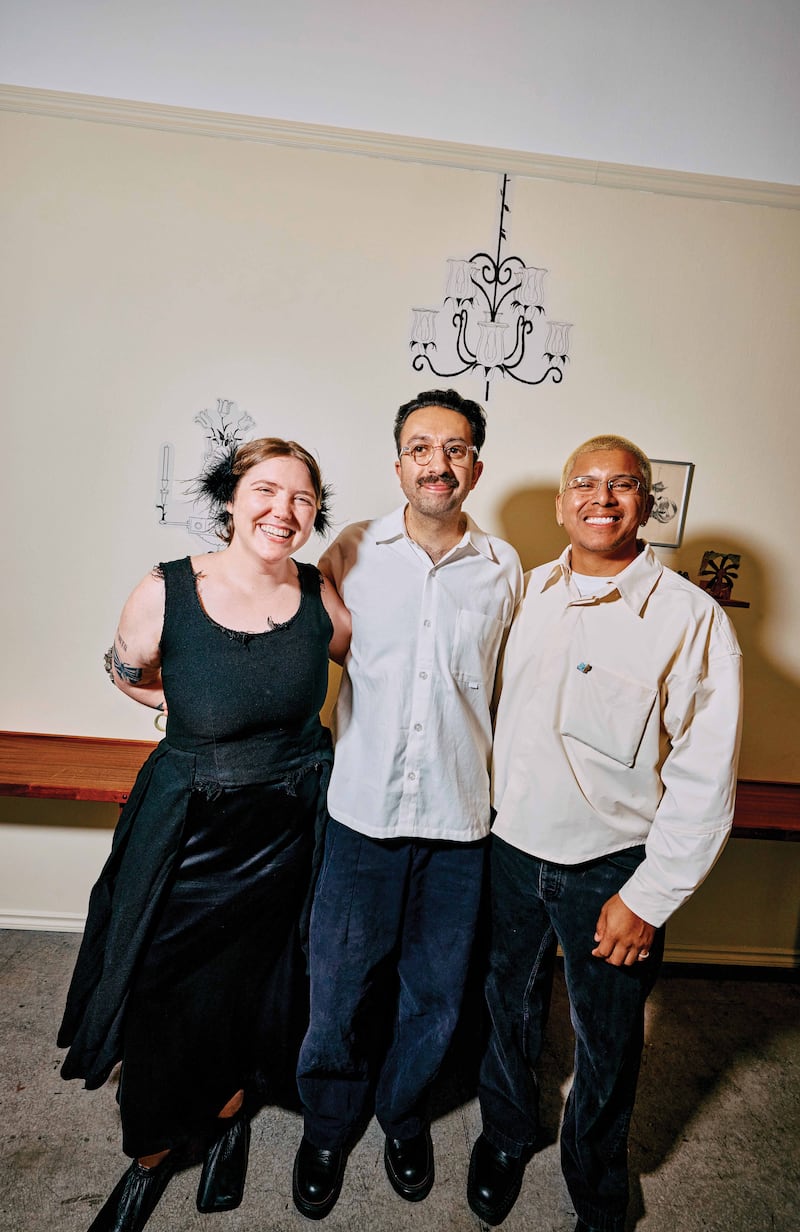
Heaven Must Be Near, FISK’s fourth and final show of the year, features drawings by Momo Gordon, a local illustrator and graphic novelist whose most recent high-profile advertising work was a pair of campaigns for Acne Studios, one announcing the designer’s latest New York storefront and another promoting its show at Paris Fashion Week. At FISK, Gordon’s drawings are shown alongside ceramics by Erasto Reyes-Silva, founder of BESTDAYS, a creative studio based in L.A. that produces custom typefaces, logos, graphic design and art direction for perennially youthful brands like Nike and Call of Duty, as well as unapologetically opulent brands like Givenchy and Maserati.
The drawings and ceramics in Heaven Must Be Near more or less diverge from the artists’ commercial portfolios, resulting in an exhibition that quietly celebrates the abundance that can be made, both figuratively and literally, with a resourceful imagination. Spare in materials (Gordon’s faint graphite drawings, Reyes-Silva’s rough-hewn stoneware), the works, displayed together in a series of domestic scenes, seem to say that it takes very little to have more than enough.
Take Gordon’s fantastically precarious iterations on chairs. In All I Have to Offer, a boulder sits atop a flimsy bistro table between two chairs, the rock so large it spills over the flat surface and presses into a chair on the right, sending it backward in a balanced tilt. (A similarly hazardous situation involving a hoard of stacked Danish chairs shows up in Acne’s Paris Fashion Week promo.) Chandeliers are another leitmotif in Gordon’s drawings. One is constructed entirely of champagne flutes; another drawing, cheekily titled Burst Pipe, is of a grand fountain fixed to the ceiling. (Gordon also produced chandeliers for Acne, gilded ones that wouldn’t have been out of place on the Titanic.)
What distinguishes Gordon’s personal work from their commercial projects is not technique or material, as both hinge on the artist’s delicate sureness of hand, but a more pronounced sense of humor that can be read through inanimate objects. There’s a soft face where you least expect it, in a sultry bushel of grapes or the seat of a chair.
The difference is perhaps more obvious with Reyes-Silva. BESTDAYS’ design work is characterized by impeccably clean lines, high contrasts and ripe colors—qualities that could only be achieved through a digital interface. Reyes-Silva’s ceramic chalices, simple human figures and dandelions, by contrast, retain the texture of their mineral medium, a welcome surprise.
As I meandered through the rooms, however, it became clear that these were not two divorced practices related only through their creator, but two complementary modes of processing the same wealth of visual references, from the poppy palettes of sports teams to well-worn family truisms. In the case of Paraiso, a small-scale ceramic rendering of a tropical landscape, we are transported to a time and place away from the grind where a sky seems to be cut-and-pasted behind a tree bright as construction paper. The glaze gleams as if buffed by sand on the beach.
When I arrived at the gallery on opening night, I entered on an internal walk-through with Reyes-Silva and W+K staff. He was describing the influence of Oaxaca and a wish to transmute personal hardship into light. In Burro Consado, an unglazed effigy of a donkey resting on its knees, Reyes-Silva honors his mother and a timeless adage with a reminder not to “work like a donkey.” This wish for light tracks through the exhibition as a formal metaphor. It shows up in the glazes, different oxides creating unpredictable hues of turquoise and coral as metals react to oxygen. Tiny air bubbles gather in a pool of glaze at the bottom of a faded crimson chalice, Rich & Pretty Red, that seem to literally make “light” of heavy material.
The dissonance of a fine art show inside one of the most famous ad agencies in the world is not lost on me. But Heaven Must Be Near leverages that dynamic. Advertisements and other forms of commercial art are certainly the most frequent aesthetic experiences we have. On a societal scale, one might argue they are also the most impactful. As the world grows ever more hostile for the artist, and more comfortable for the advertiser, maybe commercial art is what the masses will be left with, and some of it we’ll be grateful for.
SEE IT: Heaven Must Be Near at FISK Gallery at Wieden+Kennedy Portland, 224 NW 13th Ave., fiskprojects.com/events. Noon–5 pm Friday and Saturday and by appointment through Nov. 22. Free.