Skip to main content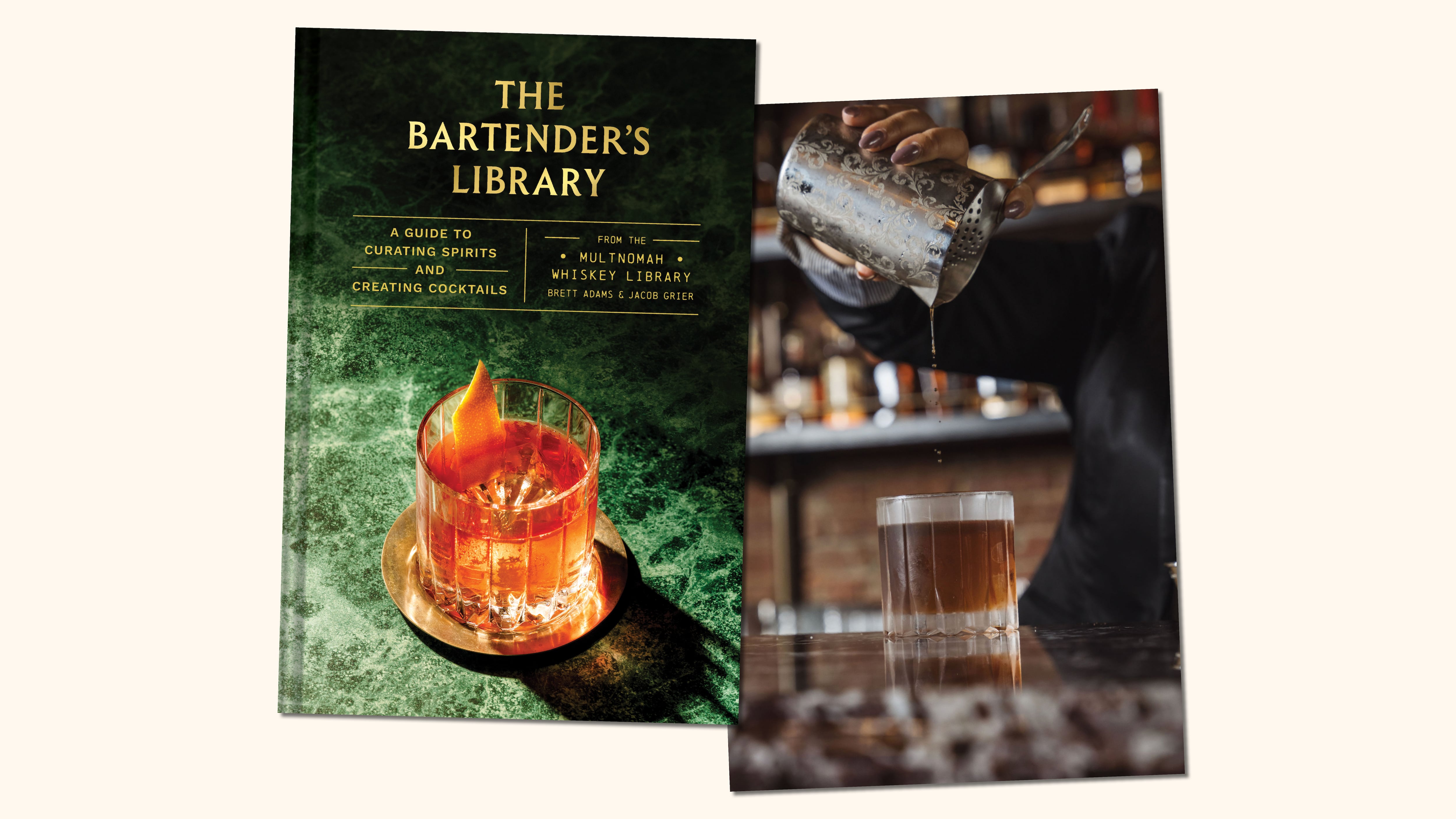
When does a library have no books? When it’s West End institution Multnomah Whiskey Library, with its 2,600-plus bottles of not just whiskey (and whisky; it’s kind of like color vs. colour), but also rum, mezcal, brandy, sherry, herbal spirits and liqueurs. It’s not your usual gin joint, or even your usual cocktail bar. For one thing, it is primarily for members, though you can buy a “hall pass” reservation (or walk in and wait a while). Inside, the “bartenders” actually wheel a well-stocked cart around to tables, ready to engage in depth about such topics as the distillation process, what flavor notes each of 12 distinct ingredients bring to a particular house cocktail, or the differences you might find in a flight of unpeated, sherried scotches.
But now, with The Bartender’s Library: A Guide to Curating Spirits and Creating Cocktails (Chronicle Books, 376 pages, $30), there actually is a book, and anyone can acquire some of that same Multnomah Whiskey knowledge while at home.
Four years ago, co-authors and MWL bartenders Brett Adams (who currently carries the very academic title of education manager and spirits curator) and Jacob Grier (who has worked there off and on) published Raising the Bar, a booze primer covering 25 different types of liquor and more than 200 cocktail recipes. Its not quite sequel is more advanced, nerdier and explicitly a product of their workplace.
“People have asked me online like, ‘Oh, I wish I could get ahold of your study guides for your team,’” Adams says. Now he can tell them to read the book. “The book is the shorthand for everything you would need to know to work at the Whiskey Library.”
If you’re not planning to apply for a job, the book also holds the secrets of curating a home collection on par with the Multnomah Whiskey Library shelves—or at least an abridged version of them.
“The question that we get asked all the time is, ‘What is the next bottle I should get? What do I need in my home bar?’” Adams says.
Perhaps you’ve got a lot of bourbon, but not a wheated or high-rye bourbon. Or you might want to expand the geography of your mezcal stash, adding something from a different state than Oaxaca.
Bartender’s Library is as much a book about distillation as bartending or drinking. “It’s sort of a liberal arts education in distillation,” Adams says. “If people have made a bourbon cocktail, for example, with the first book, the second book is like, well, how is bourbon made?”
Not so you can do that yourself. We’re all still bartenders here, professional or hobby. (Just because you play guitar doesn’t mean you want to make one; and that goes double for people who just like to listen to music.) Instead, the point is to give you a more sophisticated understanding of bourbon and all its nuances. “Then you’re more empowered to choose the one that’s going to give you the flavors that you want the most,” Adams says.
And the same goes for all the other spirits featured in the book. Grier is also especially pleased to include two that didn’t make it into the first book—aquavit, a particular passion of his, and genever, a forerunner to gin.
“We hope people will come away from the book with an understanding of why spirits taste the way they do and [the ability] to connect the way it was fermented and distilled—and maybe aged—with how it tastes,” Grier says. “To have that extra layer of appreciation beyond thinking, ‘Oh, this is good. I like it.’”
GO: The Bartender’s Library cocktail reception and book signing at Powell’s City of Books, 1005 W Burnside St., 800-878-7323, powells.com. 6 pm Thursday, Oct. 15. Free. 21+.