Skip to main content
Arietta Ward remembers waiting for the number 4 bus at the corner of Northeast Russell Street and North Williams Avenue to take her home after attending classes at Harriet Tubman Middle School on North Flint Avenue. It was the early 1990s, and Ward would often look at the large empty lot on the other side of Williams and wonder, “What was there? Why’s it empty?”
Raised in the area of North and Northeast Portland known as Albina, Ward hadn’t yet learned about the city-sanctioned removal, displacement, and effective devastation of Portland’s historically Black community from the 1940s to the early ’70s. Ward and her mother—celebrated pianist, composer, and future Oregon Music Hall of Famer Janice Scroggins—moved from Oakland to Portland in February 1979, arriving just at the tail end of the city’s infamous relocation of hundreds of Black families and businesses to make room for the construction of Veterans Memorial Coliseum, Interstate 5, and an ultimately scrapped expansion of Legacy Emanuel Hospital. Though Albina was still home to most Black Portlanders, Ward was then too young to understand why there were so many empty lots and abandoned buildings in her neighborhood.
“When you’re little, you don’t see any significance in it, you just go to these different places,” she tells WW. “But as you age, it’s like, ‘Wow, a lot of places that hold so much historical significance are gone.’”
Arietta Ward, known professionally as Mz. Etta, has since become a celebrated singer in her own right, and she’s also now the voice of Soul Walk North—a new audio walking tour documenting the rich musical history and hopeful future of Portland’s Albina District. Using a free downloadable app, participants are guided on a milelong, 90-minute route through Albina, narrated by Ward, while also hearing the voices, stories, and musical selections of the neighborhood’s most storied elders.
“A lot of the people in the neighborhood now, they have no clue as to the greatness on the grounds that they walk or live—what was poppin’ off back in the day, even before I got here,” Ward says.
Soul Walk North was spearheaded by the nonprofit Albina Music Trust, which had launched Albina Soul Walk in 2021. While the first tour concentrated mostly on Lower Albina, this expanded tour continues farther into Upper Albina, practically doubling the historical locations, persons, and featured music.
Karen J. Russell, a former associate professor of urban studies and planning at Portland State University, outlined the Albina District in her exhaustive 2007 study, “Bleeding Albina: A History of Community Divestment, 1940-2000.” Russell situated Lower Albina in the Eliot, Irvington, and Lloyd neighborhoods, with Upper Albina comprising the five neighborhoods north of Fremont Street: Boise, Humboldt, King, Sabin, and Woodlawn. (Soul Walk North largely stays within the borders of Boise and Humboldt.)
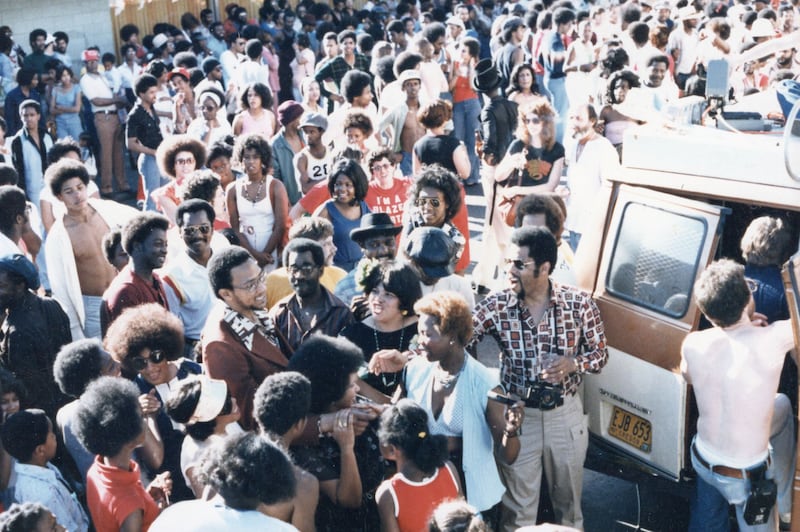
Listeners will recognize the familiar, mellifluous voice of Paul Knauls Sr., “The Mayor of Northeast Portland” (whose nightclub, The Cotton Club, hosted some of the most famous jazz acts in the country in the 1960s; Geneva’s, a neighborhood bar, famously hosted a massive block party following the Blazers’ 1977 championship win). The new audio tour also brings in several additional testimonies, by elder musicians and business owners, with musical interludes by pioneering Portland DJ J.W. Friday, spinning selections from such local R&B, soul, and funk acts as The Gangsters, Shock, Pleasure, The Fabulous Majestics, and the Legendary Beyons. Soul Walk North also devotes considerable and appropriate time to acknowledge the importance of Black churches to Albina, visiting the historic Vancouver Avenue First Baptist Church and playing music from such Portland gospel artists as the Rev. Louis Overstreet, Willa Mae Dorsey, High and Mighty (featuring the late, great drummer, DJ, and radio host Carlton Jackson), and the Youthsound Choir and Stage Band, which, in May 1982, performed at Jefferson High School, under the direction of veteran musician, educator, community leader, and current Albina Music Trust board president Kenneth W. Berry.
Media archivist and Albina Music Trust executive director Bobby Smith tells WW that since the first tour in 2021, the foundation has been able to add substantially to its collection. The Albina community archive now holds about 15,000 items, from 200 different private and organizational collections.
“The archive itself has grown immensely since that time,” Smith says, “so the variety of materials that have either come through our door, or that we’ve had the capacity to digitally preserve, has increased quite a bit.”
Soul Walk North, however, isn’t only a historical tour; it isn’t a stroll through the ruins of some bygone civilization. Incorporating the voices of local business and community leaders, it highlights ongoing plans and proposals for the revitalization of Albina, from building affordable housing to investing in Black businesses.
While the history of Albina has been well documented, its future is still unwritten. And though Albina is not the flourishing Black community it once was, the many voices in Soul Walk North, rather than mourn its loss, celebrate its potential.
“That’s a big thing that people talk about—they say that the community is not here,” Ward says. “It may not look like it, but, by the actions and the work, it’s still here.”
GO: Soul Walk North launches with a street party with DJ O.G. One at Lillis-Albina Park, 2451 N Flint Ave., albinamusictrust.org. Noon–4 pm Sunday, June 14.