Skip to main content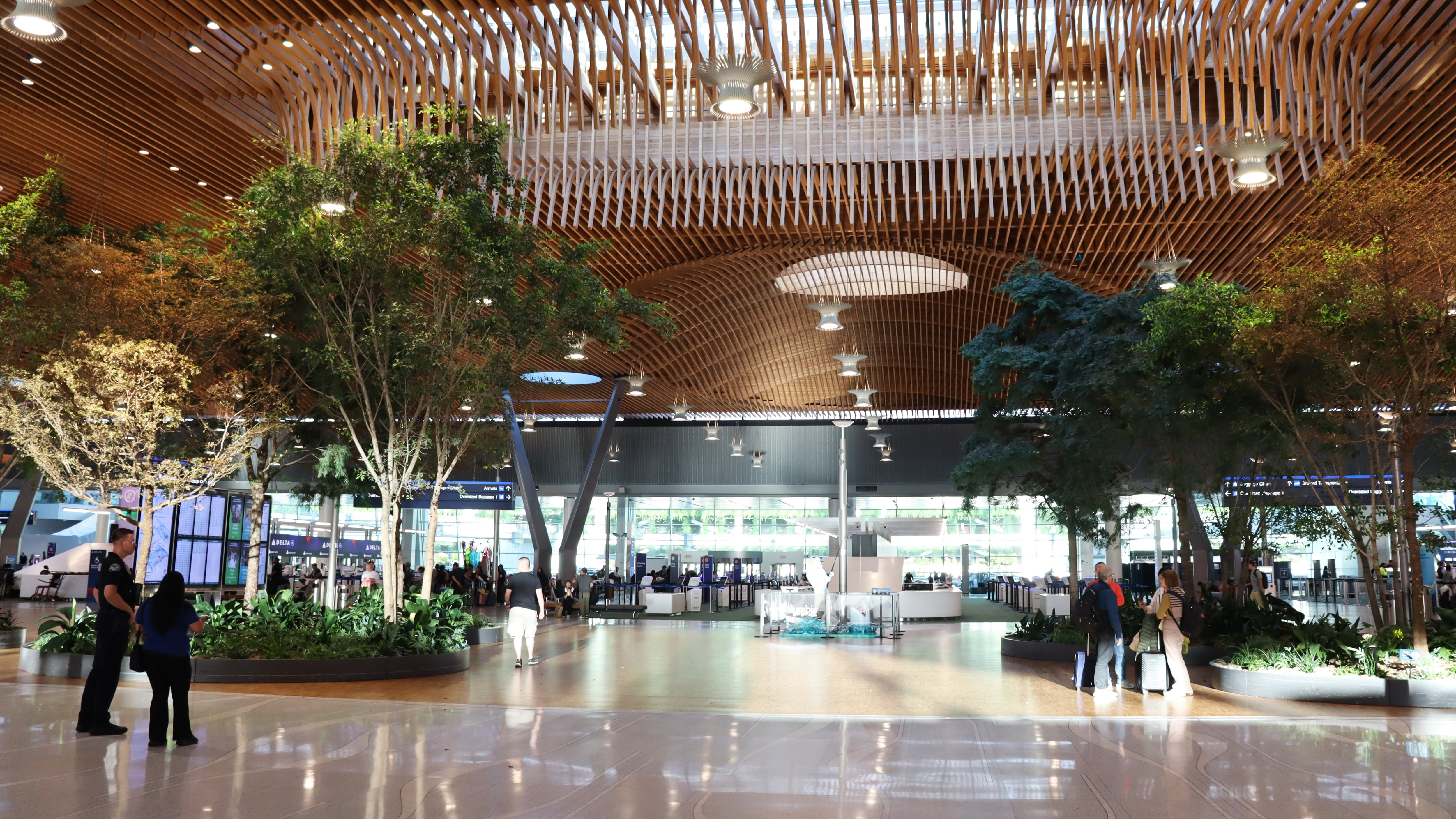
The first time horticulturist Elizabeth Snodgrass walked through the renovated Portland International Airport about a year ago, she took in the showstopping 9-acre mass timber roof. “Gorgeous,” she thought. Snodgrass noticed the 49 skylights and 36-foot-high window wall. Then she saw the 70 live trees, including black olive (bucida), African fern pines and Indian laurel fig trees.
“I sent a text to my business partner with an accompanying photo of the bucidas and said, ‘Good luck with this,’” Snodgrass says.
Snodgrass suspected the trees were set up for failure when she saw how far some of the Bucidas were from light sources. She would know: Snodgrass has been an interior plant landscaper in Portland for 40 years. She co-owned her own business, Kropf & Snodgrass, for most of that time before selling to a large local landscaping firm in December.
In July, the Port of Portland admitted several of the black olive trees were struggling when The Oregonian pointed out that some of the trees installed inside looked sickly, with leaves turning brown and dropping off. In the story and in information sent to WW, the port pointed the finger, in part, at PDX travelers. They said people had been dumping coffee into the planters and letting their dogs pee on the trunks, leading to the trees’ decline. The port has since posted signs in the planters that say “Please no liquid or litter.”
That’s not going to fix the problem, Snodgrass says. She has a lot of thoughts on the interior plantscape at PDX, though she is not connected to the airport in any professional capacity. (Kropf & Snodgrass’ roster of clients included the Louisa Apartments in the Pearl District, DWFritz Automation in Wilsonville, and OHSU’s Knight Cancer Institute.) She’s also got some hot takes on the recently deceased PacWest pine tree. This interview has been edited for brevity and clarity.
WW: What were some of your initial impressions of the PDX plantscape?
Elizabeth Snodgrass: I can’t even imagine how much that entire landscape is worth. When I saw it, I’m like, oh my God! In the old days, the big projects used to be malls like Washington Square. If you had a mall job in the ’80s, that would be a $100,000 or $200,000 job. So that’s got to be a million. [The landscaping budget was $2.4 million all in, according to the Port of Portland.]
Do you have any qualms with the trees they chose?
No. That’s what I would have chosen. But I would have said, listen, they need 500 foot-candles.
Candles?
That’s the way you measure light. I know, it sounds archaic. This is a specific kind of olive tree that’s used in interiors. It’s called Bucida buceras. If you want that tree, if you want it to do well, you need to provide it with 500 foot-candles of light. And to get that, you need to look at the location of the plants relative to the skylights. The trees that are dying, they’re not directly under the skylight. It needs to be super-bright light. So the leaves on the top of the trees are still OK, but the lower you get down around the lower part of the canopy, they were really suffering. So, to me, that’s an obvious light situation. They did put in lights that I know are not for ambience, it’s supplemental lighting.
Could coffee and dog pee actually be the primary culprits?
No, not in my opinion. I had an executive that had an 8-foot tree in his office and he would just pour his coffee when it got cold into his plant. It drove me crazy. The soil turned hard as a rock, but the plant didn’t die. So, I’ve seen this. I’ve done maintenance forever. And the pet thing? I mean, how many pets? That just seemed sort of like grasping at straws.
But could the dog pee be the main problem?
We would have a couple trees at the exit of the Louisa Apartments that would die because they had so much dog pee. Urine is high nitrogen, so eventually the plant will burn, especially if it’s in a container where the urine can’t leach out. I mean, if they really wanted to find out, they could take a soil sample and have it evaluated.
What would you do next? The airport is leaning toward replacing the struggling trees with ficus (fig trees).
I think it would be cool, if the trees are defoliating, if they just left them there. They’re kind of like sculptures.
Finally, I’d love your take on another famed Portland tree that just died, the PacWest pine on the 25th floor of the skyscraper downtown. It was there from 1984 until this spring, when an arborist declared it dead and replaced it with a cherry tree. What do you think happened there?
Not all trees live forever. There’s a natural decline, and that’s not a natural environment. There’s a limited soil mass on top of that building so it probably started getting stressed the older it got, and then it finally just died. I don’t think it’s that alarming. Things die. Half my job was trying to get people to throw plants out.