Skip to main content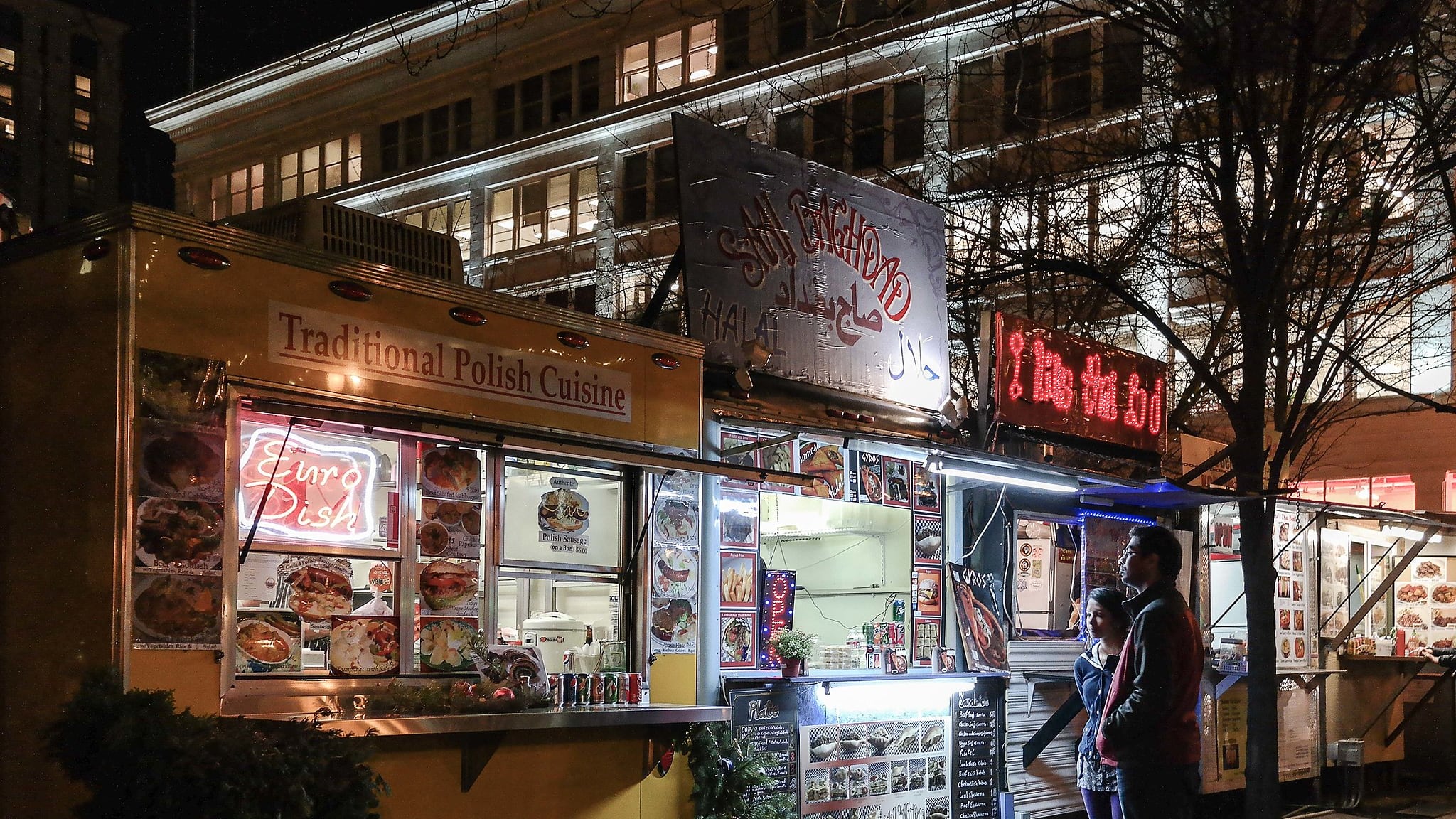
Two longtime food cart pods in downtown Portland will close later this year after the development company that operates them says the city’s new regulations around waste disposal are unreasonably onerous.
The two pods, operated on parking lots owned by the Downtown Development Group, are at Southwest 3rd Avenue and Washington Street, and Southwest 2nd Avenue and Oak Street. The former contains 15 food carts, and the latter has just four.
Matt Goodman, co-president of the real estate company, wrote about the impending closures in a July 28 email to Mayor Keith Wilson and the Portland City Council. Behind the closure, he said, are the city’s new regulations for waste disposal at food cart pods.
“Portland pod site owners are facing the dilemma of building a permanent restaurant-like pod site for a temporary use, or closing,“ wrote Matt Goodman, co-president of the company. “Portland’s decision to implement unique code requirements sends entirely the wrong message to small business owners and operators at a time when our city should be making great strides to keep them.”
The pod regulations are a product of the city’s local implementation of Oregon Health Authority rules that went into effect in 2023. Goodman said the city took the state’s rules a step further, requiring that pod operators have centralized waste disposal.
“Rather than simply enforcing the state code like elsewhere in Oregon, Portland now requires major infrastructure upgrades to the pod sites like sewer hookups and grease interceptors (items that may be appropriate for restaurants, not for temporary food cart pods),” Goodman wrote.
The city’s Bureau of Environmental Services, which oversees and enforces wastewater disposal, says 77 of the city’s roughly 90 pods have complied with the city’s new rules.
Bureau spokesman Brandon Zero said the city’s regulations—adopted in 2020 but not implemented until 2023 after the pandemic threw a wrench into things—created new wastewater standards for food cart pods that “loosely aligned with the sewer infrastructure most pods were already providing voluntarily, and appeared to eliminate the spills and illicit discharges that were common at pods that did not provide sewer infrastructure.”
Zero says that pods not in compliance were “sent multiple notifications between 2023 and 2026 and provided technical assistance upon request.” Seventy-seven of the city’s pods now comply, Zero said. Nine are “in development, have requested extensions, or have not yet reached the deadline”. Three are not in compliance.
“The regulations are placed on the properties, not the food carts directly, since property owners/operators have primary responsibility for site conditions and any associated discharges,” Zero said. “Connecting to the public sewer system provides individual food carts with better waste and wastewater services, while also better protecting the environment and the public by reducing spills and discharges.”
The Goodmans, a prominent real estate family that owns many of the parking lots across downtown Portland and some office and commercial buildings, don’t want to have to comply, and are therefore planning to shutter the pods later this year.
Goodman said in the letter that the city was hindering downtown recovery, comparing the waste disposal regulations to the Portland Bureau of Transportation’s brief attempt to extend paid parking hours downtown, a policy it retracted after backlash. “Although potentially benefitting the city’s finances, this policy was destructive on a much larger level...enacting rules that might further its own goals, but which inhibit the recovery of our downtown economy.”
District 4 City Councilor Mitch Green said he’s concerned about the two pods closing.
“I found the letter on my desk this [morning], read it, and was concerned to learn of this. I reached out to request a meeting with Mr. Goodman to learn more about his interaction with the city,” Green said. “I’m deeply concerned about the impact on our food cart scene based upon his account, particularly as a D4 councilor with a special interest in street food as part of our downtown economy.”