Skip to main content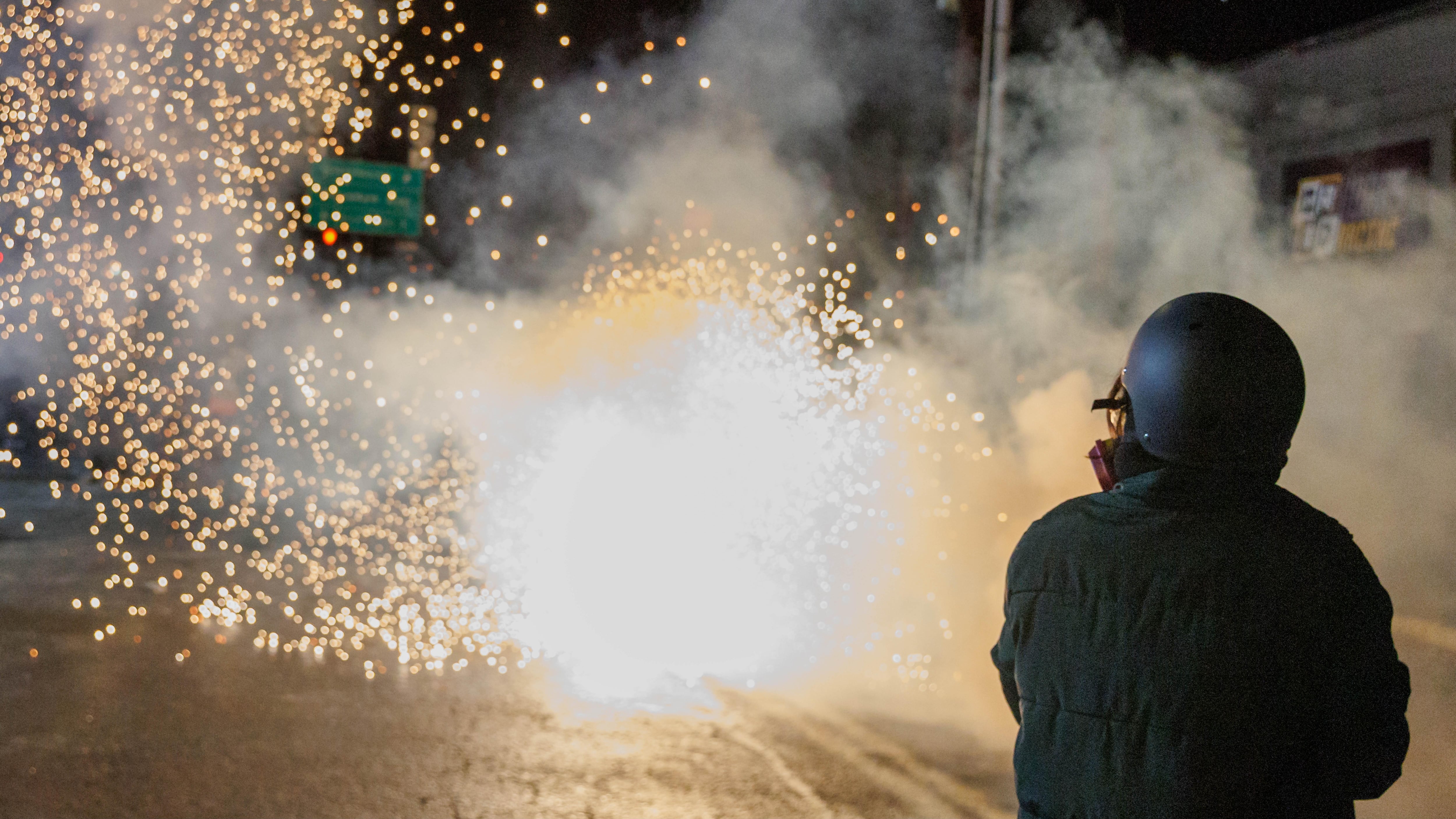
Three days after federal agents sparked outrage by deploying tear gas on a protest that featured numerous children, a federal judge on Tuesday severely restricted the Trump administration from using chemical or projectile munitions around the U.S. Immigration Customs and Enforcement facility on Portland’s South Waterfront.
U.S. District Judge Michael Simon’s order bans the use of the “less lethal” weapons except in situations of imminent danger. Imminent danger, the order makes clear, can not simply be trespassing, refusal to move, or refusal to obey a dispersal order.
“No Enjoined Person may direct or use chemical or projectile munitions, including but not limited to kinetic impact projectiles, pepper ball or paintball guns, pepper or oleoresin capsicum spray, tear gas or other chemical irritants, soft nose rounds, 40mm or 37mm launchers, less lethal shotguns, and flashbang, Stinger, or rubber ball grenades, unless the specific target of such a weapon or device poses an imminent threat of physical harm to a law enforcement officer or other person,” Simon wrote.
The judge added that a federal officer at Portland ICE could also not shoot such weapons at the head, neck, or torso of any person, “unless the officer is legally justified in using deadly force against that person.”
The court order marks a new phase in a case that has been months in the making, but which picked up steam in recent days with a rush of new filings. In the ACLU of Oregon-led class action lawsuit, journalists and protesters—including Jack Dickinson, the Portland Chicken—allege federal agents at the ICE facility have repeatedly assaulted them and violated their First Amendment rights.
Court filings recount a range of incidents of gratuitous violence against protesters. A video journalist says a federal officer shot him the groin. Dickinson says agents shot him multiple times with pepper balls, and guessed that feds exposed him to chemical munitions dozens of times over a five month span. Laurie Eckman, 84, recalled how an agent shot her in the head with a chemical impact munition. “I was coughing and choking,” she wrote in a court filing. “I couldn’t see. I was disoriented and very scared.”
She said she returned home soaked in blood.
In a statement to WW, Department of Homeland Security spokesperson Tricia McLaughlin said the First Amendment only protects speech and peaceful assembly—not rioting—and that federal agents in South Portland have faced grave threats.
“DHS is taking appropriate and constitutional measures to uphold the rule of law and protect our officers and the public from dangerous rioters,” her statement said.
In a separate case, federal judge found in November that federal “overstate the degree of physical danger they faced at the ICE facility.”
And it’s not just protesters who feel the feds have been overly aggressive too. Asked to evaluate the police work of feds in Portland, Gil Kerlikowske, a former chief of U.S. Customs and Border Protection, as well as the Seattle Police Department, was unimpressed.
“DHS has exhibited a consistent pattern of deploying excessive force against protesters and journalists around the ICE Building,” he wrote in a court filing late last month, “including by using force against people who are not engaged in threatening acts, misusing crowd-control munitions and teargas, and indiscriminately using force that needlessly injures people who pose no threat to law enforcement.”
The plaintiffs sought a temporary restraining order in recent days, and the judge’s opinion grants their request. The order last two weeks, during which period the plaintiffs may try to seek a more durable restriction.
In his 22-page order, Simon, the judge, wrote that violent against protesters seemed to be escalating, and his decision suggests he believes the plaintiffs are likely to succeed in their claims if the case makes it to trial.
But he began his opinion with language indicating he saw the case in a larger context.
“In a well-functioning constitutional democratic republic, free speech, courageous newsgathering, and nonviolent protest are all permitted, respected, and even celebrated,” Simon wrote. “In an authoritarian regime, that is not the case. Our nation is now at a crossroads.”
This is not the first time Simon has been assigned a case involving the ICE facility. Owing to his marriage to U.S. Rep. Suzanne Bonamici (D-Ore.), he recused himself last year from an earlier case regarding the Oregon National Guard—not, he said at the time, because it was required, but because it was necessary that the focus of that lawsuit remain on that case’s critically important constitutional and statutory questions.
In a statement, another member of the Oregon delegation to Congress, U.S. Sen. Ron Wyden, called the ruling a win for Oregonians who care about common decency. “The judge,” he said, “put it well when he stressed how the First Amendment sets America apart from totalitarian regimes.”