Skip to main content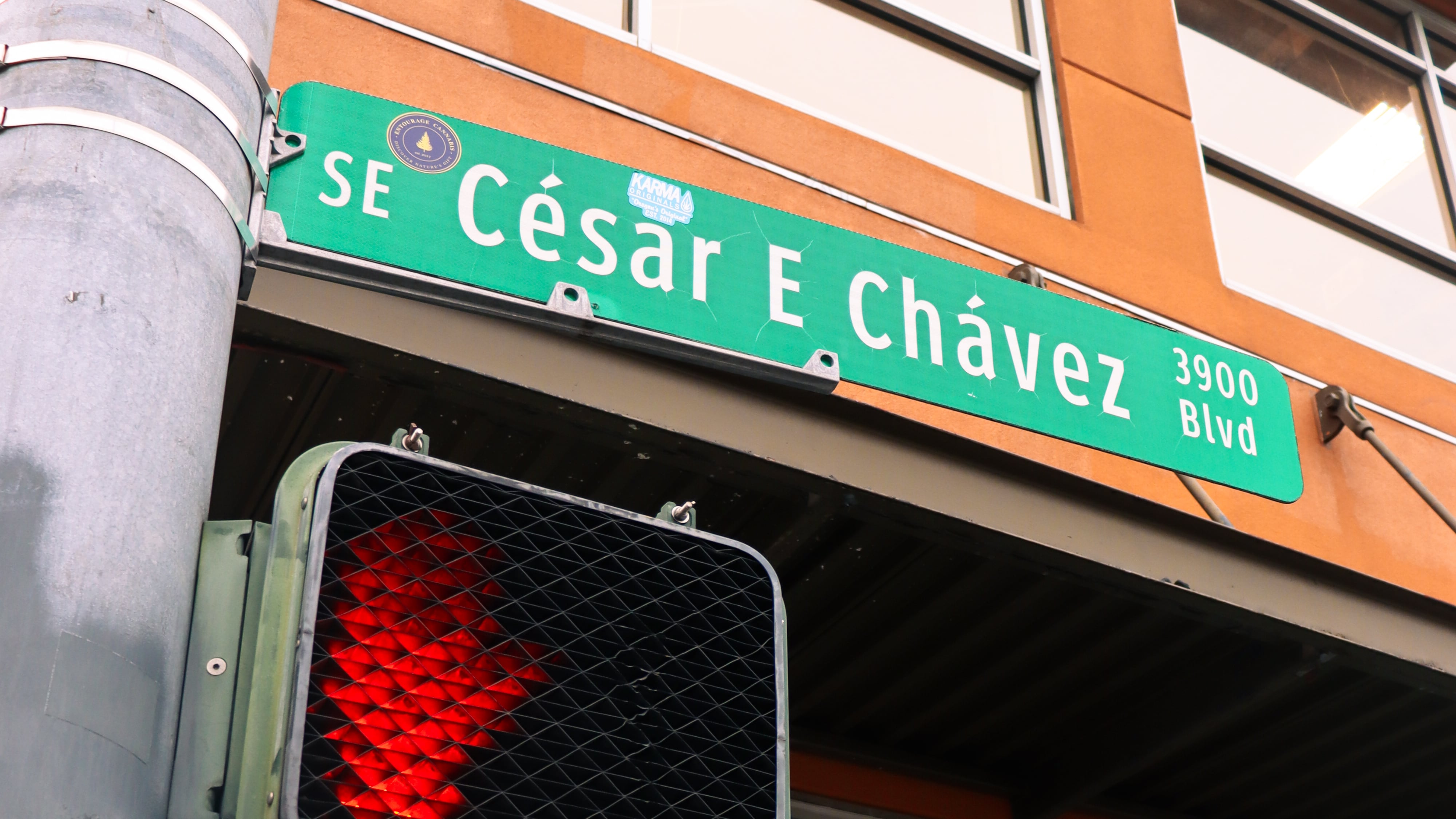
PORTLAND CITY COUNCIL MULLS CAMPESINOS BOULEVARD: Portland city councilors appeared eager May 26 to rename Northeast and Southeast César E. Chávez Boulevard to Campesinos Boulevard. Councilor Loretta Smith brought an ordinance forward late last week proposing that the street be renamed after campesinos, or farmworkers, in light of a New York Times investigation published in March that found Chávez, a co-founder of the United Farm Workers union, had sexually abused multiple young girls and women throughout his career. Smith told WW on May 22 she’d engaged with a number of important stakeholders while developing the ordinance, and said Pineros y Campesinos Unidos del Noroeste, or PCUN, was central to the name selection. “The name ‘Campesinos Boulevard’ centers the farmworkers themselves,” Smith said at the hearing. Constituents at the hearing spoke overwhelmingly in support of the name change—a striking contrast to online calls to change the boulevard back to 39th Avenue. Said Marta Guembes, a Por La Causa Committee co-chair who also helped lead the effort to rename 39th to César E. Chávez: “The ordinance before you today is about telling a fuller truth and choosing values larger than any one symbolic individual.” A few residents opposed the resolution because it waives certain city ordinances. The Public Works Committee sent the resolution to the full council with a unanimous recommendation to pass.
SITTING CIRCUIT JUDGE OUSTED: It’s unusual for a sitting judge to receive an election challenge, let alone lose. But little was typical about the first and only term of Multnomah County Circuit Judge Adrian Brown, who was unseated May 19 by public defender Peter Klym by 70% to 29%. Brown was the subject of a prosecutorial boycott by District Attorney Nathan Vasquez, who filed a court memorandum alleging she did not try Measure 11 criminal cases impartially; she was reprimanded by the court’s presiding judge for asking her colleagues to cover her trial docket while she campaigned; and she missed the deadline to file a statement in the Voters’ Pamphlet. (This oversight was particularly damaging, as Klym’s name was the only one voters saw when consulting the pamphlet.) Also unusual: The day after results arrived, Brown sent an email to her supporters suggesting Klym lied his way into office. “His comments were unprofessional, they misrepresented my record as a judge, and they were misleading to voters,” Brown wrote. “There will be other opportunities to set the record straight—for now we go forward with goodwill.” Reached for comment, Klym told WW: “Judges need to remain above the fray and not engage in public squabbles with elected officials or make unsupported—and knowingly false—insinuations about incoming officials. I will adhere to those tenets and focus on the job.” One loose end from the contest: Brown filed a public records request for all correspondence from Vasquez mentioning her, including communications with reporters.
EQUITY AND RESOURCES TOP OF MIND AS PORTLAND SCHOOL BOARD WEIGHS SCHOOL CLOSURES: A resolution to be presented May 26 to the Portland School Board after WW’s press deadline outlines the clearest guiding principles and work plan yet for Portland Public Schools’ school closure process. As PPS considers closing five to 10 schools by fall 2027, the resolution establishes four priorities: All students across the district should have access to well-resourced schools (currently, uneven enrollment distribution makes this difficult); schools should be safe and healthy learning environments; PPS should provide options of both robust neighborhood schools and choice programs; and the district must consider how decisions might affect its most at-need students. (PPS defines “most impacted focal students” as Native students, Black students, multilingual learners, those receiving special education services, and those experiencing poverty.) If approved, the resolution would implement a work plan requiring PPS to conduct a data analysis of schools it identifies to close and an “equity impact analysis” of closure scenarios it presents. That analysis would assess everything from access to specialized programs to Title I status.
OVERDOSE DEATHS PLUMMET BUT OREGON RATE STILL HIGH: Oregon saw a sharp decline in drug overdose deaths in 2025, according federal data, as an opioid-fueled drug crisis continued to recede nationwide. Oregon’s improvement was better than in most states, but it also started 2025 in a relatively worse place. After years of troubling trend lines, the U.S. began to see a reduction in overdose deaths in mid-2023, but both the peak and decline began slightly later on the West Coast. Since 2023, Oregon’s overall drug overdose death rate has declined from 40 to 25 per 100,000 people. This remains higher than the national average of 19 per 100,000. The broader figure is about even with levels nationwide before the COVID-19 pandemic, although it remains far above historic U.S. rates. Researchers at health policy organization KFF attribute the recent improvement to a number of factors: expanded treatment access, overdose-reversal drugs, public awareness efforts, and a shifting drug supply. The drug data does not include alcohol-induced deaths—an area in which Oregon has long ranked grimly high (it peaked in 2022 at 25 deaths per 100,000 people). Here, as in the U.S. overall, alcohol-fueled deaths spiked following the pandemic, but have recently seen a slightly downward trend.
MIDYEAR ASSESSMENTS AT PPS SHOW PROGRESS IN READING AND A SLIDE IN MATH: Data from Portland Public Schools’ winter benchmark assessments show signs of growth in reading, but a slight slide in math proficiency among students in grades 3 through 8. The district tests students at different points during the school year using two computer-adaptive exams that increase question difficulty if a student answers correctly and vice versa. In reading, students at grade level or higher jumped from 61.5% in fall to 64.9% in winter, with more significant gains in grades 3–5. Achievement in reading also increased significantly among some student groups of color, though disparities continue to persist between those scores and white student achievement in the district. In mathematics, proficiency decreased slightly from 58.1% to 57.3%, with the same students in earlier grades losing a bit more progress. Dr. Renard Adams, the district’s chief accountability and equity officer, told School Board members May 14 that measuring growth is important because it indicates to the district if students are improving, even if they’re still behind. “When you’re in a school that has lower achievement or students who are further from their grade-level expectation,” he said, “you could have worked really hard as a teacher and gotten that student up a whole grade level, but if they’re two grade levels behind, the end-of-the-year assessment is still going to show you that you didn’t make it.”