Skip to main content
As director of the Small Donor Elections program for the city of Portland, Susan Mottet holds the keys to the public coffers that can bankroll a city councilor’s bid for reelection. The program’s first and only director, she evaluates whether candidates have received sufficient grassroots support to unlock ascending tiers of taxpayer dollars—up to $300,000 per candidate for City Council.
Yet last year, records obtained by WW show, Mottet used her free time to lobby city councilors on behalf of a progressive interest group. Lobbying reports list Mottet attending four meetings in 2025. (Prep time for such meetings counts as its own distinct lobbying activity; records reflect Mottet prepared for two of those meetings.)
The fact that a city director was lobbying the same elected officials to whom she might later allocate public campaign finance dollars raises ethical questions for some observers, who say it could compromise Mottet’s neutrality during election season.
“As a public official overseeing the operations and enforcement of an elections program, your conduct must be beyond reproach and avoid any hint of bias,” says longtime Democratic political consultant Jake Weigler. “Conducting advocacy while in that role risks eroding trust in the program, both among those running to serve on City Council and the general public.”
Two incumbent Portland city councilors seeking reelection and currently participating in Mottet’s program said her lobbying activities struck them as unethical and concerning, but because they were seeking money from her program, they feared saying so on the record.
Mottet has defended her lobbying, though declined to answer questions about whether she felt it compromised her neutrality as an elections officer. She directed those questions to the city’s communications team, which said it saw no red flags in the matter.
“On my own time, I volunteer for a nonprofit in advocating for policies that give Portlanders a more meaningful voice in front of City Council,” Mottet told WW in an email. “Community feedback is essential to a healthy democracy, and that matters to me personally.”
The Portland City Council voted in 2016 to create a public campaign financing program by which candidates who accepted small campaign contributions could unlock matching funds from taxpayers.
City commissioners at the time said the program would work to neutralize well-heeled private interests that had historically dictated the outcome of local elections by pouring money into the campaign coffers of their chosen candidates.
Leading up to the council’s vote, commissioners were lobbied aggressively on public campaign financing by progressive groups working to implement such programs across the nation. One such lobbying group was Every Voice. In 2016, Every Voice—and Mottet, then its state legislative director—took dozens of meetings with commissioners or their staff to advocate for the idea. It worked. The council approved what would later be called the Small Donor Elections program.
The program went live for the first time in 2020. Though it’s gone through some changes, the fundamentals have remained the same: Eligible contributions from Portland voters are matched by taxpayer dollars. This election cycle, contributions up to $25 are matched at a ratio of 10 to 1. That means an eligible $5 contribution can turn into $55 for the candidate. For November 2026, that means each candidate running for City Council can unlock up to $300,000 in matching funds.
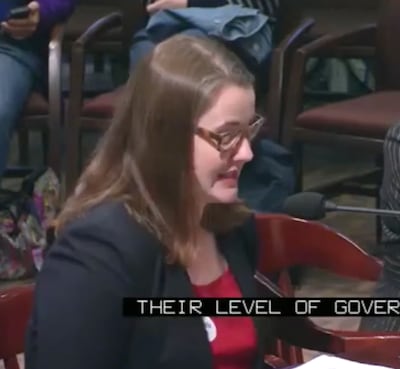
Mottet, who had lobbied the council on the program, was hired by the city as the program’s director. It made sense: She was an expert on public campaign financing and had spent two years urging elected officials to adopt such models. And she had come from a background of progressive lobbying and advocacy. Prior to working at Every Voice, she’d worked as legislative director for Progressive States Network, which supported left-leaning state lawmakers and tracked legislation nationwide.
For much of the past eight years that Mottet has run Small Donor Elections, the nascent program has sparked some level of controversy—in part because it could not disentangle itself from bitter local politics.
In 2022, Mottet issued a large penalty to then-City Council candidate Rene Gonzalez for accepting deeply discounted campaign office space from a wealthy donor. Her program fined his campaign $43,890 and required that it pay $33,250 to the office’s owner. Gonzalez appealed the decision in court and won.
In 2024, the program encountered another rash of problems. With nearly 100 candidates running for 12 council seats along with mayor and city auditor, the program saw candidates getting creative with ways to unlock program funds, or at least try. One candidate who owned a downtown bar required patrons to pay an inflated cover charge one night that would go directly to his campaign. And more than a dozen candidates agreed to swap contributions in an attempt to unlock matching funds, a strategy the Oregon Department of Justice this year determined was a probable felony, though the state declined to prosecute.
Mottet knew about the contribution swapping weeks before it was first reported, WW found. Yet she told the whistleblower the program’s rules were silent on the matter and that she’d have to take it up with the Secretary of State’s Office. (Mottet defended her response and, to her credit, quarantined all contribution swaps to determine which were actually eligible for matching funds.)
The program is chugging along this year with just 13 candidates having qualified—a much more manageable number than the 54 in 2024.
Despite the setbacks, candidates in general seemed to like the program, and the Portland Elections Commission has said in annual reports that the program is working as intended. “The program, in combination with ranked voting and district Council elections, fulfilled its promise,” the commission, which oversees Mottet’s program and provides guidance when problems arise, concluded in its 2025 report.
But in July, in the buildup to the November election, Mottet was embroiled in another controversy. She recorded video of a petition circulator gathering signatures for a ballot initiative that would have rerouted 25% of tax revenues from the Portland Clean Energy Fund to hiring some 400 police officers. Her video showed the circulator misrepresenting what the initiative would do, saying it would reduce 911 response times. Backers of the ballot initiative complained that Mottet’s activism indicated bias at City Hall—but Mottet correctly pointed out that her office had no role in verifying petition signatures.
“I openly and legally recorded a signature gatherer engaging in illegal activity that undermines the integrity of the ballot measure process,” she told WW at the time. “These violations of election law that I—and many others—witnessed are alarming, and the government must take action on them.”
Her efforts to lobby City Council members, however, reveal a direct interplay with her gatekeeping of public campaign dollars.
Disclosures maintained by the city of Portland show that Mottet met with city councilors or their chiefs of staff five times last year as a lobbyist. She lobbied on behalf of Portland Forward, a progressive organization led by James Ofsink, a longtime citizen activist who has both managed campaigns and sought elected office himself as a member of the Pacific Green Party. (Another of Portland Forward’s primary lobbyists is former mayoral candidate Jefferson Smith.)
Reports show Mottet lobbied three city councilors last year: Tiffany Koyama Lane, Candace Avalos and Elana Pirtle-Guiney and two of their chiefs. Topics of discussion listed in the disclosures include: “investigate shared priorities”; “discussion of council operations/rules”; “discussion of meaningful community engagement in the legislative process”; “support democracy improvements for council operations”; “city housing action update”; and “city democracy enhancement.”
Koyama Lane tells WW she doesn’t think Mottet’s lobbying compromises her role as a regulator. “I don’t feel pushed to make decisions based on that,” Koyama Lane said. Pirtle-Guiney had a different take. “As a former staffer, I believe public employees should be able to be civicly active, but there are many ways to do that without directly lobbying the same candidates who you have a duty to support on an even playing field. While Susan Mottet was very clear with me that she was on her own time, I can understand why current candidates would be uncomfortable being lobbied by the person who conducts oversight of campaign financing.”
Avalos said her meeting with Mottet was unrelated to her official work and that she has “yet to see any evidence that her personal involvement with civic engagement initiatives affects her professional capacity to serve as a neutral regulator.”
Dan Mason, who served on the Oregon Government Ethics Commission for eight years until 2025, says Mottet should have disclosed to her superiors a potential conflict of interest given her position of authority over councilors running for reelection.
“The livelihood of the city councilors is based on their ability to raise money, and she is the arbiter of that,” Mason tells WW. “If you’re a city councilor, you absolutely know who’s in charge of that program and where that could go. She fits a super-lobbyist-type influencer that could have more impact even if she doesn’t realize it or acknowledge it.”
Mason says Mottet, by being in a position to “help decide the outcome of elections,” is in a “very powerful spot” that isn’t lost on councilors she may have lobbied.
Portland Forward lobbyists, not including Mottet, continued to meet with one councilor in particular this year—Steve Novick—about bringing “civic assemblies” to Portland. Those are gatherings of citizens tasked with studying public issues and recommending action to lawmakers. Since early 2025, Portland Forward lobbyists also lobbied Councilors Angelita Morillo and Eric Zimmerman, records show.
To complicate matters further, Ofsink himself serves on the Portland Elections Commission. The commission’s chair, Amy Sample Ward, declined to comment on Mottet’s lobbying, saying it would be “inappropriate for the PEC to comment on protected activity that city employees engage in on their free time.”
Ofsink says Mottet joined Portland Forward as a lobbyist in early 2025. The group has recently lobbied councilors on “improving public engagement under the city’s new structure of government,” Ofsink tells WW, but the group’s most intensive lobbying has historically been on public campaign financing. Although Portland Forward has “advocated for campaign finance reform since its inception in 2017,” Ofsink says, the group has not met with councilors specifically about Mottet’s program.
To be sure, the city’s “statement of ethical conduct” does not appear to explicitly prohibit city employees from lobbying elected city officials on their personal time, and city code is silent on a specific scenario in which someone who regulates city councilors’ reelection campaign funds is allowed to lobby those same councilors. But it does state that “employees are expected to conduct themselves in a manner to avoid the appearance of impropriety” and that “employees are expected to recognize the possibility of a potential or actual conflict of interest they may have and disclose the conflict, in writing, to their supervisor and Bureau director.”
Mottet reports to City Administrator Raymond Lee, who, according to city code, “will provide program oversight and have the authority to hire and terminate the Director.” When asked if she had disclosed her lobbying activity to higher-ups, Mottet said she had not: “The definition of a disclosable activity is not met.”
A city spokeswoman says Mottet’s lobbying was proper and does not affect the integrity of her program.
“Councilors participating in the Small Donor Elections program are not placed under any undue pressure because the administration of matching funds is governed entirely by statute and objective program rules,” says spokeswoman Alison Perkins. “Any personal lobbying Susan engaged in last year was on issues unrelated to campaign finance and is separate from her official responsibilities.”
Perkins says Lee had no comment on the matter because he became city administrator in December—two months after reports show Mottet last lobbied.