Skip to main content
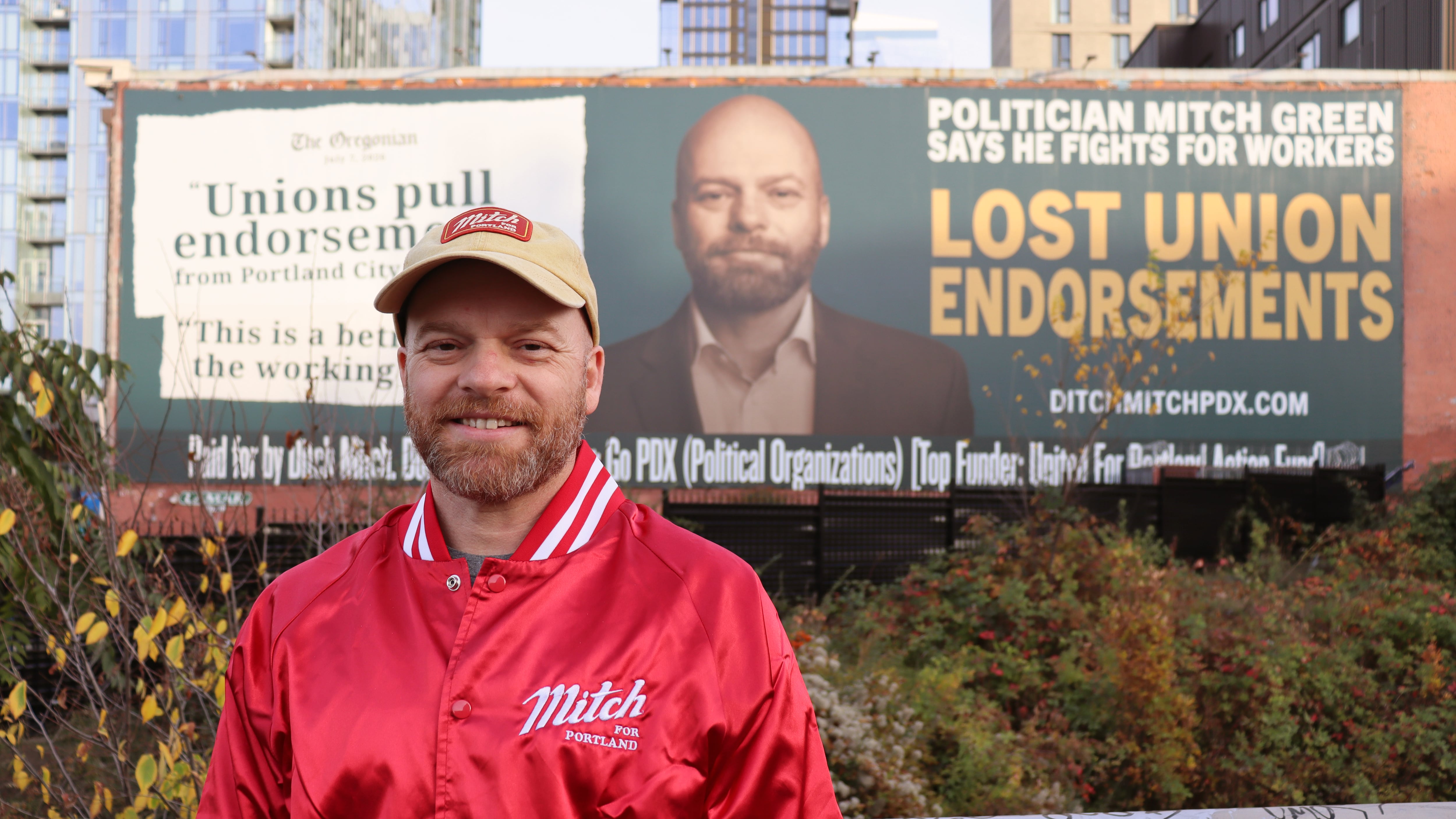
The October revolution against Portland City Councilor Mitch Green failed to depose him. Now all that’s left are the monuments: billboards scattered along the highways memorializing the boardroom attempt at regime change.
Business interests marked Green, 44, as the Democratic Socialist to target in the Nov. 3 election in order to reshape the balance of power on the City Council. Elected in 2024 among the first wave of councilors in a new and expanded form of Portland city government, Green played to win in ways both small (successfully banning foie gras, trying unsuccessfully to legalize sidewalk hot dog vendors) and more ambitious, like seeking to tax CEO compensation and investigate Zenith Energy and its management of the Northwest Portland oil terminal.
He was also his own worst enemy.
WW revealed this summer that Green violated multiple burn bans by starting a brush fire in his backyard, and The Oregonian reported that he failed to pay a $7,000 property tax bill. Add in a cache of old tweets raging against Portland police officers, and business interests saw an opportunity to break a 6–6 council deadlock by unseating Green in District 4, where westside voters skew slightly less progressive than their eastside counterparts.
Cue a $75,000 “Ditch Mitch” billboard campaign by Unity PAC, the political arm of the Portland Metro Chamber that was funded in large part this election cycle by the police and firefighter unions.
The billboards did nothing. In fact, perversely enough, all the attention might have helped Green. Contributions flooded his campaign after the tweets dominated a new cycle, and the latest returns show he narrowly finished second behind Councilor Olivia Clark in the race for three District 4 seats.
In fact, not a single city councilor lost their seat last week—a static outcome that has inspired much gloating, second-guessing and gnashing of teeth about ranked choice voting as an “incumbent protection program.” Meanwhile, at the Democratic Socialists of America’s election night party at White Owl Social Club, the crowd chanted, “Mayor Mitch! Mayor Mitch!”
We caught up with Green, 44, this week before he sat down for Double Mountain Brewing pizza and his regular game of Dungeons & Dragons. These days, he plays a savvy rogue. The interview has been lightly edited for brevity and clarity.
WW: Word around town is that the DSA wants you to run for mayor in 2028. Have you discussed it?
Mitch Green: No. That’s something that people have bandied about. I say, let’s just focus on me learning how to be a good city councilor first. I finally got a full four-year term.
Have you ruled it out?
Oh, I haven’t ruled out anything. I think it’s in bad taste to run for office and immediately think about the next office. And so if I’m called to do that, and there’s the political appetite in this town to make a bid at the mayor seat, then we’ll evaluate that next year. But for now I’m just going to focus on being a city councilor.
So who was the first member of the Mod Squad you spoke with after the election and what did you say?
Steve Novick. We basically said the same thing to each other. I sent him a text saying, “Congratulations. Really good showing. I’m relieved”—something to that effect. I was worried he was going to get bumped out by Kellie Torres. And I would prefer to work with Steve.
Is there any reason to think that the next two years on council will be any less pissy than the last two?
I think there is, partly because at the end of the day, we are human beings. And I think that there’s a slipping appetite for that style of vitriol. It’s exhausting. I don’t particularly care for it. And I think that there may have been a feeling that, “Well, maybe Mitch or Angelita or Tiffany get bumped out of here, then that solves the problem for us.” That clearly did not happen. Nor did we pick up another left-flank progressive. So we’re stuck with each other, and I actually think that’s a good thing because it sort of settles the question. This can’t just be about personalities. It has to be about structures.
So I’m going to be here for four years. Steve Novick’s going to be here for another four years. We’re going to have to figure this out. But I’m optimistic. Maybe I’m being naive.
Business groups and public safety unions spent $75,000 on billboards to attack you. Why do you think that didn’t work?
Well, first of all, they ran some billboards in East Portland. There’s one out deep on Foster Road east of 82nd Avenue. They were scattered around town in ways that weren’t necessarily targeted. I think the first question is: Who advised that? Did you have a consultant you were working with? Because if you did, you should probably never use that consultant again. It’s a good way to burn some money.
And also, the messages. Yes, I had a fire in my yard. Yes, I paid my taxes late. But there were probably some better areas you could have got me on. I didn’t see foie gras on any of those billboards. That would have been a more effective attack, in my view. They didn’t do that.
I think it gave me some awareness. I heard from a lot of people who said, “I just moved to Portland and I googled you because of the billboard and I like your politics. I’m going to vote for you.” I think it had a sort of reverse polarizing impact on some Portlanders.
Sort of a reverse Streisand effect?
Yeah, I guess so. And also it was a good-looking photo.
There’s a lot of talk among the Peacock cohort that media coverage of your tweets expressing hatred for the police actually gave you a bump. Do you think that’s true?
I think it’s definitely true. It certainly helped my fundraising. And also if you look at Google Trends data—which is not a perfect measure of sentiment, but it does tell you what people are searching for—on Sept. 16, it was the biggest search day of my name in the history of me being in public life. It was five times the exposure I got during the peak of the campaign cycle in October.
Has the new system of voting made it harder to unseat incumbents?
That’s a good question. I think it depends on which incumbent you are. If you look at my district, I would make the argument that the marginal person is Eric Zimmerman. He’s the one who has to fight tooth and nail for every vote. But ranked choice voting with multimember districts is designed to give weight to political interest groups that don’t always have a majority voice. That’s definitely a tailwind for me.
I do think the playbook has changed, and I think that the political consultants who run campaigns in this town haven’t figured it out yet.
But with the campaign over, as you take stock of the backlash, do you ever think, “You know what, some of that was on me”?
No question. The two big ones: Being late on my taxes and the fire in my yard were not great. I take ownership of that. If I continue to have missteps like that, then I would expect no grace, frankly.
On the policy side: When you’re in office for only two years, you try to do as much as possible. I think I might have bit off more than is reasonable for a 24-month period. I think I did lose some focus at some times. I went down a road trying to legalize hot dogs for sale on sidewalks, which I thought would be way less controversial than it was. Turns out, it was deeply offensive to the large property owners and the Metro Chamber. I also had some people on the left who were like, “I don’t want you to do foie gras or hot dogs. I want you to tax the rich”—those bread-and-butter core socialist things.
Is the hot dog idea dead?
It’s not dead.
It seems election night was a very bad night for Trail Blazers owner Tom Dundon. You’ve got Ron Wyden now in charge of the Senate Finance Committee. A lot of states that Dundon was looking at to move the team to are now run by Democrats. Does the election give you any hope you can drive a better bargain?
I think the fact that there was not a compositional change in the council is the best thing we have going for us when it comes to that deal. We have all the leverage. We have the first-class standard for Moda Center that we are not going to yield on, and he knows it. And he wants out of it so desperately. And there’s nowhere to move this team. Not going to be Kansas City; they just voted no on another referendum. I don’t think there’s another market that’s better than Portland, and Tom knows it. I think that Tom Dundon’s biggest hurdle is himself.
How are politics and Dungeons & Dragons the same?
You do have to tell a compelling narrative in both cases.