Skip to main content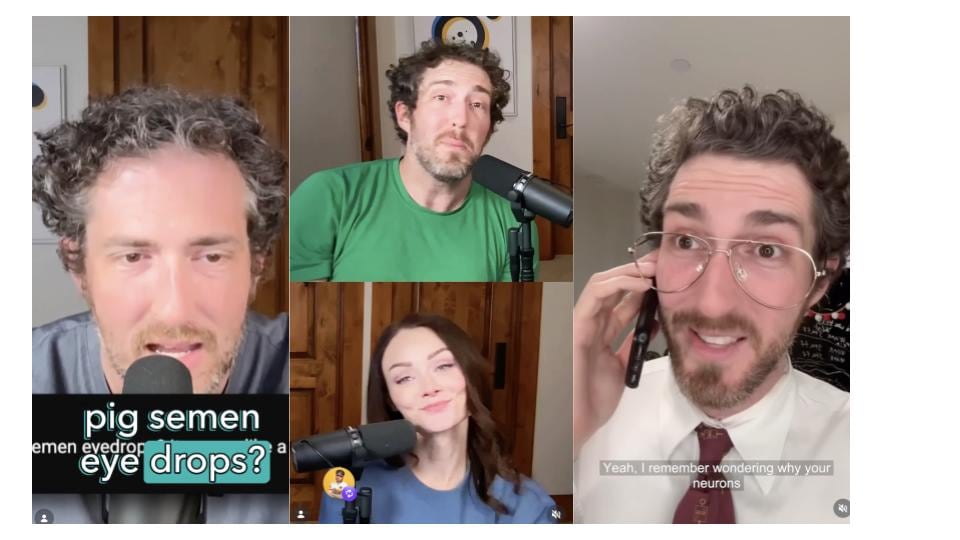
It was not so many generations ago that the bedraggled American doctor spent long nights traversing mud-slicked roads, or fending off some new-to-town competitor armed with a week or two of medical education and evangelizing some cockamamie new treatment.
Solidarity under such circumstances did not come easy. In time, though, doctors—in part through licensing boards, medical schools and associations, and epochal advances in medical science—successfully organized to greatly improve their collective social and economic status, establishing one of 20th century America’s true secular priesthoods.
Dr. Will Flanary, the ophthalmologist who practices by day at Eye Health Northwest’s Oregon City and Wilsonville clinics, but is known to his 2 million-plus TikTok followers as Dr. Glaucomflecken, is an heir to this legacy.
And he’s not alone in wondering if physicians today—increasingly divided by specialty, besieged by corporate overlords, competing with charlatans for attention—might better organize to improve their and their patients’ lot.
Flanary happens to see an obvious venue where doctors could do this: social media.
It’s the domain where he has achieved fame through winking, insiderish comedy and satire sketches about the health system. But its downsides are no secret. On TikTok feeds the world round, doctors are set on an equal plane with “coaches” and “entrepreneurs,” whose own health and wellness advice gets imbibed, according to a recent Pew Research Center study, by a huge chunk of the U.S population.
And yet Flanary sees in social media untapped potential for his profession. Today, he says, siloed medical specialties pursue narrow political interests through their respective boards and associations. Yet they remain, in his view, otherwise quite isolated from one another. Work patterns and political proclivities vary enormously between, say, your average surgeon and a family medicine doc, and getting everyone together is “like herding cats.” Plus, Flanary feels, many associations are themselves captured by private equity interests.
“A lot of people are more just looking out for themselves, and by themselves, I mean their own specialty,” Flanary tells WW. “We got to get past that. And I think social media is a place where it’s much more communal, and everyone is seeing the same content. And we’re going to make that happen.”
Not long ago, an aide to U.S. Sen. Elizabeth Warren (D-Mass.) reached out to see if Flanary would promote the “Break Up Big Medicine Act” she was developing with U.S. Sen. Josh Hawley (R-Mo.).
Game for it, Flanary drafted a script casting Warren in a video as a naive patient, and himself on the other side of the phone as the insurance company, the doctor’s office, the pharmacist, the pharmacy benefit manager—all of whom, the patient slowly learns to her disgust, happen to be one person. (“She did a great job,” Flanary said of the senator.)
Glaucomflecken content has gotten more expressly political lately. In recent months, Flanary has posted various videos, for example, about the fight Eugene emergency physicians successfully waged against PeaceHealth to keep control of various area emergency departments. Flanary’s wife, Kristin, is in on the action too, emphasizing, in videos, speeches and on their podcast, Knock Knock, Hi!, how the health system neglects patients’ loved ones.
The couple sometimes appears in more buttoned-up contexts too. Seated together on a couch, the Flanarys are among those who dispense periodic nuggets of health system criticism in Suck It Up, Buttercup: Trust & Betrayal – Healthcare in America, a new documentary about corporate control of medicine that screens in Portland Sunday afternoon at PAM CUT’s Tomorrow Theater. (The Flanarys are billed as special guests.)
It’s a long way from GomerBlog, the now-defunct website Will describes as ”The Onion for medical folks” to which he began contributing as a med student at Dartmouth, around the time he was diagnosed with testicular cancer.
Later, in residency in Iowa, he says he got another cancer diagnosis. But if comedy helped him cope, it was a time-consuming hobby. After Will got on Twitter, Kristin—they’d been together since college in Texas—recalls coming home to find her husband in the corner on his phone, giggling.
“I’d be like, ‘What’s so funny?’” she recalls. “And he tried to explain the joke to me.” There was, of course, little reason a normal person would find some Twitter inside joke funny. “So, it’s like, ‘I think if I’m ever going to talk to you again, I have to be on Twitter to do it.’” Thus was born Lady Glaucomflecken—a “heckler” to Dr. Glauc.
Paul Starr’s 1982 epic Social Transformation of American Medicine: The Rise of a Sovereign Profession and the Making of a Vast Industry stands today as a seminal history of the U.S. medical profession. Today, the author and American Prospect co-founder cites AI, corporate medicine, and U.S. Health Secretary Robert F. Kennedy’s Jr.’s MAHA movement—largely a social media phenomenon—as recent trends reshaping the social authority of doctors. Starr tells WW that he doesn’t think media technology ever played a significant role in the medical profession’s historic development.
Yet he is impressed with Flanary’s work.
“I just watched that doctor’s video on ‘Corporate Medicine on Trial,’ and he’s terrific,” Starr wrote in an email, having been asked about Dr. Glaucomflecken. “I wouldn’t call it comedy—it’s just well-done criticism.”
Dr. Glaucomflecken became a short-form video personality years ago. In his primary mode, he acted out caricatures of, say, the “surge bro,” or the hospital administrator. (“Happy Nurses Week, everyone. On behalf of the entire administration, I am happy to present all of you with a banana because we are BANANAS over the care you provide to our patients.”)
Especially during the pandemic, the idea was to give harried medical workers something to laugh at after a long day. But if there was a pivot point in their material, the Flanarys trace it to one real-life night in May 2020 when Kristin recalls waking up to a strange sound: Will was gasping for air.
She remembers how the 911 operator instructed her how to do chest compressions—the kids were in the room next door—and how emergency responders, decked out in COVID-era hazmat gear, shocked her husband’s body several times before whisking him to the hospital.
Obviously, he survived—presumably thanks in part to the awesome powers of modern medicine. But the cardiac arrest and its aftermath offered new perspectives on the U.S. health system’s dark, comic absurdities. Where, for example, Will says, the hospital to which he was taken was “in-network,” the doctors that took care of him there were “out of network”—and surprise bills flowed forth.
After all of her husband’s medical dramas, Kristin, meanwhile, had something of an awakening about the concept of a “co-survivor.” She felt loved ones of patients faced challenges the system was not well equipped to support. “I don’t expect every physician or every nurse or whatever to be looking after the psychological needs of every family member that’s coming in,” she says, “but the system as a whole needs to be designed in ways that there is support for those people.”
From the burgeoning Glaucomflecken media empire emerged new sorts of edutainment videos—probing the byways of prior authorization, nephrology, DIR fees.
“I think that education is an overlooked form of advocacy,” Will says. “And that if we can just at least teach people what the problems are, then you know we can all work together to actually create positive change in the health care system. But right now everything’s so shrouded in darkness and in obscurity. Purposely.”
He believes health insurance companies, private equity firms, and others enriching themselves from the system don’t want people to see under the hood, lest the greed get exposed.
This is not sexy terrain. “If I were just to put a camera in front of my face and explain what a pharmacy benefit manager was, no one would watch that,” Will says. “That’s boring as hell. But if you take that thing and realize that you have maybe 90 seconds to try to get this point across in a way that’s entertaining, that’s the challenge I, as Dr. Glaucomflecken, love trying to figure out.”
GO: Suck It Up, Buttercup screens, followed by a conversation with Dr. and Lady Glaucomflecken, at the Tomorrow Theater, 3530 SE Division St., 503-221-1156. 1 pm Sunday, May 31. $35.