Skip to main content
Last summer, Oregon lawmakers passed a bill allowing striking workers to access unemployment insurance during their time on the picket line. The bill made Oregon the first state in the nation that requires public employers—cities, counties and school districts—to pay unemployment benefits when their workers strike.
Labor unions celebrated the bill’s passage as a way for members to demand better contracts while easing the financial concerns that come with forgoing a paycheck. Public employers, especially school districts, warned they did not have the financial means to sustain such a model, and said the bill would incentivize more frequent strikes.
Senate Bill 916 went into effect Jan. 1. Now it could get a big test from Portland Community College professors.
Two of PCC’s largest employee unions are barreling toward strikes set to begin March 11, with 94% of members in each union voting Feb. 23 to authorize the walkouts.
The two unions represent about 2,300 members across their ranks: about 1,600 in the Federation of Faculty and Academic Professionals, and about 700 in the Federation of Classified Employees. They work across PCC’s four campuses, where more than 50,000 students are enrolled each year. While both have contracts that run between 2023 and 2027, those contracts call for midterm conversations around salary and benefits.
If the two unions—which have the lengthy initials PCCFFAP and PCCFCE, respectively—see bargaining result in strikes, they will mark the first two in the community college’s history. And if the strikes drag on, PCC could be a case study for whether SB 916 strengthens the determination of employees to hold out for a better deal.
WW took a closer look at the factors that brought PCC to this moment, and how the new law could affect the outcome.
What are the major sticking points?
Both unions are largely holding out over the PCC administration’s proposed cost-of-living adjustments. PCCFFAP is asking for a 4.25% cost-of-living adjustment in year three of the contract, and 4.5% in the fourth and final year. PCCFCE wants 3% and 3.5%, respectively.
The two unions are looking for those increases on top of 3% to 3.5% “step” increases that PCC offers faculty, academic professionals, and classified employees. There are 17 steps that workers can progress through at the college, and full-time employees progress one step a year. For part-time employees, however, union members say it can take multiple years to go up a step.
James Hill, a spokesman for PCC, says the “vast majority of union employees” under the college’s proposal would receive a 0.35% to 0.5% cost-of-living adjustment—which he referred to as a “structure increase”—alongside step increases. Hill says this would mean yearly increases of 3.35% to 3.5% for many of PCC’s faculty. (The range, he says, depends on the state budget.)
Justin Eslinger, PCCFCE contract action team chair, says there are important distinctions between step increases and cost-of-living adjustments, and that combining the two is “disingenuous.” Step increases are already guaranteed under current contracts, he says, and are not part of the latest negotiations. Furthermore, Eslinger says they are rewards for experience, not adjustments to keep up with inflation.
“When we’re asking for more than 0.35%, it’s not because we are greedy,” Eslinger says. “It’s because our members truly need our salaries, at a bare minimum, to keep up with inflation.”
PCCFFAP executive vice president Michelle DuBarry says conflating the two is particularly damaging for part-time employees, who make up about half of the faculty union. She says it also hurts employees who have maxed out their steps.
There’s also the issue of reserves. Under a financial sustainability plan PCC adopted in 2024, the administration is looking to increase end fund balance reserves to 12%, from the board-mandated minimum of 9%. That money has “severe” restrictions, DuBarry says, and cannot be used to fund salaries or benefits.
“We don’t understand the college prioritizing that ending fund balance when many of our workers are barely able to survive, they’re working second jobs, they’re doing gig work, some of them are on public assistance,” DuBarry says. “Why would you choose to put that money in a savings account that is basically off-limits to us unless there’s a severe emergency?”
Hill says the proposal to increase reserves to 12% is in line with best practices, and will help the college brace for economic instability.
He adds: “When reserves are too low, the only remaining levers to balance the college’s budget are abrupt layoffs, deep service cuts, or emergency tuition increases. Our goal is to prevent this from happening and to ensure that Portland Community College can preserve our core student and academic services during this period of volatility.”
How might SB 916 affect how the strikes play out?
School districts in Oregon rallied against SB 916 in the 2025 legislative session, warning that it would drain already struggling schools. That’s because many school districts—and most community colleges such as PCC—are what’s known as “reimbursing” employers. That means that instead of paying unemployment contributions to the state on a regular basis, these employers reimburse the state dollar for dollar.
In the final version of the bill, that lobbying led to some cushioning for school districts, which are allowed to deduct what they pay during a strike from an employee’s total compensation. (Translation: Districts aren’t required to pay employees more than their salaries.)
But PCC is in a unique jam because no such exemption exists for community colleges.
Hill, the college spokesman, says if SB 916’s strike provisions go into effect, it would not impact PCC’s annual budget. Instead, he says, the college has a $24 million risk management fund meant to handle unemployment and worker’s compensation insurance, among other assets. (According to PCC’s budget, the risk management fund’s primary sources of revenue are “from changes to the college’s operating funds and a transfer from the general fund.”)
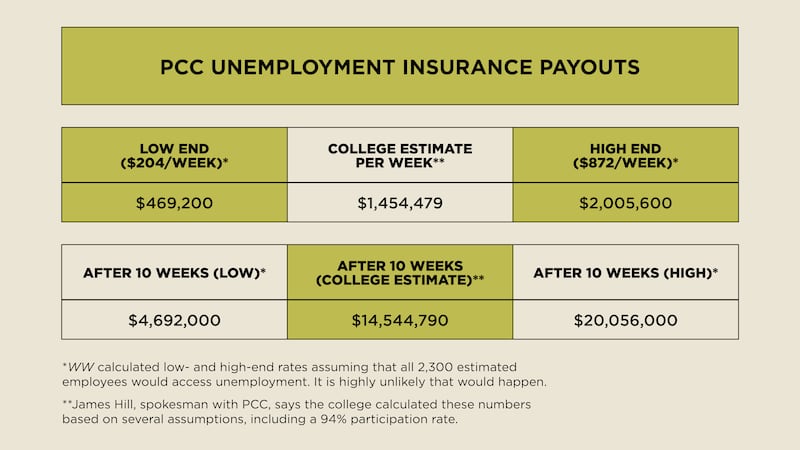
Under SB 916, workers can access unemployment insurance after two weeks (an unpaid strike week and a waiting week), and benefits are capped after 10 weeks. If all striking employees claimed unemployment insurance two weeks in, which is highly unlikely, the college could reimburse about 2,300 employees between $204 and $872 a week from weeks three to 12. (Seth Gordon, spokesman for the Oregon Employment Department, says the department determines “benefits individually based on wages from the five most recent completed quarters.”)
WW calculated how much PCC might have to draw from its risk management fund (see table below). In the worst-case scenario, in which the strike dragged on for more than 12 weeks—admittedly unlikely—the college would pay out more than $20 million. PCC offered its own estimate to WW, too. Aaron Hill, the interim associate vice president of finance, says the college would draw about $1.45 million each week to pay striking workers. James Hill says that’s based on a 94% participation rate and that the total cost to PCC “does get complicated due to the potential savings of payroll when folks are on strike.”
During the last legislative cycle, opponents of SB 916 argued that providing striking workers unemployment would make them less likely to negotiate. But as union members prepare for the first strikes in PCC’s history, they say they’re looking at the money as a way to ease financial worry, not to stall talks.
Despite some financial cushion from the bill, Eslinger with PCCFCE says unemployment benefits are not “anything close to what a normal salary is.” The classified employee union has advised members to save a personal contingency fund and continue to build a strike fund. He adds PCCFCE has helped some members understand how to apply for unemployment.
“It’s a sacrifice for our members to strike, but to make it so it’s not critically damaging to their livelihood, where they will lose housing, or lose access to medicine or food during that process is the type of assistance from the state 916 would provide,” he says.
But Eslinger says the priority of the union’s members during a strike would be to return to serving PCC’s students.
PCCFFAP’s DuBarry agrees: “It’s tremendously reassuring,” she says of the bill. “But nobody wants to be on strike that long. Nobody wants to be on strike at all.”