Skip to main content
New population estimates presented to Multnomah County commissioners July 21 dramatically alter the financial outlook of the county’s universal preschool program.
Preliminary data from Portland State University’s Population Research Center indicates the program needs about 3,000 fewer seats than it had previously estimated it would need to reach universality, county economist Jeff Renfro told commissioners.
The county will need “just above 8,000 seats” in population scenarios that assume low and baseline growth, Renfro said. That’s thousands fewer than its original assumptions that it would need to provide 11,200 seats by 2030 to give a seat to each 3- and 4-year-old whose family wanted one.
The new estimates assume a 77.5% participation rate, accounting for federal- and state-subsidized preschool programs that operate locally. And it took into account the Portland metro area’s flatlining population. (It should be noted that in a high population growth scenario, PSU estimates that the county could see close to the original 11,200, but county officials did not yet have a strong understanding of that forecast. The full PSU report will be released in August.)
The new population estimates ease county officials’ fears that the program won’t have enough money from a tax on high earners to robustly fund all the needs of preschool providers.
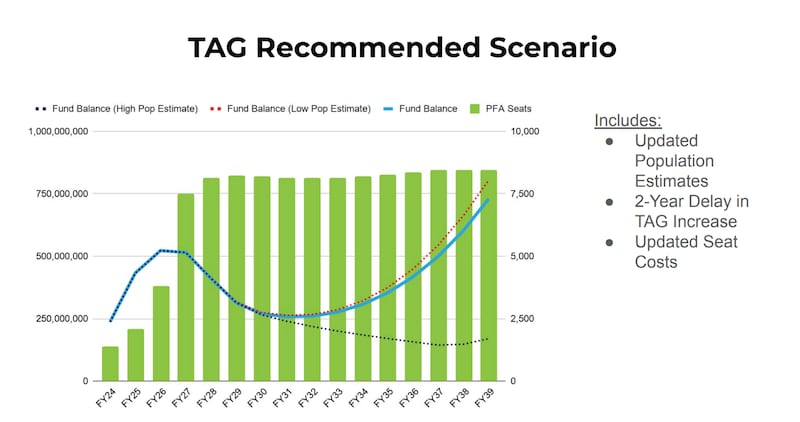
Even if the county were to delay a planned tax rate increase and incorporate new, higher reimbursement rates per seat based on a true cost of care study, modeling indicates that the program’s fund balance would only dip to about $250 million in fiscal year 2031, before recovering to just under $750 million by fiscal year 2039. (This scenario models the program’s financials based on recommendations from a technical advisory group of economic, demographic and policy experts who convened through spring to discuss the program’s financial future.)
“The thing that really moves our expenses assumptions is the number of seats we’re providing and how expensive those seats are,” Renfro said. “So when we decrease the number of seats we need by 3,000, it has an enormous impact on our assumptions going forward.”
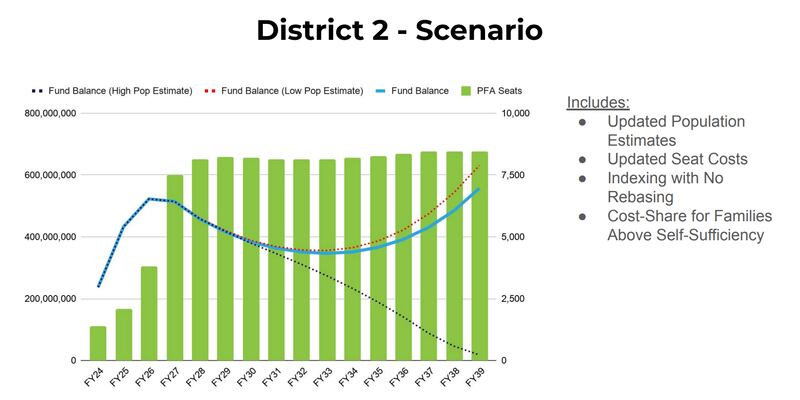
The county also modeled a few scenarios at the request of specific commissioners. (None of the models are official proposals from the commissioners.) Commissioner Shannon Singleton asked for a scenario that incorporated a couple of revenue changes that included indexing the tax to inflation (the indexing in this scenario would begin in the 2027 tax year, Singleton tells WW). The same scenario also models the program’s fund balance if families above the state self-sufficiency standard contributed to their children’s preschool.
In a high population scenario, the program’s fund balance would trend toward zero under these circumstances. But in both a low and baseline population estimate, modeling shows the fund balance wouldn’t be near zero even after indexing.
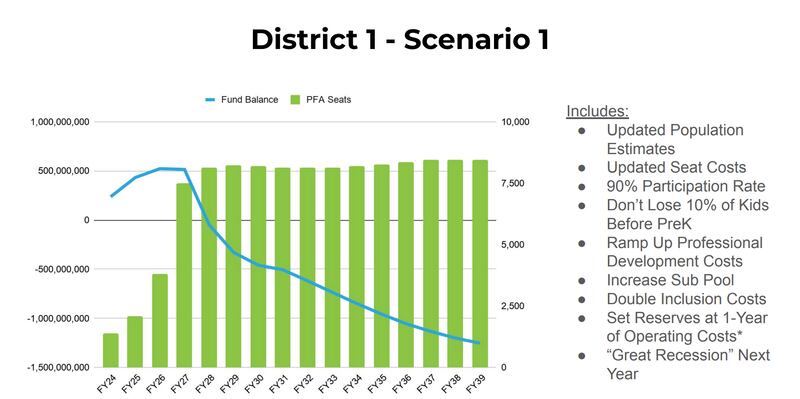
Commissioner Meghan Moyer, however, asked the county to model two scenarios that would put the program seriously in the red. Her scenario assumes a 90% participation rate and that the county doesn’t lose 10% of children before preschool begins. (Multnomah County loses some new families ahead of preschool age to nearby suburbs, Renfro says.) Moyer’s scenarios also factor increased professional development costs and inclusion support for high-need students.
Moyer’s scenarios also imagine dramatically increasing the program’s reserves. Her first scenario increases reserves from 15% of expected revenue to a year of operating costs. Her second scenario maintains the same assumptions listed above but asks the county to set reserves at two years of operating costs. (A year of operating costs for Preschool for All is currently about $400 million, Renfro says, but that is projected to increase to about $550 million in later years.)
Those assumptions send Preschool for All’s fund balance plummeting. By fiscal year 2039, the balance would be at negative $1.5 billion if reserves were at a year of operating costs, and negative $2 billion if they stored two years of operating costs.
The county, for reference, has about one month of operating costs in its reserves, Renfro said. Commissioner Julia Brim-Edwards agreed with the importance of keeping reserves, but said the county could certainly find a middle ground between 15% of revenue collected and an entire year of operating costs.
“If we wanted to keep the promise to somebody who walks in a door and the next month our economy totally crashes, getting them through that, what would that look like?” Moyer said of her scenarios. “I don’t think I’m suggesting the full cost of two years being in a reserve, but I do worry about the 15%, because that is an incredibly tight timeline that would destabilize 7,000 families.”