Skip to main content
At the close of the second season of The Pitt, Doctors Santos (Isa Briones) and King (Taylor Dearden) abscond to a karaoke club after a stressful shift for, as Santos puts it, “primal scream therapy.” For Briones in particular, this scene is a testament to her well-proven bona fides as a singer, being able to convincingly sing like a slightly off-key drunken amateur.
This season at Portland Center Stage, Isaiah Reynolds sees Briones’ example and raises her his character-defining moment as Juicy, a young man confronting the tragedy of his father’s death at a family cookout. When his mom, Tedra (Jackie Davis), breaks out the karaoke machine—revealing the play as a stealth jukebox musical—Juicy sings Radiohead’s “Creep,” escalating from a mumbled first verse to a clear, passionate, and just off-time chorus.
In this production of Fat Ham—James Ijames’s uniquely Black, uniquely Southern reinvention of Shakespeare’s Hamlet—Reynolds returns to Portland Center Stage approximately 18 months after his last turn treading the Armory boards as Tobias Ragg in Sweeney Todd. This time, he stars in a production with a significantly shorter history.
However, since Fat Ham debuted in Philadelphia in 2021, it’s racked up Pulitzer and Lambda prizes, plus numerous Tony nominations, and it played last year at both the Oregon Shakespeare Festival in Ashland and at the Royal Shakespeare Company in Stratford-upon-Avon.
Incredibly, despite years of collaboration, this is the first time Portland Center Stage is officially co-producing with Portland Playhouse. Local theatrical multihyphenate Charles Grant directs this production and its all-Black cast.
“It feels like exactly the right show to do it with,” says Playhouse artistic director Brian Weaver. “I fell in love with theater through Shakespeare, so watching James Ijames crack Hamlet wide open feels personal to me.”
Ijames himself is quoted in the PCS playbill: “I wanted to play with Shakespeare, if that makes sense. When I say, ‘play with Shakespeare,’ I mean in the sense of like, ‘Do you want to go outside and play?’”
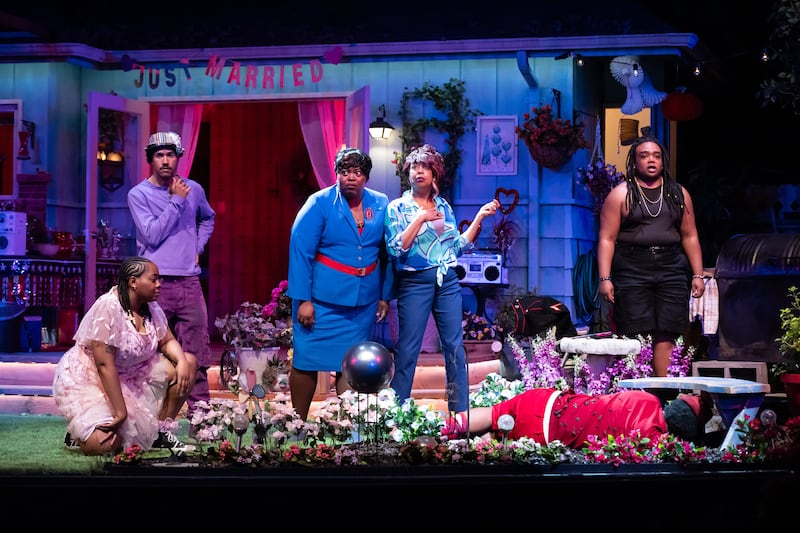
Ijames takes Hamlet to his metaphorical sandbox and uses it as the foundation for a stylistically new edifice. Here at PCS, the stage is the backyard of a small, sky-blue house, with trees towering on all sides and a rooftop realistically littered with leaves. The effect is cluttered, yet intimate.
In his script, Ijames addresses issues of interest to the Black and gay communities alike. Several characters express fear of “the sugars” (diabetes is known to affect Black people at greater rates), but also shame Juicy for being overweight. The parents tend to be overtly Christian and complacent in their gender roles, alienating Juicy and others, who are deeply closeted. Juicy also shows his flawed side by threatening to out another character before they’re ready, thinking himself justified when everyone else’s secrets are being revealed anyway, and he earns a faceful of corncobs for it.
Interestingly, Juicy’s weight informs a more complex view of his identity. At first, his feminine presentation codes him as gay, but as Tedra and others ask probing questions, he admits he doesn’t really know what he wants romantically. He may be asexual, but he may also feel desexualized and undesirable due to his weight, and is genuinely surprised when someone actually does want him. This feeling stays subtextual even as he frequently breaks the fourth wall for brief internal monologues punctuated by blue lighting.
In contrast, his cousin Tio (Marcel M. Johansen) is tall, slender, and sexually expressive. Sadly, he only gets a handful of scenes, but he shines obnoxiously in each: Highlights include a solo game of Twister (as Tio tries to imitate porn positions while watching) and an extended monologue (delivered while cross-faded on whiskey and weed) about masturbating to a VR game’s 8-bit gingerbread man.
Eventually, Tio does get to his point: We need pleasure in a world that demands misery. If only Juicy’s dead dad, Pap (Clinton Lowe), and uncle-turned-stepdad Rev (also played by Lowe, who wears green and red to differentiate between the roles) could have had a figure like Tio to teach this lesson.
Instead, Tio holds Pap and Rev up as examples of generational trauma, continuing cycles of slavery and incarceration. Their brotherhood is biblical in so many ways, most of them unfortunate as they both prove abusive, rather than protective, to their family. Lowe, however, plays them both so massively over the top that it calls forth even more laughter when Juicy delivers deadpan wit in response.
Though it’s a tragedy that inspired this play, it’s a comedy through and through. Even when the subject matter grows heavy, it’s worth it to reach the end when the actors, by then all dressed in powerful purple, cut loose with a truly therapeutic dance party that demands audience participation.
SEE IT: Fat Ham at Portland Center Stage at The Armory, 128 NW 11th Ave., 503-445-3700, pcs.org. 7:30 pm Wednesday–Saturday, 2 pm Saturday, Sunday and select Thursdays, through May 17. $25–$86. High school age or older recommended.