Skip to main content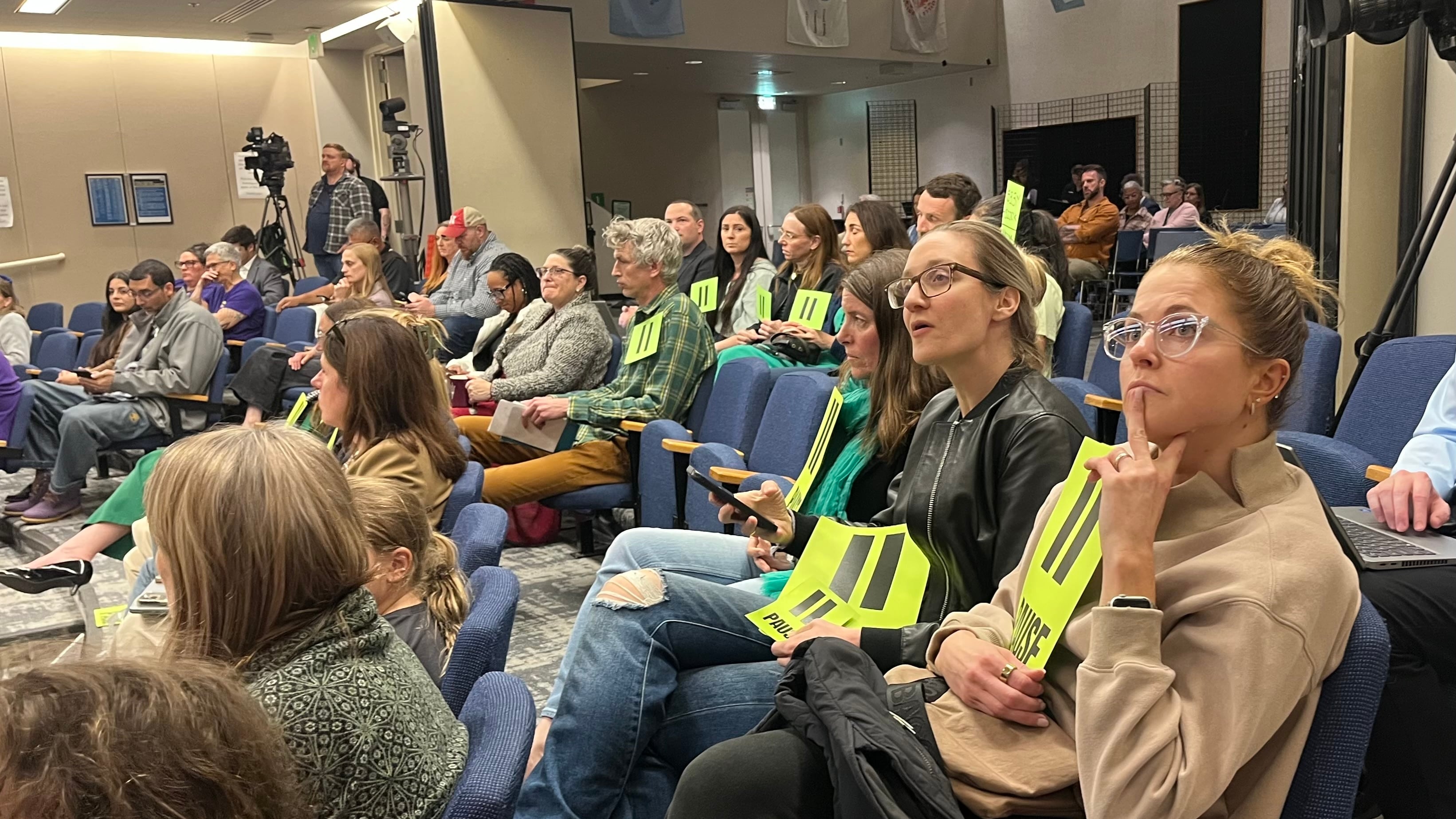
The Portland Public Schools Board will not reentertain a former district fundraising model that allowed individual schools to raise money for staff through local school foundations, or LSFs.
Board members at a Tuesday night meeting largely signaled their unwillingness to look backward—not without at least giving The Fund for PPS and a new executive director the chance to hit a $1 million fundraising goal for the academic year, money that will be distributed to schools across the district for supports determined by a parent advisory committee. The decision not to revisit LSFs came even as the bulk of the board acknowledged the launch of the new districtwide model had been turbulent, and as Superintendent Dr. Kimberlee Armstrong expressed some hesitations about the decision to abandon the lost revenue stream.
The board voted in May 2024 to overhaul the controversial LSF model—which, on average in the past three years, raised about $3.3 million a year for the district. By a vote of 5-2, board members agreed with parents who argued then that LSFs were inequitable. These parents cited data that indicated wealthier and whiter schools were often the system’s biggest beneficiaries (though LSFs were required to contribute one-third of any money raised after the first $10,000 to a districtwide fund.)
School foundation defenders had said the district stood to lose a valuable source of funding and didn’t have the infrastructure to replace it. In the years since, the district has put more effort into The Fund for Portland Public Schools, a districtwide foundation. There were some delays: The organization’s board underwent leadership changes, and the hiring of an executive director stalled. (It now has an interim executive director, Nick Brodnicki, and a solid board membership.)
Perhaps predictably, in its ramp-up period, The Fund for PPS has so far failed to match the bounty LSFs once brought in. It raised $593,324 in the 2024–25 year, and the most recent numbers from February indicate it’s raised just over $200,000 in the current year. (This year, largely funded by leftover LSF money, The Fund for PPS made large investments in math support, food pantries, and high-impact tutoring for early grades at some 30 schools.)
Layered on top of that, PPS has faced a series of multimillion-dollar budget deficits since the 2022–23 school year. At the same Tuesday night meeting, the district unveiled it would face a $56.3 million deficit in the upcoming year.
This all set the stage, in recent weeks, for a groundswell to revive LSFs, at least temporarily—an idea that seemed to correspond with layoff announcements for the upcoming year spreading through schools. A group of parents organized to “pause” the new foundation policy, which effectively sunsetted LSFs by preventing individual schools from fundraising for staff. And they captured the attention of School Board member Patte Sullivan, who openly asked why the district wouldn’t take revenue where it could get it. (Sullivan had been one of two board members to vote against sunsetting LSFs in 2024. The other is no longer on the School Board.)
On April 14, joined by School Board members Virginia La Forte and Stephanie Engelsman, Sullivan managed to reopen the foundation conversation. But at a more in-depth discussion on Tuesday, it appeared La Forte and Engelsman were at best skeptical of immediately pausing the policy, and the remaining four members of the School Board seemed opposed to the idea. (Engelsman clarified Tuesday that she wanted to put the discussion on the table, even if she was not sure looking back was the right answer. She said she wanted the board to discuss the topic because she had received dozens of emails from both sides.)
The crowd in the board room was largely split into two distinct groups. One was a coordinated body of supporters for pausing the LSF ban—many of whom were decked out in green. One parent passed out green “pause” signs for attendees to hold. Many of them argued that the pause would give The Fund for PPS time to reassess and build while the district held on to valuable revenue. Others threatened that, without LSFs to make up for key staffing holes, they would turn to private schools instead.
Among them was Ayla Ercin, a parent and co-chair of the parent advisory committee. Ercin said that the committee at this point “has almost no money to distribute for staffing next year.”
Ercin said The Fund faces challenges as it continues to ramp up, and that the district is in no position to refuse funding.
“At our school, parents want to help, but when they have to choose between their teachers who are asking for help with a 33 kid elementary school classroom or a fund that its own leaders describe as poorly set up, of course they’re going to choose that local giving with direct accountability as opposed to a black hole,” she said.
A smaller but equally vocal group of parents arrived in support of the districtwide model. They argued that it was time to abandon LSFs once and for all, arguing any investments in such foundations at this point would detract from the districtwide vision of collaboration that would ultimately improve conditions for students at all schools. Pausing, they argued, would not lead parents across the district to back The Fund for PPS.
Among them was Beth Cavanaugh, who helped lead the effort to overhaul the foundation model.
“There’s no better way to inspire creativity and build trust, relationships, and understanding between school communities than by getting into a room together…and rolling up our sleeves to work together towards a common goal,” she said.
School board members, apart from Sullivan, were largely split into two camps: those who said they saw both sides of the debate, but who were, at this point, hesitant to pause, and a couple who fully disapproved of the campaign to bring back LSFs. Some suggested they might be more open to discussing the matter again if The Fund could not meet a $1 million fundraising goal by the end of the school year. “I want to give you a chance,” Engelsman said, gesturing to Brodnicki and Jackie Wirz, The Fund’s board chair.
Brodnicki, for his part, told School Board members “one singular system creates the most value.” In a statement on behalf of The Fund, Brodnicki said he had in 90 days talked to 200 people about how to scale up The Fund, and had set up its first real fundraising infrastructure. He said The Fund’s main mission was to uplift students with philanthropy where it could, but that it would not be a solution to patching the district’s structural deficit. “That is a public funding conversation, and it belongs to the state, the district, and the voters,” he said.
But he also called for improving The Fund: “We need clarity and stability,” he said. “This is critical. Major donors, corporate partners and foundations do not give to ideas in motion, they give to organizations whose scope and governance are articulated and clear.”
The debate on fundraising seems to boil down to intentions and their consequences, a complicated balance that seemed to weigh on Superintendent Armstrong, who said she wouldn’t have supported the decision to sunset LSFs had she been a part of it, but noted she had respect for those pushing for a more equitable system. (Armstrong joined the district shortly after the foundation policy’s reform).
“When we get into the details of equity is where I think I get a little lost in the conversation because what it sounds like to me is we’re saying that we need to cut off a source of funds because kids who are in the maximum amount of need aren’t benefiting, and I think it misses the fact that we have kids with significant needs all across our district,” she said. “I never just really understood that.”
But School Board member Rashelle Chase-Miller, among the most vocal in full opposition of returning to LSFs, underscored that it was not acceptable to her to move backward because the district’s “most privileged” community members refused to participate in the new model, noting nothing was stopping families from pitching in to The Fund for PPS.
“When affluent school communities choose to fundraise for their own headcount rather than contributing to The Fund for PPS, they mirror a historical mistake, pursuing progress within their own neighborhood blocks, while abandoning the systemic duty to support every child in the district,” she said. “True equity is not found in the luxury of an isolated success, but in the refusal to accept a victory that leaves the most vulnerable behind.”