Skip to main content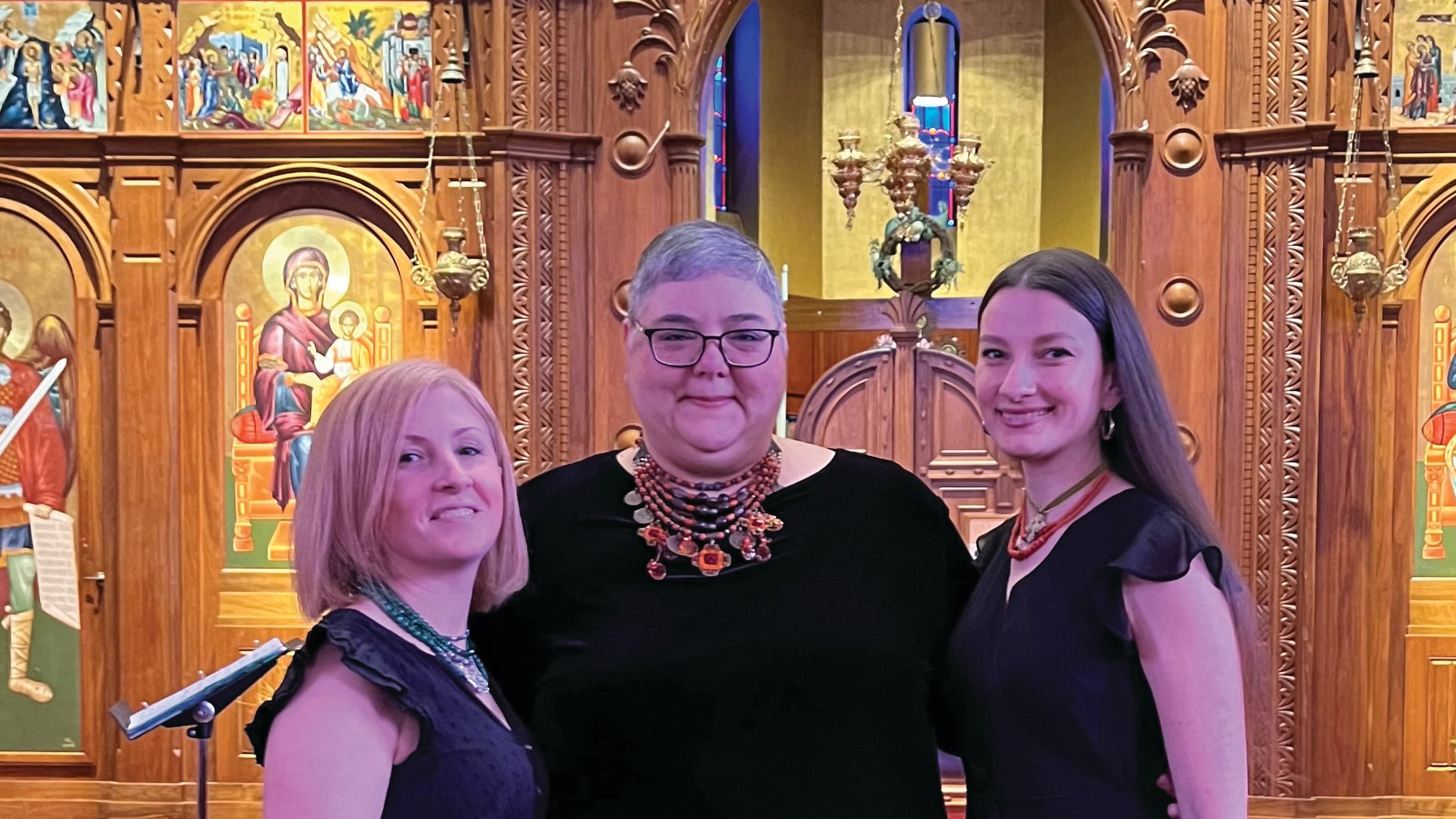
Nearly 40 years ago, much of the Polissia region in Eastern Europe was evacuated. Whole villages were abandoned and centuries of cultural tradition dissolved overnight.
The region—heavily forested and swampy lowlands in northern Ukraine, southern Belarus and parts of Poland—is often associated with the ancient village of Chornobyl (or, to use the Russian spelling more common in the U.S., “Chernobyl”), which in 1986 became the scene of a globe-altering nuclear disaster.
Today, much of Polissia remains devoid of human life and, of course, human culture as it remains contaminated with dangerous levels of radiation. But this weekend, powerful and persistent songs from this singular place will fill PSU’s Lincoln Recital Hall in a special night of Ukrainian folk music, Chornobyl: A Song Never Silenced.
The free concert will mark the Chornobyl disaster’s 40th anniversary with folk songs written prior to the rise and fall of the Soviet Union (1922–1991). Some even predate the emergence and dissolution of the Russian Empire (1721–1917). In fact, some of the melodies recovered by Portland singer and musicologist Inna Kovtun are five centuries old and have rarely been heard outside Europe.
The music of Polissia resembles other Slavic folk traditions in its unique use of polyphonic harmonies and themes of love, death, family and the changing of the seasons. But it has an eerie, discordant, bone-chilling quality all its own.
Like much folk music, the songs of Chornobyl were shaped by the land, according to Kovtun.
“This is a special sound,” Kovtun says. “Chornobyl is an area with a lot of forest, and so it’s loud. But it’s a beautiful sound. It’s powerful. You need to sound powerful to sing through the trees.”
Kovtun will perform alongside vocalist-folklorists Hanna Tishchenko and Nadia Tarnawsky and accompanied by multi-instrumentalist Michael Caruso and bravura bandura player Valentyn Lysenko. A piano tuner by day, Lysenko lends his expert ear and sure hands to Ukraine’s official instrument, a many-stringed version of the lute and zither.
Kovtun seems a fine fit to interpret this music as well as to teach it. A leading authority on Ukrainian folk music, she was, prior to Putin’s full-scale invasion in 2022, artistic director for Kalyna, the Ukrainian state folklore assembly, and a noted scholar of Ukrainian folk history and tradition. Over numerous research trips, including to Polissia, Kovtun has collected and cataloged more than 1,000 songs of Ukrainian and Baltic origin. And as a musician, she’s taught and performed many of these works around the world in various ensembles. As a solo artist, she recently released her 11th studio album (two of its 13 tracks hail from Polissia).
“She’s the queen of Ukrainian folklore,” says Yulia Brockdorf, president of DAWN, a Portland-based pro-Ukraine nonprofit that’s organizing the Portland State University concert and a free singing workshop the following day. “And I mean it. If not for her, many of these songs would not be heard today.”
Proceeds from both events (donations are encouraged) go to DAWN’s humanitarian efforts in Ukraine, which include sending medical supplies to front-line troops.
Kovtun’s journey to the U.S. started at around 4 am Feb. 24, 2022, when she and her 7-year-old daughter were awakened by explosions in their home in Kyiv. Fear, shock and air raid sirens; for a week, they slept in the subway for safety. Eventually, they relocated to Lviv, 350 miles west, then across the border to Poland. A month after the invasion began, they landed in Portland. It was to be a short, three-month stay.
But the war continues. Kovtun is one of approximately 6 million Ukrainians who have fled since 2022, according to the United Nations Human Rights Commission (around 3 million have been displaced internally).
“It is not an easy situation,” she says. “I don’t yet have a clear answer about the future.”
Now, far from the front lines, she continues to preserve and promote Ukrainian heritage, performing and teaching regularly, often wearing a vyshyvanky, or embroidered shirt, and other traditional attire. She says the work was important prior to Putin’s invasion but is especially important now.
“It’s a profession, to be a folklorist. But this is not about money,” Kovtun says. “This is about soul: my soul. It’s about the songs that our ancestors gave to us. And now it’s especially important because Russia tried to kill not only our country and our beautiful cities and villages. They tried to kill our identity.”
Folk music’s power to unite was apparent in late 2022 when “Stefania” won that year’s Eurovision Song Contest. The song and video by Kalush Orchestra combine modern hip-hop verses with traditional Ukrainian folk singing and dancing. The song was a global hit and remains a symbol of Ukrainian strength and resilience.
With the upcoming concert, and her work writ large, Kovtun aims to show that even in hard times, when millions have been forced from their homes, Ukrainian culture and tradition is alive, and beautiful. Some of the songs she performs are from villages that effectively no longer exist.
“The 26th of April is a tragic day in Ukraine and we hoped it would never happen again,” she says. “If you go to Chornobyl, you will see it looks like the end of the world. But unfortunately with this war, we have a lot of cities that look like Chornobyl.”
SEE IT: Chornobyl: A Song Never Silenced at Portland State University’s Lincoln Hall, Room 75, 1620 SW Park Ave., dawnus.org/events. 7 pm Friday, April 17. Free; $20 suggested donation.
CHECK IT OUT: Inna Kovtun leads a Ukrainian singing workshop at Zidell Yards, 3121 S Moody Ave., dawnus.org/events. 1–3 pm Saturday, April 18. No singing experience or knowledge of Ukrainian required. Free; register at innak@dawnus.org.