Skip to main content
Last year, fewer people moved from city shelters to affordable housing than the year before, Mayor Keith Wilson told members of the Portland City Council on Thursday.
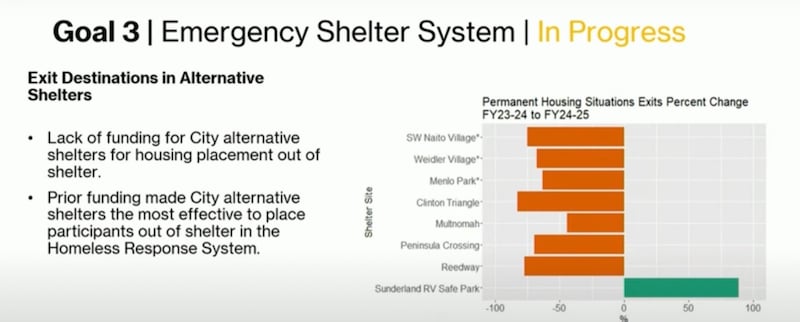
The chart shared with councilors showed that placements plummeted in fiscal year 2024–25 from the prior fiscal year.
Wilson and Portland Solutions director Skye Brocker-Knapp said that was because Multnomah County had stopped giving them money to move people from the city’s shelters into apartments.
The city received “zero housing placement dollars from the county in 2024–2025,” Brocker-Knapp said. “This has hurt our exits to permanent supportive housing. All studies to date have made it clear that funding determines results in terms of housing placements from shelter.”
City staff presented shelter-specific data showing the number of placements in fiscal years ’23–24 and ’24–25.
Total placements in 2023–24, into both temporary and permanent housing, totaled 508.
The following year, that dropped to 240.
Placements into permanent housing in 2023–24 totaled 452. By the following year, that plummeted to 180.
Importantly, the city did not provide complete data about placements from the current fiscal year, nor did the city include data about how many people had moved from Wilson’s new overnight shelters into housing. City officials presented only three months of placement data from the current fiscal year—43 people moved from an alternative shelter to permanent housing—making it difficult to know how placements this year compare with those in prior years. However, Brocker Knapp told councilors on Thursday that the city received no placement dollars from the county this year, either.
Moving people from shelter to housing is a critical part of reducing the number of people living on Portland’s streets. Yet the new data shows the city is performing worse at finding housing for shelter users than in prior years.
The dismal data comes as city councilors cast doubt on the effectiveness of Wilson’s ambitious shelter plan—he added 1,500 beds to the shelter system in his first year in office—and his promise it would end “unsheltered homelessness” in the city. (It did not.)
While Wilson hit his goal of setting up 1,500 new shelter beds, he has not yet laid out a clear plan for how he plans to move people from shelters into affordable apartment units. (On Thursday, he appeared to announce what seemed a hastily put together plan to build 20,000 units of housing in eight years. When asked by Councilor Steve Novick how he planned to do that, given that the city is lagging in development, Wilson deflected and said: “I’ll be meeting with you and your offices. Let’s find out what your ideas are. Because we can’t do this with one person, we’re going to have to do it with all 13.”)
A report released by Multnomah County earlier this week suggested that by reducing the number of adult shelter beds and shifting some of the savings to rent assistance, “the homeless services system could house, and possibly shelter, an equal or greater number of people as the current shelter system, all without increasing cost.”
It’s unclear how well Wilson received that report, which suggested the mayor’s goal to add beds may have been overkill and not as effective as a system more balanced between shelters and housing placements. In a statement accompanying the report, County Chair Jessica Vega Pederson did not mention Wilson or his plan, but did say the report “suggests that by moving some of the dollars currently being used for shelter and putting that money toward housing assistance—specifically for people currently staying in shelter—we may shelter and house more people than we can today.” Her statement echoed remarks she made to WW about Wilson’s ambitions last fall.
Wilson told councilors one of his goals for the new year was to “work with Multnomah to develop a clear referral process and funding mechanism to move people from shelter to permanent housing.” So far, no such funding mechanism has been identified.
County spokesman Denis Theriault said in response to a request for comment that how the city and county “collectively allocate and balance funds for housing placements out of shelters is a question for our entire system of care, bigger than any one set of sites.”
It also may be the case that the city’s claim that the county provided no housing placement dollars is an oversimplified one. That’s because the county provides funding for outreach services, such as housing placement, to nonprofit shelter providers across that city—including those that run city shelters. How much of that money was spent on housing placement is a question the county said it couldn’t immediately answer without digging further into the data.
Theriault did say the county was able to funnel more resources to housing placements in fiscal year 2023-24 because of one-time programs funded by Metro’s Supportive Housing Services tax that were not funded in subsequent years. The county pulled back a $2 million allocation for housing placement at adult shelters, including city shelters, in early 2025 after it discovered a $50 million hole in its homelessness budget. That money was eventually released to city providers, Theriault says, but not until summer 2025.
Finally, after being provided with the city’s placement figures, Theriault said the county found discrepancies between its placement data and the city’s, an issue he said the county would address with the city.