Skip to main content
The Blazers, to their credit, have never failed to produce compelling drama. The team would seem to secretly employ a small HBO writers room to contrive the events of each season of The Portland Trail Blazers—in which a starcrossed small-market professional basketball team tries to make the conference semifinals—and this season was one of the best in the show’s history.
The team proved resilient and went 42–40, making the playoffs for the first time in five years after their head coach was indicted as part of an alleged federal gambling conspiracy on opening night. The team’s new owner, during the first stretch of the team playing meaningful games in years, began to cut costs in comically over-the-top and public ways, but only after he’d leveraged threats of moving the team to get commitments of $365 million in taxpayer money to renovate the team’s arena. Their best player, already very easily compared to a figure of Greek tragedy, sat on the bench all season with an injury named for an actual tragic Greek figure. (Except when he won the 3-point contest in February.) Their young point guard returned from injury, was bad, redeemed himself in a series of high-profile games, then was bad again.
This all meant that the 2025–26 team stuck to the tried and true formula of Blazers seasons through the years: interesting people achieving marginal results under complicated circumstances.
After a spirited close to the season over the past two weeks, the team finally collapsed under its own weight and inability to shoot the ball. This will be the main takeaway from the season: that when the team was healthy and shooting the ball even decently, it was very good. But that team is gone now. On Thursday, the Blazers conducted exit interviews. A handful of their players from last week’s playoff series are now free agents.
The team is faced with a fork in the road as new owner Tom Dundon presides over his first offseason and a surgically repaired, mid-30s Damian Lillard prepares to reclaim his throne.
Despite Lillard’s return to the team and the team’s return to the playoffs, it has been Dundon who has dominated headlines. With a City Council vote looming over whether Portland puts itself on the hook for upwards of $400 million to renovate Moda Center, Dundon will continue to dominate headlines over the course of the summer, as reports of him being a spendthrift in his early days managing the franchise will be held up against his attempt to reduce the size of the city’s budget by hundreds of millions of dollars over the next 20 or so years. The conclusion that some people will reach is that Dundon doesn’t have enough capital to own and operate an NBA team in the long run.
Whether or not that is actually true, the more imminent question the team faces is whether Dundon will use any of the dollars he’s found on the ground to pay people who will play for and/or coach the team next season.
“I don’t know if I can remember a worse first month for an NBA owner, PR-wise,” says Sean Highkin, an independent journalist who covers the team through his news site The Rose Garden Report. “It’s open season on national podcasts to make jokes about things Dundon can’t afford to pay for.”
The 2026–27 season could bring about any number of outcomes—something that hasn’t been true for the team in many years. They face fundamental questions around who will manage the roster, coach the team, and play for it. But they’re also in an interesting position. If they’re smart and produce the right answers, they could finally find themselves contending for a title. On the other hand, they’re a couple of bad decisions away from watching everything blow away in the wind. The NBA is a tough league.
So, then, the questions:
What are things we know for sure?
This seems the right place to start since there are only a few of them. We know the team will play next season at Moda Center. We seem to know the team will be down one mascot. We know the team will be coached by, you know, an individual of some sort. We have very little sense of what the roster will look like, though we can work backward from the question: Who are the players that will definitely be on the team to start next season?
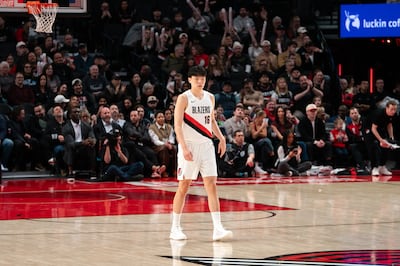
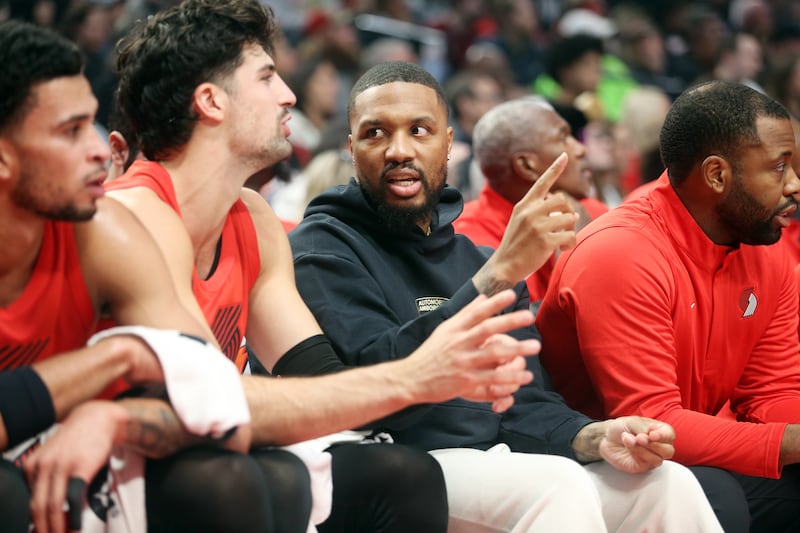
Damian Lillard will be on the team all of next season. Yang Hansen, who everybody has admitted makes the franchise more valuable simply by dint of his popularity in the Chinese market, will be on the team.
One would have to assume Deni Avdija and Toumani Camara would remain on the team in the event of even the splashiest of trades. The team’s starting forwards, both 25, have been its heart and soul for the past two seasons, with Avdija emerging as an All-Star this season and Camara continuing to establish himself as one of the league’s best perimeter defenders. Both are on team-friendly contracts, which is a term people around the league use to say that a player is underpaid.
But all of the team’s other veterans, including Jerami Grant for the fourth consecutive year, are question marks to return. The team’s young core improved this year, but any of the players in it could see their names included in a trade package for a star. (The Blazers have recently been linked to Milwaukee forward Giannis Antetokounmpo and Washington center Anthony Davis.)
Something else we know for sure is that the team has to find ways to improve its outside shooting, which this season could most generously be described as “enthusiastic.”
“The thing that did them in during the Spurs series was not having anyone that can shoot,” Highkin says. “Getting Dame back next year will help, but they need more. That could be internal development from a few guys, but those are the kind of additions they need to be making, not just chasing the biggest name they can get. But you know how new owners can be.”
Who will be head coach?
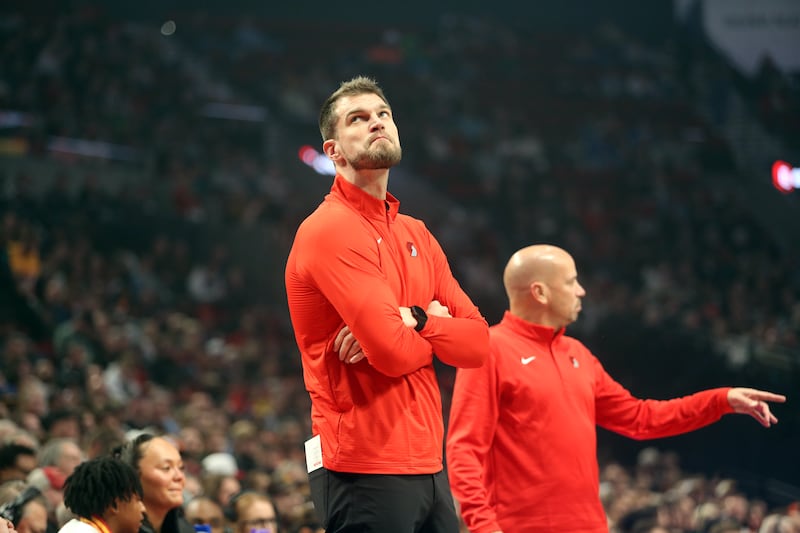
Chauncey Billups will never coach the team again, though he may remain the team’s head coach on paper for a while as a technicality while his trial goes on. Tiago Splitter, who did a good job under difficult circumstances after taking over for Billups, is a candidate to become the permanent head coach but is by no means a shoo-in.
Dundon has been talking to everybody he can get a hold of, reportedly being rebuffed by the coach of the University of Saint Louis, among others. Some reports say Dundon is looking to pay $1.5 million for a head coach, which would be the league’s lowest salary by a wide margin. His contact with other coaches while Splitter was coaching the team raised a lot of eyebrows around the league. Splitter may be questioning whether Portland is actually where he wants to coach.
Who will be GM?
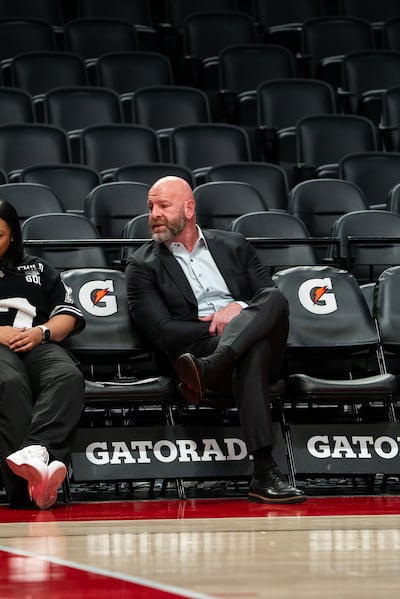
Joe Cronin, the team’s general manager, has worked for the team since 2006, when he started as an intern. Tapped by Jody Allen to replace Neil Olshey in 2021, Cronin has navigated the team through a multiyear rebuild that saw it tank for three top-seven picks from 2022 to 2024 and then emerge over the course of the past season and a half, amassing a 69–60 total record.
Cronin was given an extension by Allen at the end of last season and is under contract through 2028. This year’s team’s success, plus his work to get the team’s finances in order, hoard draft picks, and reacquire Lillard would, in any other case, give him a bit of breathing room. But, under Dundon, he has had to sing for his supper. Cronin’s path to power has been defined by how good he is at this, though, and he appears to have won over the new owner, at least for the time being, and will help him select the team’s coach.
At Dundon’s introductory press conference, he revealed the team had nearly made a trade for a star player at the trade deadline. Cronin may be under a mandate to trade away members of his prized young core—for what he called “star power” at exit interviews—sooner than he would have hoped to.
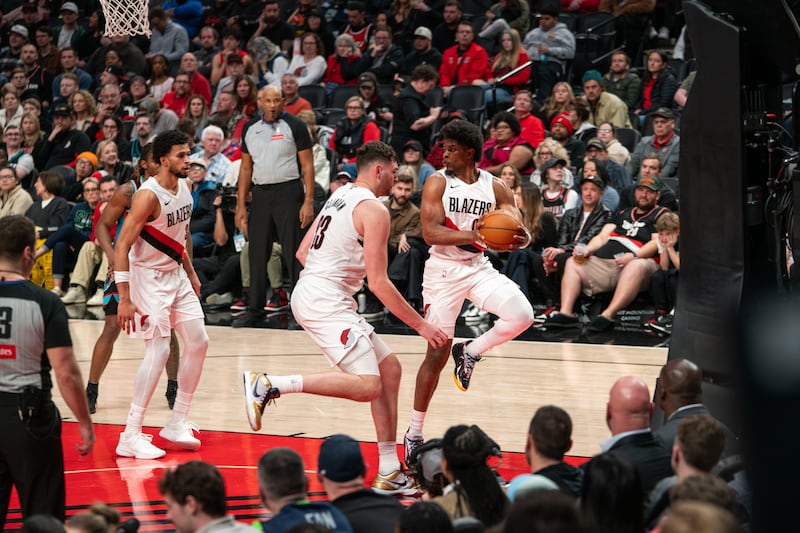
What of the young core?
The three players mentioned as having been drafted in the top seven of their respective drafts, who the team in effect lost many games on purpose to acquire, are Shaedon Sharpe (No. 7 in 2022), Scoot Henderson (No. 3 in 2023), and Donovan Clingan (No. 7 in 2024).
All three players are 22 years old. Sharpe signed an extension last offseason that will pay him $90 million over the next four seasons. Henderson and Clingan remain on their rookie contracts, though Henderson will become eligible to sign an extension.
All three showed improvement this year but failed to find the consistency that would cement them as definitive cornerstone players.
After a strong regular season in which he led the league in offensive rebounds, Clingan was bad against Victor Wembanyama in the team’s playoff series against San Antonio, but more troublingly, he was also bad against backup Luke Kornet.
Sharpe had a terrible start to the year after signing his extension, then looked like a max player for 20 games, missed a long stretch with a stress reaction in his left fibula, unexpectedly returned at the end of the season, and helped the team win its play-in game against Phoenix with a key performance off the bench, and was ultimately benched by Splitter down the stretch of the Spurs series.
Scoot Henderson, for his part, missed 52 games to start the season and was very bad when he first returned to the lineup, only to find his footing and occasionally flash virtuoso two-way point guard play as the season escalated. After a redemption-arc Game 2 performance where Henderson scored 31 points, he too fell off a cliff in his first playoff series, scoring 5 points across the series’ final two games.
If the team does look to trade for a veteran star this offseason, any member of the team’s next generation could find themselves packing their bags.
It is, however, worth considering how young 22 is in the arc of a player’s development. Henderson, Sharpe and Clingan have all now established that, at a minimum, they are solid NBA rotation players. This is the real goal in the first few years of a player’s career. Generally speaking, a player isn’t who they are until they reach about 24 to 25. In the next two seasons, any of the three could in theory become an All-NBA–caliber player and then remain one for many years, in which case the team would regret having traded them for a 33-year-old Anthony Davis.
When Avdija and Camara were 22, neither was in a better position developmentally than Henderson, Sharpe or Clingan is today. Avdija at 22 was averaging 9 points and shooting 30% from three for the Wizards. Camara was averaging 14 points and 8 rebounds at his second school, the University of Dayton.
It would be a shame, if you will, to see the Blazers trade Jermaine O’Neal for Dale Davis.
What happens next?
The team’s last four offseasons have been defined by the draft and the draft lottery, but this year they’re slated to sit out the event altogether, having seen their first-round pick conveyed to the Bulls as part of a long-ago trade. Their second-round pick is owned by San Antonio. But the Blazers could still look to use some of the draft capital acquired when they sent Lillard to Milwaukee in order to trade back into the middle of this year’s draft (held June 23-24).
The team doesn’t project to have much in the way of cap space when free agency opens on June 30. But they do have premium assets (future draft picks and young players) to pair with the big contracts attached to veterans Jerami Grant and Jrue Holiday and use in a trade. Barring something spectacular, things will likely be slow for the next six weeks. But once the draft draws nearer, all bets are off.
It remains to be seen how the team’s negotiations with the city over the arena will factor into the offseason. If Dundon can get the city to go deep into the couch cushions and give the team everything it’s asked for, it’s reasonable to project he would be more willing to take the team into the luxury tax. The City Council is expected to vote on Moda Center renovation funding ahead of the league’s free agency period.
Having come to town and immediately alienated the fan base in a way that seems sort of scripted, Dundon now appears poised to reshape the team. For most fans—desperate to see their team go to the finals—if he does this in a way that turns the team into a contender, everything else that happens along the way would be forgiven.