Skip to main content
For the better part of a decade, the knock on downtown Portland has been that it’s not safe to walk the streets at night.
Jeff Swickard says walking downtown at night was the first time he ever felt safe.
Thirty-five years ago, he and his friends—fellow undergrads of the University of Oregon—would get dressed up and pile into a car. The whole drive from Eugene to Portland, he’d feel nervous, slightly sick. Swickard was a young man slowly coming out as gay after a childhood in a small conservative town outside Sacramento. “Back then,” he tells WW, “it was like a big deal to go to a gay bar.”
One night, he and some friends encountered police officers outside a downtown establishment. He remembers a flash of panic. Then he saw a rainbow pin on an officer’s uniform. “I realized that they’re not here to arrest us; they’re here to protect us.”
That story is one of the ways Swickard tries to explain an investment in Portland that confuses many observers.
In short order, Swickard, 54, has come to control around 2.4 million square feet of downtown commercial and mixed-use real estate—becoming a key figure in the hoped-for revitalization of Portland practically overnight.
Oregon’s business and political leaders have welcomed Swickard’s sunny optimism as well as his bankroll, though some wonder if he’s perhaps a little naive, or even nuts.
They wonder how he managed to finance these recent transactions, worth a combined quarter-billion dollars. They ask why Swickard has invested so heavily in only one market—one that, if it is coming back, is crawling. Many local professionals won’t put their money here, let alone their investors’. So what does Swickard—an auto-sales billionaire who has never actually lived in Portland—see that they don’t?
“I look at people like him with just a sense of humility,” says David Squire, managing director of Newmark’s Portland office. “Who am I to say that the guy’s out over his skis?”
Since opening his first dealership 12 years ago in Wilsonville, Swickard has grown his auto network, the Swickard Group, to 54 dealerships on the West Coast and in Alaska and Hawaii. He’s done incredibly well in the current, roaring stock market, and over the past two years, he’s moved especially fast acquiring Portland real estate, much of it Class A office space.

In July 2025, he bought the U.S. Bancorp Tower, aka Big Pink, for pennies on the dollar, paying $45 million in cash. He purchased the nearby Five Oak Building for $10.5 million, then partnered with Melvin Mark Investments on a $70 million purchase of the “Black Box” at 200 SW Market St. He followed those up last month by acquiring a majority stake in the 30-story, mixed-use Park Avenue West, which had been underwater for years. And, as reported by the Portland Business Journal, he’s recently grown his auto portfolio, developing a BMW dealership in Goose Hollow and a Mercedes-Benz Sprinter dealership in Vancouver, Wash.
He is the most significant self-made real estate investor to arrive in Portland in a generation, and is white-knighting for a city that hasn’t recently enjoyed a lot of private-sector boosters.
“He really believes that Portland’s going to recover long term,” says prominent Portland civil lawyer John DiLorenzo. “More power to him. Because, look, at the end of the day, somebody has to own these. And frankly, I would rather have a guy with his motivation own them than a bank that I’ve never heard of own them.”
Swickard was born in California, the son of Valerie and Deane Swickard, a special ed teacher and a career civil servant in federal land management, respectively. He attended the University of Oregon and earned a business degree. It was as a UO student he first fell in love with Portland.
These days, he lives primarily in Las Vegas with his partner, Chris Hattasch, and their rescue dogs, Mason and Maggie. Closer to Portland, he has the kind of cheering section and new friends that would catch the eye of F. Scott Fitzgerald.
“Portland should feel fortunate to have him,” says real estate developer Greg Goodman of Downtown Development Group. “Don’t dismiss Jeff. He’s put a significant amount of resources into a bet that our city and our state will turn itself around.”
Swickard’s not just betting that people will come back downtown but that they’ll come back downtown to work in offices. This flies in the face of several powerful trends.

To be sure, plenty of money managers would advise a client turning big profits from car sales to diversify their investments by buying commercial real estate as a noncorrelated asset—especially if those purchases come with significant tax write-offs for depreciation. Yet Swickard insists that short-term benefit isn’t part of his plan. In fact, he says he has no grand strategy at all.
In his adopted state of Oregon, he’s quietly become a major political backer—of pro-business Dems and a few socially liberal Republicans. A lifetime animal lover, he’s been deeply involved behind the scenes in the effort to close Oregon Health & Science University’s National Primate Research Center—a lobbying effort he has not previously discussed and remains reluctant to describe.
“He wants to see businesses grow here,” says House Minority Leader Jeff Helfrich (R-Hood River), whose campaign received $10,000 from Swickard last month. “And the primate center—those are the issues that he wants to see figured out.”
That advocacy is also how he met Gov. Tina Kotek. On Oct. 5, state campaign finance filings revealed that Swickard had contributed $100,000 to Kotek’s reelection bid. It’s among the largest contributions the governor has received from an individual this election cycle. “We’re very much aligned on primates,” Kotek says. “That’s how we originally met. He’s focused on the same thing that I am: making sure that we can put businesses and jobs back in downtown.”
It’s a measure of Swickard’s near-universal popularity in Oregon’s rarefied circles that he also counts among his friends one of Kotek’s onetime opponents, former state Sen. Betsy Johnson: “He’s maybe the pivotal figure in Portland’s future.”
This week, Swickard spoke to WW via video from Nevada. The interview has been edited for brevity and clarity.
WW: There are a lot of guys who own car dealerships in the U.S.
Jeff Swickard: Seventeen thousand.
Well, there you go. But not a lot of them go from zero dealerships to 50 in the time that you did. What are you doing that others aren’t?
One of the things, and I’m sure this will parlay into the conversation about Portland later, is that I’m just not risk averse. I’m not afraid of investing in businesses that I believe in—in things that I believe in. And to be honest, I started with zero, and I’m OK if I go back to zero. I just am not afraid to invest, and I’m not afraid to grow.
What’s the approach that you learned from dealerships that will translate to real estate?
I think all business is the same. I mean, it’s just people, right? And the only thing that can make people happy are other people. Whether it’s a car, whether it’s telecom, whatever, at the end of the day, the only thing that matters to someone is how you made them feel and whether they think you’re on their side.
And if they think they’re on your side, they’ll do business with you, whether they’re leasing space, buying a car, choosing a network provider. It’s all the same.
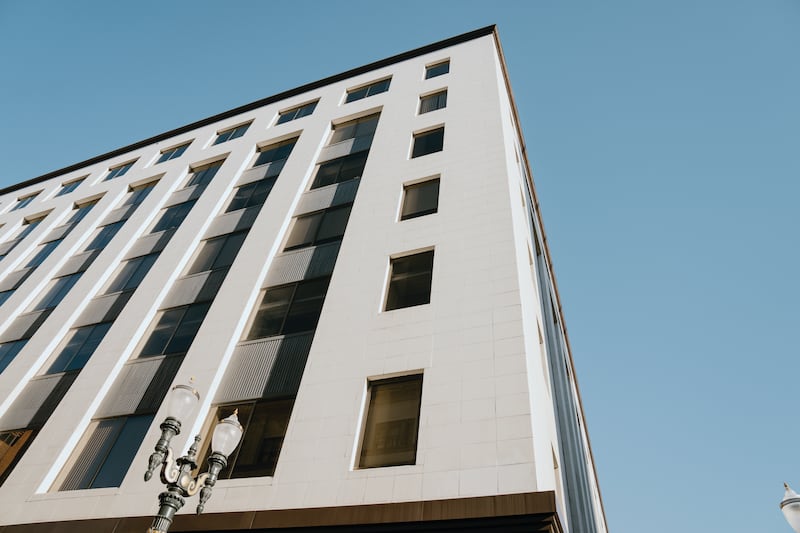
The question everyone has for you is, “What exactly is he up to downtown?” So, what’s your plan? What’s your vision?
They ask me that too [laughs]. It’s hard because I just care so much about Portland and I want to be part of its revitalization. I want to be part of its future.
So every deal I’ve done has been a lender-controlled transaction. Every one of these is the bank or the lender taking control of a building and selling it. And I should not be the highest bidder or the only bidder. Portland should not be in this condition. I don’t want to see these buildings become like zombies because the banks won’t reinvest. But the banks don’t have the authority to go and reinvest, right? They can’t say, we’ve already lost $150 million so how about we redo the lobby for another $10 million, and if a tenant is coming in, let’s invest $2 million in their new office.
They have to cut their losses. And when they start cutting their losses, it means no growth. It means no new tenants. It means no new projects, no reinnovations, no anything. It’s very unhealthy for a lender to own anything—a business, building, whatever. That’s the worst-case scenario.
I want to revitalize these buildings. I want to see people come back. And we have good examples like San Francisco and Bellevue—there are lots of places where people have come back. I think they will come back to Portland, and I just want to be part of it. I don’t know whether or not my investments will be helpful or hurtful. But I don’t want to stand on the sidelines.
Could you give me a lay explanation of the diversification benefit and the tax benefit that commercial real estate offers? What’s the potential upside for you?
So that again is deal-dependent. There’s a variety of tax benefits that are available to most business owners, including real estate owners, and the most significant is depreciation.
You’re right that an accountant or financial planner would tell you to diversify your assets no matter what. But they’re never going to tell you to buy distressed real estate in downtown Portland. They would tell you to buy, like, municipal bonds or high-yield bonds and maybe Nike, maybe commercial real estate that’s recovered—commercial real estate that has tenants. Commercial real estate where there’s a lot of demand. But they’re never going to tell you to go in and buy a distressed building that the lender owns where you’re essentially showing up to auction to buy a building that you know nothing about. We don’t even get good data on these buildings.
But like I said in the beginning, I’m not worried about the downside. And maybe I’m just an optimist.
I’m trying to pin you down as shrewd, and you keep telling me you’re naive. That’s unusual.
I mean, I don’t think I should have been a business person [laughs]. I think I’d rather have been like a psychotherapist or something. I almost don’t care if I lose or make money on some of this stuff. I mean, I’ve made more money than I thought I would. My life is better than I thought it would be.
And if the buildings do well, good for me. But I don’t know that they will. Between us, I don’t see Portland just rebounding tomorrow and, suddenly, the office market just blows up and these buildings get occupied. That’s where I’m probably not that naive. I don’t have some sort of secret formula here.
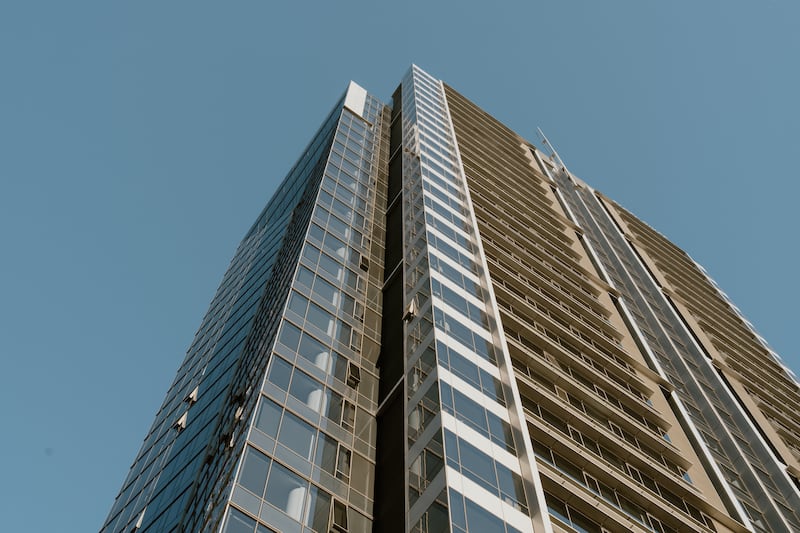
There’s not a whole lot of tenants to go around right now. So I’m curious, who are these big Class A clients that you must hope to land? Where would they come from?
You’ve got some people in Class A that are kind of just moving around for a good deal, right? They’re in another Class A building, and the market is so tenant-friendly that they can get any deal they want.
I’m doing a deal right now on a 10-year lease and the payback period is 80 months. That means I won’t get my money back for 80 months. No real estate developer in the world would do that deal. We’re going to do it because we want the tenant. But 80 months of payback is really long.
So you’ve got people in Class A moving around. And the other thing is, how do we get people from B and C to move up to A? Because that is our opportunity for growth. I don’t know if I can do it. We haven’t seen it that much. But we want to do that because we feel like you can get Class A space right now for Class B and C prices.
So are you offering tenant improvement allowances in Big Pink?
Yes. Pretty much anything people want.
It seems like some people in the business community believe that office work will return to downtown only after some of the larger societal problems are addressed: public drug use, for example. Do you feel this way?
I was in downtown Portland yesterday. Is it perfect now? No. Does it continue to improve? Yes. It has gotten much better.
I think the larger problem we have is, we’ve run the middle-class worker out of town. The only way that our economy thrives is if the middle class thrives. And I’m worried that we have found ways to run them out of town. And we need to bring them back.
We need more jobs. If I were in charge of economic development—which no one has asked me to do—I would focus on one thing: jobs. That’s it. What do we need to bring people back to work? Work from home, hybrid work, whatever—just get them a job. I mean, middle-class jobs are critical to the economic success of the Portland region, and we’ve seen such a massive loss of middle-class jobs that it’s worrisome.
Where are the jobs that pay $90,000 to $200,000 a year? Where are they? I feel like those folks got the squeeze in Portland and left town.

It really seems like your campaign contributions picked up in the last year. Why?
Well, if I tell you the truth, then you’ll write about it, and I don’t want you to write about it.
I’m a nonpartisan person, and there are some causes that are just really important to me. So I got more active in Oregon this last year for a variety of topics. They’re both near and dear to my heart, so that’s why I contributed.
Rep. Jeff Helfrich said you came in and talked about the National Primate Research Center. Based on what he said to us, one of the causes near and dear to your heart is the elimination of animal cruelty at the primate center. Is that accurate?
Animal rights and animal welfare are probably what I care the most about. But, I mean, I prefer to talk about Portland.
What’s your involvement with the Physicians Committee for Responsible Medicine, the group backing the campaign to close the primate center?
I’m a very proud supporter of the Physicians Committee for Responsible Medicine.
Are you pleased by what you’ve seen from the Legislature and OHSU to move in a different direction with this place?
Yes, very pleased. Absolutely the right direction. I really appreciate the legislative support. I appreciate OHSU’s leadership on it. I think if I had to pick the one thing that’s most important to me in my life, it’s animal rights.
Has that always been the case?
Always.
Why? Why does that issue resonate with you so strongly, and why has it resonated for so long?
I don’t know. I just feel like I’ve been cursed with a love of animals. I mean, there’s not one night that I don’t go to sleep worried about a primate sitting in a cage. And I think, if I was in a cage somewhere, wouldn’t I want someone to help me? So I’m just cursed with it.
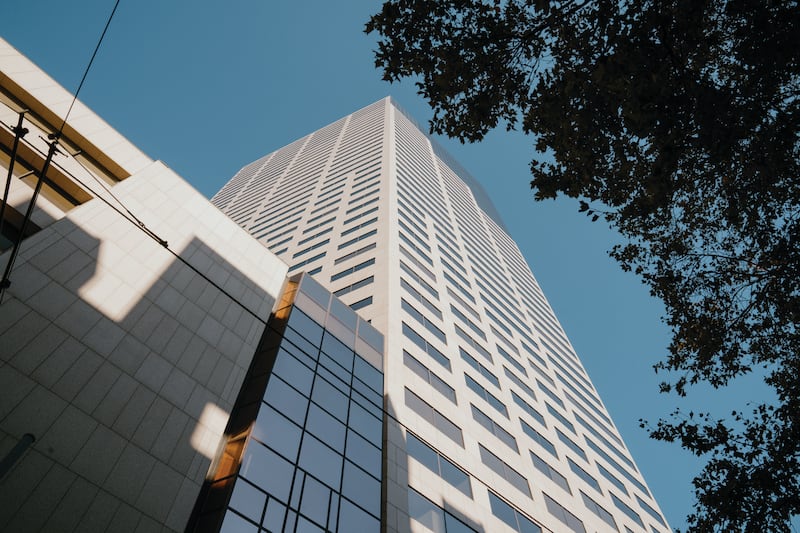
You gave some money to the measure that would have increased staffing at the Police Bureau. How do you feel about that measure failing to qualify for the ballot?
I was disappointed. I just feel like everyone deserves to be safe, and I don’t know how you do that when you’re understaffed.
Before you became one of the biggest investors in Portland, you and Tom Dundon traveled in the same circles. What do you make of his business model?
First of all, I love Tom Dundon, and I might be the only one who does. But I do. I actually think that Portland is going to love Tom Dundon as an owner once all the negotiations are over.
That would suggest that you don’t think he’s going to move the team.
Well, you’re a newspaper reporter, and I’m scared to tell you this. But no, I don’t think he’s going to move the team. I personally think that Tom is a rational, reasonable guy. When they all get at the same table and they all express what they want out of the deal, I think the Blazers stay. I hope they stay, even though I’ve never been to a game.
You’re doing business in a lot of different states. And you just spent a little while talking about middle-class jobs. How is Oregon different from the others that you’re doing business in?
I’ll take any jobs. Jobs are the key. I live in Nevada, and Nevada is a Democratic state, which I like. It’s super-high growth, and the unions are private sector. When states really focus around jobs, they’re much more successful because they create more income for themselves, and then they don’t have to make difficult decisions. You’re seeing that in Arizona, Nevada, places that have Democratic governors.