Skip to main content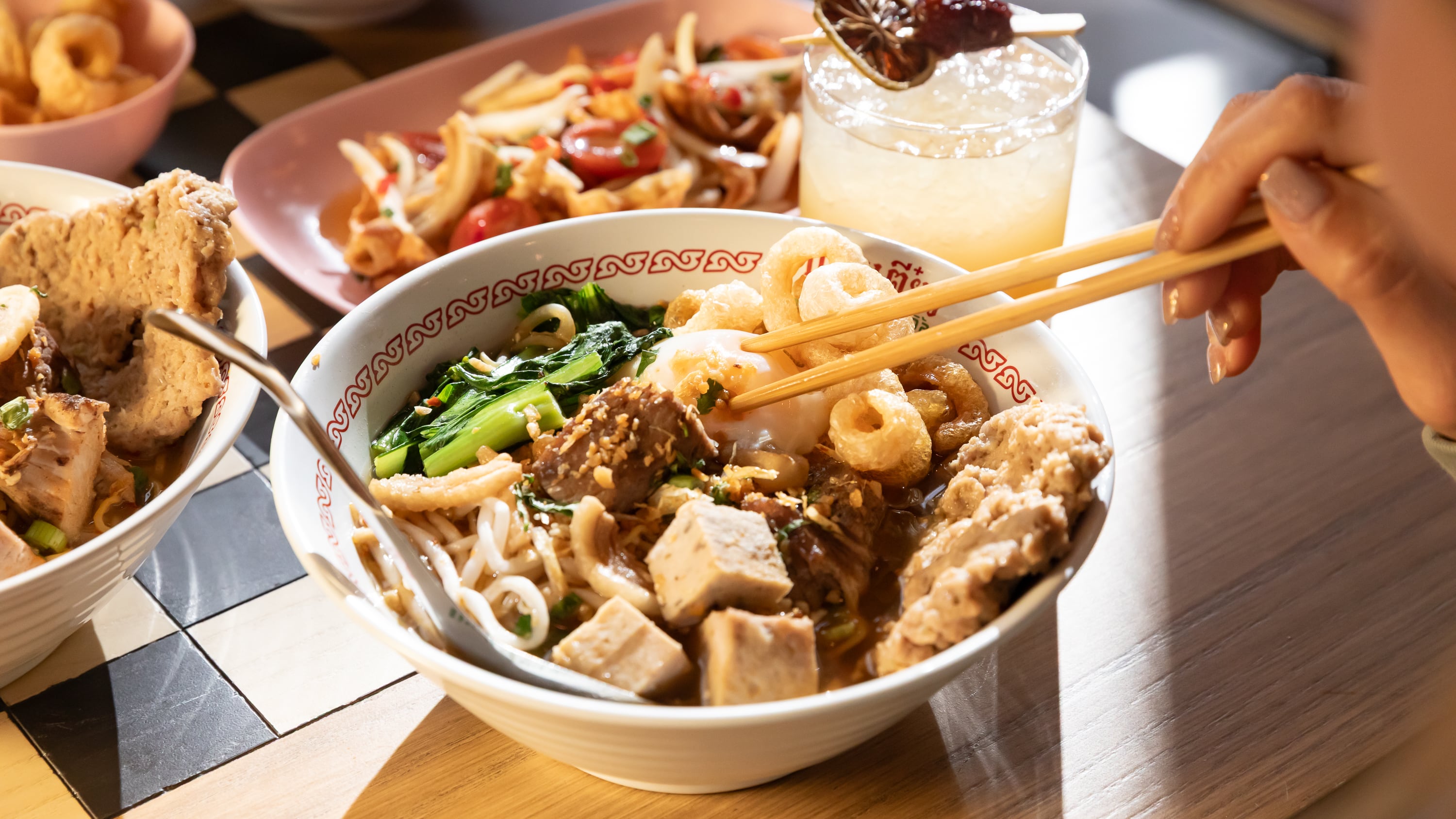
There is a long and growing list of restaurants that have expanded what Portland knows about Thai food.
Before Pok Pok opened in 2005, you’d have been hard-pressed to find anything past pad thai and bland “yellow curry” in town—not that many Americans knew to look for anything beyond those westernized standards. A few years later, Nong’s Khao Man Gai brought the simple pleasures of Thailand’s take on Hainanese-style chicken and rice. Akkapong “Earl” Ninsom’s wave of influential restaurants kicked off in 2011 with Paadee, and his group has since swelled to include deliciously educational stars highlighting distinct regional cuisines of Thailand, like Langbaan, Hat Yai, Eem and OK Chicken and Khao Soi.
Chookiat “Hamm” Saenguraiporn was serving Thai food in Portland before any of that. He opened Thai Peacock downtown, a block east of Powell’s City of Books, in 1999. But in recent years, his restaurant group has made a progressive showing on the eastside, opening Khao Moo Dang in 2019 and Rukdiew Cafe in 2022.
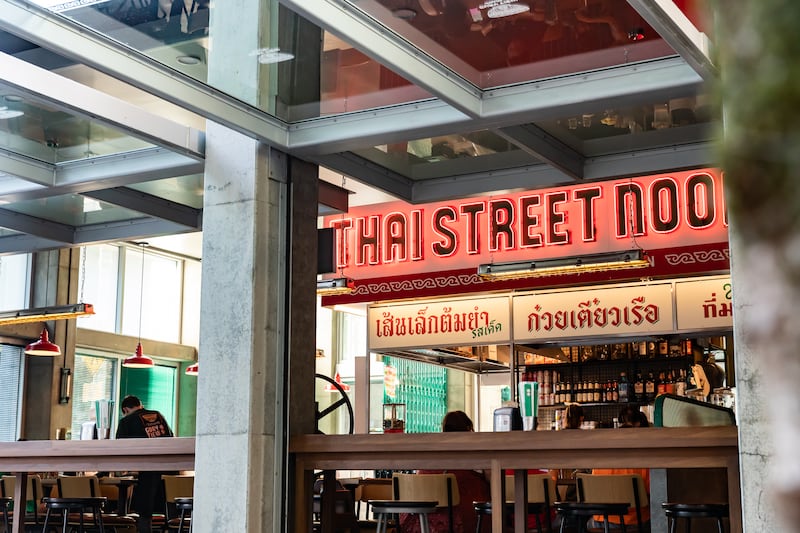
Guay Tiew, Saenguraiporn’s latest project, brings him back across the river. The restaurant took over a Brutalist-ish, bunkerlike building in the Pearl at the end of March. At first blush, its décor fits suspiciously well into the neighborhood—monogrammed bowls and chopsticks and elaborately gilded pub mirrors hinting toward corporate polish. But any worry of cookie-cutter blandness goes away as soon as you eat something.
Thai noodles are the game here. Guay tiew translates to “noodles” or “rice strips,” though colloquially the name refers to noodle soups. However limiting that might sound, the menu shows just how much of Thailand you can cover eating noodle soup. (Some have compared the ubiquity of noodle soups in Thailand to that of sandwiches in the U.S.)
The instructions on “HOW TO ORDER” are quite clear: “1. PICK YOUR BROTH 2. PICK YOUR NOODLE.”
And so you do.
Pretty much every dish is a slight variation on this setup: Tender braised pork, ground pork, red pork, square-cut pork meatballs and two kinds of chiplike pork rinds sit on a bed of noodles with a scattering of bean sprouts, blanched yu choy, and crispy garlic to freshen things up. It’s not so much a mountain of meat as a deftly executed sampler of so many different preparations. Also, every dish is available as a mirrored tofu version.
Broth selection is what guides things. The clear nam sai ($16) is a nice first order (this is the kind of place you keep coming back to). It’s light enough to let everything else shine but far from bland. The slightly richer five-spiced pepper variation would be great on a colder day. There’s also a hot and sour tom yum, and two broths from Northern Thailand: khao soi (listed as “house curry,” $17) and a take on the spicy tomato pork soup nam ngiao (listed as “chili tomato broth,” $17).
Guay tiew ruea or boat noodle soup ($16)—so called because it was traditionally served out of little boat stalls in Bangkok—comes with a “rich, spicy herbal brown broth.” What makes it rich, and lusciously velvety, is pork blood. It’s solid, though it’s not my favorite local boat noodle (that’s in Beaverton at Khamdee); I miss the broad sen yai rice noodles sometimes served with the dish, which Guay Tiew doesn’t offer.

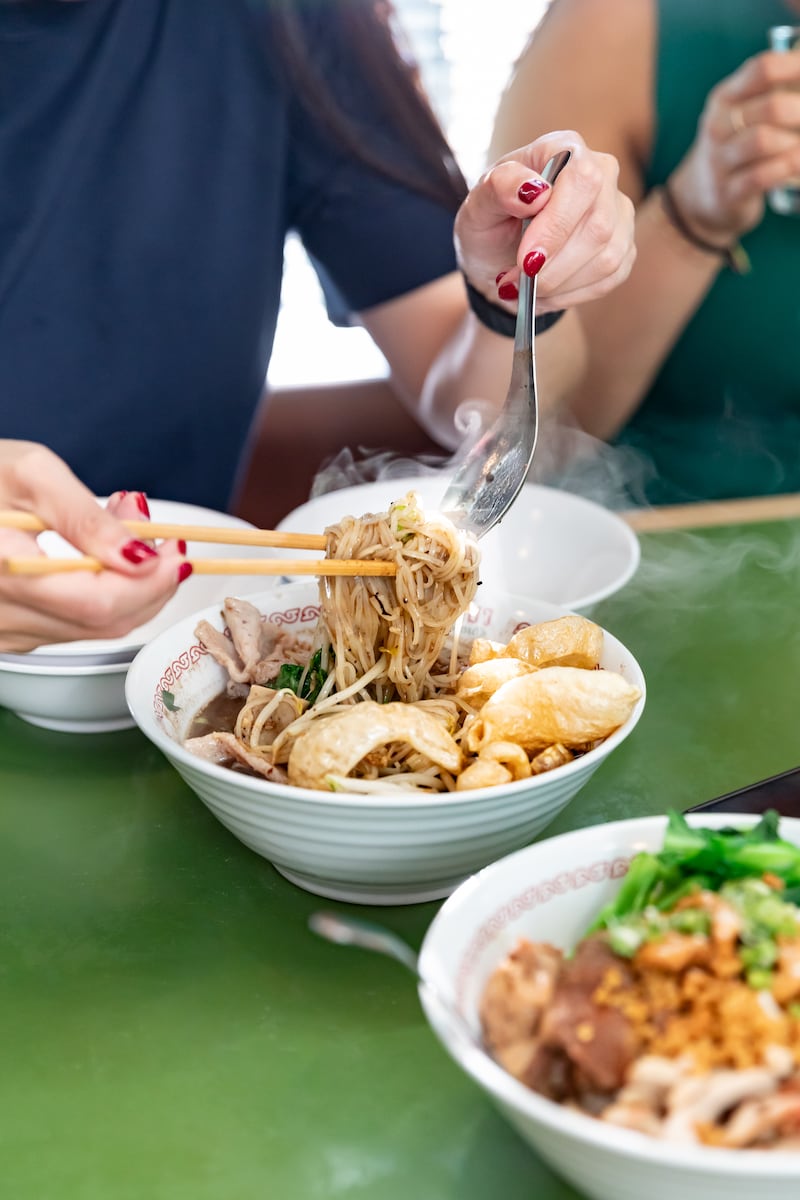
Speaking of noodles, you have three choices. Vermicelli-style rice noodles are tender and hold together wonderfully. I had trouble with the slightly wider, flat rice noodles Guay Tiew offers (these are labeled “thin” versus the other “very thin”). They were too fragile, and broke into short strips as I tried to lift them from the bowl. Bouncy round wheat noodles, aka ba mee, were my favorite. Try them in the guay tiew hang, or “dry noodles,” which is what it sounds like: all the soup fixins minus the soup, though you do get a sidecar of broth.
This mode of taking apart dishes so you can reassemble them has the effect of pulling back the curtain. Instead of trying to hide that all of its dishes are creative reinterpretations of the same basic set of ingredients (what most restaurants do), the menu at Guay Tiew flaunts its ingenuity.
The pork meatballs are an obvious example; served with most soups, they also come alone as an appetizer with tamarind dipping sauce ($8). I would also guess that the filling in the crispy fried pork wontons ($8) is made from the same mixture—that satisfying snappy texture is hard to miss.
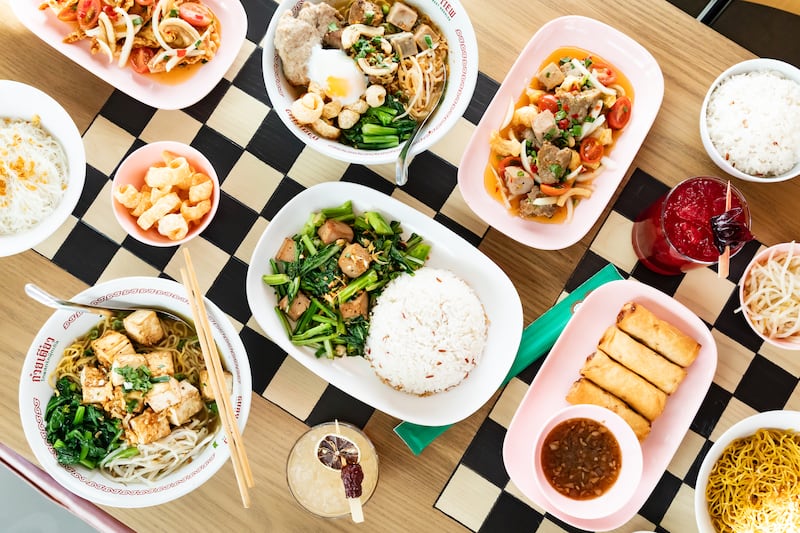
Elsewhere, the braised pork that comes with most of the soups shows up in “tender pork basil stir-fry” ($15, $2.50 to add a soft-boiled egg). Spiked with hot Thai chiles, it’s transformed into something that approximates pad kra pao, the stir-fried pork dish usually made with ground pork. (Don’t skip the impressively custardy coddled egg.)
It would be easy to guess that all these dishes taste the same. In fact, it’s quite the opposite. But eating this way, picking your noodles and your broth, and seeing how this set of ingredients stretches to make up all kinds of dishes across the menu, becomes a kind of lesson. That’s to say, you can certainly add Guay Tiew to that list of restaurants expanding what Portland knows about Thai food.
EAT: Guay Tiew, 330 NW 10th Ave., 503-730-9995, guaytiewpdx.com. 4–9 pm Wednesday and Thursday, 11:30 am–9 pm Friday–Sunday.