Skip to main content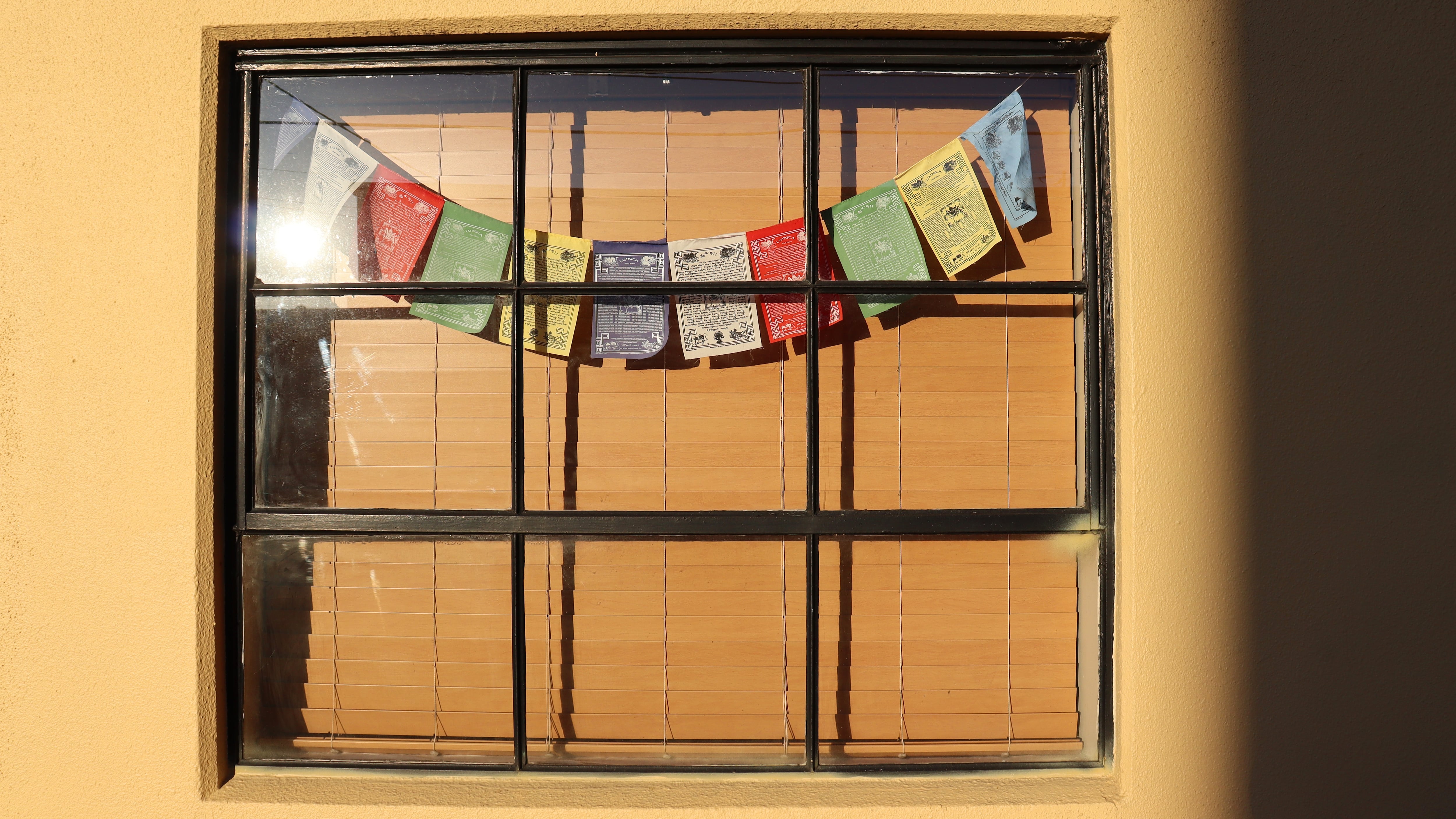
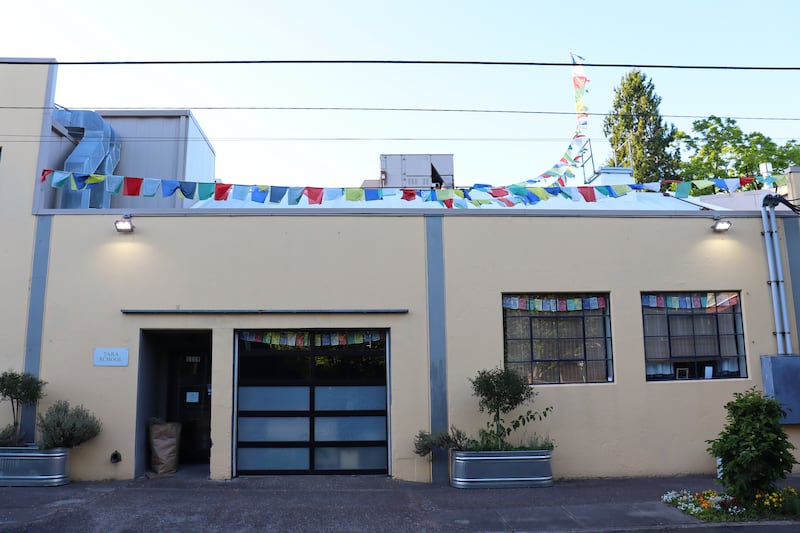
Maitripa College could be mistaken for just about any warehouse office in the Central Eastside, if not for the Tibetan prayer flags strung along the windows.
Founded in 2005, the college on Southeast Market Street is authorized by the state to grant degrees, including a Master of Arts in Applied Buddhism and a Master of Divinity. Yet the 14,592-square-foot building houses an institution of higher learning unlike any other in the state. It doubles as a religious center, and at its helm is a man whom the student body reveres as a spiritual master.
His name is Yangsi Rinpoche. The title “rinpoche”—it translates to “precious one”—is a rare honorific in Tibetan Buddhism, reserved for accomplished gurus or lama reincarnates. At age 6, Yangsi Rinpoche was deemed the reincarnate of Geshe Ngawang Gendun, a renowned Buddhist scholar.
Many practitioners at Maitripa took Yangsi Rinpoche as their guru: the person who would guide them closer to enlightenment. When he entered the building to host teachings, students and staff dropped to their knees. Participants jockeyed to serve him black tea. Others regularly brought him flowers or his favorite foods.
But last year, one former student and staffer alleged she had had a five-year sexual relationship with Yangsi Rinpoche from 2015 to 2021. During that time, she alleged, she found the sexual encounters unwanted, but they felt mandatory and expected due to his position of power at the college.
Her allegations are laid out in a draft civil complaint her attorney sent to the college and Yangsi Rinpoche in April 2025, a copy of which was provided to WW. The complaint was never filed, and the allegations never saw the inside of a courtroom. Last October, the parties settled for an undisclosed amount—meaning the woman’s allegations have never before been made public.
The woman’s name is Sunitha Bhaskaran, and this year she shared her story with WW.
“Taking care of students and not harming them is central to Yangsi Rinpoche’s [stated] mission,” Bhaskaran says. “And, in that sense, he has really failed as a spiritual teacher, without doubt.”
Bhaskaran’s account—which the college and Yangsi Rinpoche deny—paints a portrait of a spiritual guru who used his position to create an environment in which at least one person who saw him as a holy figure felt acceptance of his sexual advances was mandatory. It also displays the difficulty of reckoning with allegations of the misuse of power within a cloistered religious society.
In this famously unchurched city, Portlanders often turn a skeptical eye toward organized religion—except, it sometimes seems, for Buddhism. But Bhaskaran’s allegations against one of Oregon’s most revered Buddhists underscore a vulnerability that extends beyond any spiritual community to the fundamental imbalance of power that exists between a leader and a follower.
The college disputes Bhaskaran’s allegations.
“We strongly deny the allegations of violence and abuse,” the college said, “and also have great concern for the complainant.”
Maitripa College is part of a network of Buddhist centers and institutions that fall under the umbrella of an organization called the Foundation for the Preservation of the Mahayana Tradition, or the FPMT, which oversees 132 centers and other affiliates around the world to further this sect of Tibetan Buddhism, the world’s largest. The FPMT is headquartered in the same Southeast Portland building.
Maitripa College wrote to its students and staff in an April 24 email that Yangsi Rinpoche was on leave pending an investigation by the FPMT into Bhaskaran’s allegations.
“We regret that the matter has escalated,” the college wrote in the email.
Maitripa College is an insular place. Richly colored wall tapestries called thankgas line the walls of the main prayer room. Practitioners sit on maroon floor cushions. People there speak gently and with great earnestness.
The college is small: 15 staff and anywhere from 35 to 50 students. Though Maitripa is registered for tax purposes as an educational institution and nonprofit, it also doubles as a religious institution, and former students say it operates more as a spiritual center. At its heart was Yangsi Rinpoche, 58.
Standing above 6 feet, Yangsi Rinpoche—Maitripa’s longtime president and professor of Buddhist studies—led teachings and prayers in a low, slow voice. The whole college was oriented toward him as its guru, former students say, and his teachings often centered on guru devotion.
“Maitripa heavily emphasizes this tantric practice, that your relationship with your guru is the most important part of the practice,” says a former Maitripa student, Dr. Jacob Lindsley, who attended the college from 2012 to 2020. “You have to see that person as pure and enlightened, such that everything they do and say is perfect and vital.”
In 1975, at age 6, Yangsi Rinpoche, whose legal name is Kesang Tuladhar, was deemed the reincarnate of a famous Tibetan scholar. Grainy film from his ceremony 50 years ago shows a small boy dressed in maroon robes being led into a monastery in Kathmandu by monks. He’s lifted onto a throne by his armpits. Monks hand him white scarves one at a time, which he touches to his forehead. A man lifts the boy off the chair and holds his hand as they follow a procession of monks playing long horns.
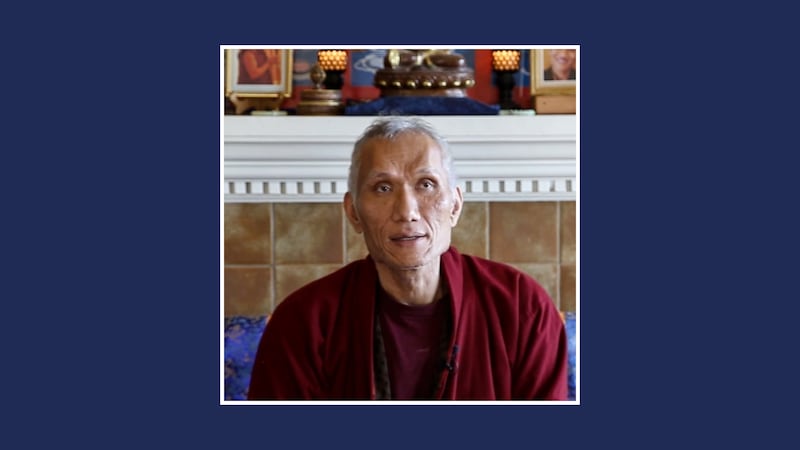
Yangsi Rinpoche worked as a monk in Asia until he moved to the States to teach in 1998. He landed at a monastery in Madison, Wis. He wore richly colored saffron and maroon robes. His personal assistant was a nun named Miranda Adams, who went by “Namdrol.”
Yangsi Rinpoche “disrobed,” which means to put aside a monastic calling for more worldly pursuits, in 2004 and moved to Portland. Adams followed him shortly thereafter. They co-founded Maitripa College with several others in 2005 and purchased a home together in the Pleasant Valley neighborhood of East Portland in 2007. (Adams’ husband lives there, too, and he also works at Maitripa.)
Former students of Maitripa say Yangsi Rinpoche always had a close inner circle of staff and devoted students. They would go to his home for meals. Adams largely controlled who spent time with him, they say—and he routinely had a handful of women that were among his most devoted acolytes.
“It wasn’t unusual to see women trying to get close to him,” Lindsley says.
Former students say they often performed free labor for Rinpoche. They would cook meals, clean his house, and sometimes take his young son on outings. (The mother of the boy appears to no longer live in Portland. She and Yangsi Rinpoche divorced in 2017—she was 27 at the time, and he was 49.) It was not uncommon for a Maitripa practitioner, student or staffer to serve unofficially as Rinpoche’s driver.
“I remember at one point Namdrol asked if we would weed their lawn,” recalls Elena Alfaro, who was a longtime devotee of Yangsi Rinpoche’s until she left Maitripa in 2018. “At the time, it was like, ‘Oh, wow, this is an opportunity to gather merit or good karma and serve my holy teacher.’”
A former student who asked to remain anonymous said “there was pressure from the staff and Rinpoche to do what Rinpoche wanted—anything he wanted from students, they should do.”
Sunitha Bhaskaran moved from India to the United States when she was 27 to pursue a master’s degree in computer science. By 2013, Bhaskaran had been working as an engineer in the Bay Area for six years. She started exploring Buddhism and was drawn to its teachings of the bodhisattva—someone who seeks enlightenment to alleviate the suffering of others.
She moved to Portland that year to study full time at Maitripa. “I gave up my job. I had about $50,000 in my bank,” Bhaskaran, now 53, tells WW. “I packed up, put whatever I could put in a Jetta, and drove up.”
She first enrolled as a student at Maitripa and then worked at the college for the next eight years, including as bookkeeper, teacher’s assistant, and then library assistant.
“She was such a purehearted person who really wanted to be a Buddhist,” Lindsley recalls. “She was extremely devoted and very agreeable.”
In her draft complaint, Bhaskaran alleges Yangsi Rinpoche had his first sexual contact with her in 2015, when he brought her a small figurine to her apartment. “[He] touched his penis to Plaintiff’s genitals over clothing and told her, ‘we will engage,’” the complaint states.
“He would describe himself as her Guru, talk about her devotion to him, and express his love to her. He began to visit her at her home, lay his body on hers with clothes on, rub his body against hers, and kiss her,” the complaint alleges. “The conduct progressed to removing clothing and sexual penetration with his penis in Plaintiff’s vagina and anus. During these sexual encounters, Defendant Tuladhar would often encourage Plaintiff by making statements and expressing sentiments such as, ‘you are doing something holy for me,’ and ‘you are offering me a service.’”
The unfiled complaint alleges Yangsi Rinpoche would tell Bhaskaran that the sex was a “tantric practice of Tibetan Buddhism in which he was purifying” her, and the complaint alleges he “presented the sexual contact as mandatory and expected.”
The complaint—which is not a criminal complaint but instead contains civil allegations of sexual battery—alleges Yangsi Rinpoche was often violent toward Bhaskaran during sex, including “violently biting and pushing Plaintiff’s chest and abdomen while also penetrating [her].” Bhaskaran “often found the sexual conduct to be disturbing and painful, and at times Defendant Tuladhar’s conduct would cause her body to bruise and bleed,” the complaint states.
Bhaskaran also alleges in the complaint she essentially served as Yangsi Rinpoche’s maid. She would cook Indian food for him, care for his young son, and drive him around. During some of this time, she was also his teaching assistant, grading assignments and writing class handouts.
Her complaint alleges that “based on the broad power and authority defendant Maitripa had given to Tuladhar, and the culture of obedience and servitude cultivated by Maitripa, Maitripa fell below the applicable standard of care, was negligent, and unreasonably created a foreseeable risk of harm to students and employees.”
In a two-hour interview with WW, Bhaskaran described the evolution of the relationship. She also shared text messages and logs of phone calls between her and Yangsi Rinpoche over the years, and dozens of emails between her and college leaders. Much of what she says aligns with the allegations in her threatened 2025 complaint, but what she described to WW was, in some ways, more complicated.
During those five years, Bhaskaran says she grew close to Yangsi Rinpoche’s youngest child, a boy who’s now 12. She says that while she watched him on outings, Yangsi Rinpoche would often be talking on his phone, leaving her to care for the child. The frequency of the sex ebbed and flowed. She concedes she was confused and hurt when she suspected he was sleeping with other women.
“It was study, practice, cook for Rinpoche, then come home and have this thing. It’s not something that I resisted really actively because I felt it was my life,” Bhaskaran tells WW.
“I was at the bottom of the hierarchy [at the college],” Bhaskaran adds. “And I’m realizing this teacher, he is one thing in front of you, but he’s like another person behind [closed doors].”
Bhaskaran says it took her years after the relationship ended to define what she believes she experienced: an unwanted sexual relationship that because of Yangsi Rinpoche’s powerful position, she had no choice but to acquiesce to.
Bhaskaran first brought her allegations to Miranda Adams. In a string of distressed emails in the early morning of Aug. 10, 2021, Bhaskaran told Adams about her and Yangsi Rinpoche’s yearslong relationship.
“I will categorically say that I have felt emotionally abused and disrespected,” Bhaskaran wrote. “The sexual relation was often painful, bordering on abuse, and I feel a spiritual leader who speaks about Dharma has to be held accountable…Please help me here.” Just minutes later, she wrote she had “emotional and physical scars from my time with Rinpoche.”
Adams responded that same morning that she was “very sad to hear that you have been hurt.”
“Please rest assured that I have not and never will do anything to ‘cover this up,’ and I will do anything I can to help and support you,” Adams wrote. “We have a zero tolerance policy for harm of any kind at Maitripa.”
The board hired a third-party investigator, a now-retired lawyer named Carol Merchasin, to investigate whether Yangsi Rinpoche violated the college’s consensual relationship policy. During her tenure at the law firm McAllister Olivarius, Merchasin represented victims of what the firm calls “high-control, male-dominated religious groups and gurus”; for years, Merchasin led the firm’s ongoing lawsuit against the Shen Yun dance company.
While Maitripa has declined to give Merchasin’s full report to WW and Bhaskaran, the college did provide what it called an “executive summary” that the board wrote after the 2021 investigation.
According to the summary, Merchasin’s investigation concluded there had been an “undisclosed intimate, sexual relationship, a violation of Maitripa College consensual relationship policy,” though the memo noted that Yangsi Rinpoche “categorically denied that a sexual relationship had taken place.”
“The investigative team is confident that, in this situation, there was and is no intention to harm on the part of any party, and that all individuals are engaged with finding a peaceable, restorative, and beneficial resolution to this matter,” Maitripa’s board wrote in its summary.
Two board members, Mark Waller and Jose Cabezon, took the lead and spoke to Bhaskaran about what forgiveness might look like following Merchasin’s investigation—at one point, Yangsi Rinpoche requested that he and Bhaskaran partake in a Buddhist confession ceremony. (Bhaskaran says she declined.)
In March 2022, Bhaskaran sent an email to Waller and Cabezon saying she had let the matter go. “I don’t want to bear the burden of breaking some practitioner’s heart or cause someone to lose faith in the Dharma or the lineage. Neither do I want to embarrass the Tibetan community, the great monastic institutions or Rinpoche’s teachers and family,” Bhaskaran wrote.
In a final Zoom call among Bhaskaran, Yangsi Rinpoche, and Waller, Bhaskaran tells WW she told Yangsi Rinpoche he had “really wrecked my life.”
Leading up to that call, Bhaskaran says, she received more than five calls from Cabezon and Waller, asking that the matter be resolved swiftly.
“I feel they pressured me into forgiveness,” Bhaskaran now tells WW.
Waller disputes Bhaskaran’s characterization. “There was certainly no pressure,” he said in a text to WW.
Bhaskaran continued working at the college in various capacities following the 2021 investigation, mostly remotely.
She joined a sexual assault survivors’ group in 2024 and decided to take action.
She retained lawyers Amber Kinney and Whitney Stark, who emailed the board of Maitripa the draft complaint on April 9, 2025. Maitripa College and Bhaskaran reached a confidential settlement in October 2025.
In March, the Foundation for the Preservation of the Mahayana Tradition suspended Yangsi Rinpoche from teaching at all of its affiliated centers.
The organization did so after Bhaskaran and Elena Alfaro, another former student, filed a formal complaint with the FPMT in January. Alfaro alleged to the foundation that, first in 2017 and again in 2020, Yangsi Rinpoche slept with at least one former Maitripa student.
Documentation provided by Alfaro shows that when she sent a letter expressing concerns about Yangsi Rinpoche in 2016 to then-FPMT president Lama Zopa Rinpoche, he warned that Alfaro would endure spiritual torment if she even thought ill of her guru.
“If you get angry, arise heresy towards your Guru…one has to be born in the hell, suffering the most heavy suffering of samsara,” he wrote back in a March 2017 email. “Make this your principal meditation, otherwise you will destroy your life totally.”
A former board member, Lynn Ogden, wrote in an email to Bhaskaran and Alfaro in May that she had left Maitripa College in 2021, shortly after the FPMT faced allegations of sexual assault against a Buddhist teacher named Dagri Rinpoche. (Bhaskaran’s allegations are not the first leveled against FPMT-affiliated teachers and monks. Read more here.)
“Whether intuitively or based on my observations of Yangsi Rinpoche during [His Holiness the Dalai Lama’s] visit in 2013 and earlier reports, I felt as a Board member that Maitripa might be targeted or investigated,” Ogden wrote. “I asked in subsequent board meetings around this time that they address all related complaints or inappropriate behavior at the college. Namdrol showed documents and how Maitripa had a policy in place. I did not feel that it was handled with any diligence or concern.”
Ogden declined to elaborate when reached by WW.
On March 18, the chair of the FPMT board, Karuna Cayton, told Alfaro and Bhaskaran that the college had suspended Yangsi Rinpoche from teaching at all of its affiliated centers due to the “serious nature of the allegations” and would be hiring a third party to investigate the claims while also conducting its own internal investigation.
Notably, the FPMT’s headquarters were lodged for years in Maitripa’s building—which the two groups co-own—until the FPMT began working remotely a few years ago. The memberships of the two boards have historically had some level of crossover, as have the organizations themselves.
The FPMT has repeatedly declined to provide further details about the investigation to WW.
On April 24, Maitripa sent an email to its staff, alumni and students about “disturbing allegations” made against Yangsi Rinpoche by an unnamed former student. The college wrote that it “firmly [denies] the allegations” and is “cooperating openly and without reservation” with the FPMT’s investigation. Yangsi Rinpoche was on leave, Maitripa wrote.
Both the other Buddhist centers where for years Yangsi Rinpoche served as spiritual director recently announced his departure, too. The Ganden Shedrup Ling Buddhist Center in Puerto Rico wrote in an April 18 email Yangsi Rinpoche would “cease to exercise his functions” at the center, and the Dharma Friendship Foundation in a May 25 email wrote that he’d resigned from his role as spiritual director of the Seattle center. It did not provide a reason.
Maitripa declined to make Yangsi Rinpoche and Adams available for an interview, but it has repeatedly denied the truth of Bhaskaran’s allegations.
The college won’t say whether Yangsi Rinpoche is on paid or unpaid leave, and it also declined to confirm basic facts of his biography; the college also told WW it had concluded that Yangsi Rinpoche hasn’t “acted with negligence nor violated our stringent ethical codes of conduct.” Adams is currently listed as the president and chief academic officer of Maitripa.
Current board members WW reached by phone or text declined to comment. Board member Mark Waller told WW he doesn’t believe Bhaskaran’s allegations because “they are way out of character of the man I know.” Board member Scott South said: “If you want to destroy an institution that’s an all-female-run institution that’s trying to do good for the betterment of humanity, fine.”
Bhaskaran, for her part, says she wants to move on.
“I worried about defaming Buddhism. But I have come to believe that bringing it to light helps Buddhism. It doesn’t defame,” Bhaskaran says. “The Dalai Lama has said, ‘Buddhism has survived for 2,500 years. You don’t have to worry.’ So I have changed with time.“
To accompany this story, WW has reported about other issues that confront the Foundation for the Preservation of the Mahayana Tradition. Read more.
Correction: A previous version of this story stated that a former board member left Maitripa in 2019. In fact, she left in early 2021. WW regrets the error.